• Post Reply Bookmark Topic Watch Topic
  • New Topic
permaculture forums growies critters building homesteading energy monies kitchen purity ungarbage community wilderness fiber arts art permaculture artisans regional education skip experiences global resources cider press projects digital market permies.com pie forums private forums all forums
this forum made possible by our volunteer staff, including ...
master stewards:
  • Devaka Cooray
  • Carla Burke
  • John F Dean
  • Nancy Reading
  • Timothy Norton
  • r ranson
stewards:
  • Jay Angler
  • Pearl Sutton
  • paul wheaton
master gardeners:
  • Christopher Weeks
  • M Ljin
gardeners:
  • thomas rubino
  • Eino Kenttä
  • Jeremy VanGelder

When to Sift Compost and Why

 
pollinator
Posts: 452
Location: Dayton, Ohio
144
forest garden foraging urban food preservation fiber arts ungarbage
  • Likes 2
  • Mark post as helpful
  • send pies
    Number of slices to send:
    Optional 'thank-you' note:
  • Quote
  • Report post to moderator
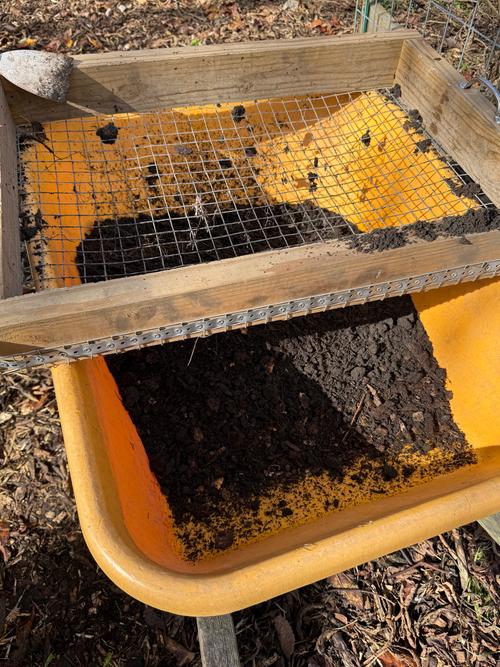
    Currently, I'm trying to incorporate a coarse compost into heavy clay soil as a preliminary step before starting a new garden. Because I bought a huge load of compost totalling eleven cubic yards, sifting seems to take up a significant portion of time of incorporating the compost into the soil. I calculated that it takes me one hour to sift six cubic feet of compost through a 1/2 in. sieve and I have 700 square feet of soil to incorporate the compost into. If anyone is wondering about the nature of the compost I'm using, it is a compost made from autumn leaves and horse manure that I bought in bulk from a local composting facilty. Although the compost does not have any significant ammount of wood chips in it, it still has occasional pieces of garbage and fiborous bits of leaves that did not fully decompose.

    So far, I have found mixed advice on whether or not to sift compost. Although my neighbor usually sifts his compost before applying it to his garden and at least one youtube video here suggests that undecomposed woody debris might lock nitrogen in the soil:  
 , two other gardeners do not recommend sifting compost before applying it to a garden. Luke Marion on the MIgardener channel suggests that sifting compost may actually do more harm than good when applying it in this video:  


In another video by Joseph Jenkins, author of The Humanure Handbook, he does not sift his compost before top dressing his humanure compost mixed with animal mortalities when when he applies it to his garden. He even comments that he finds occassional skulls and hair bits when he applies the compost to his garden:


    The problem with the video by Luke Marion and the Video by Joseph Jenkins is that they do not explain whether or not sifting is still necessary when initially tilling the compost into a new garden bed rather than top-dressing the compost on top of the existing soil.

    Since time is currently running out for me to finish setting up my garden beds, I'm going to take a chance and apply my pile of coarse compost directly to my remaining garden beds without sifting the remaining compost. I'll let anybody know if I experience any problems later in the season.
 
steward & manure connoisseur
Posts: 4700
Location: South of Capricorn
2677
dog rabbit urban cooking writing homestead ungarbage
  • Likes 9
  • Mark post as helpful
  • send pies
    Number of slices to send:
    Optional 'thank-you' note:
  • Quote
  • Report post to moderator
I also have heavy clay and am constantly adding homemade compost from bokashi and rabbit cages (shredded paper, spoiled hay, wood shavings, stems from plants they don't eat). These components are often pretty big (occasionally whole spoiled mangoes or squash), I do not sift. I figure I'm creating more interesting places for soil biota to investigate and even shelter in. There is also wood buried deep from when I hugeled these beds (some of the harder wood is still down there, pretty much everything else got "eaten" within a year)-- I never was concerned about the wood locking up nitrogen during that process.
I only would consider sifting if I'm using the compost in a homemade seed starting mix, honestly.
 
gardener
Posts: 5517
Location: Cincinnati, Ohio,Price Hill 45205
1171
forest garden trees urban
  • Likes 8
  • Mark post as helpful
  • send pies
    Number of slices to send:
    Optional 'thank-you' note:
  • Quote
  • Report post to moderator
To me,a few bits of wood here and there are really no big deal.
I plant into unfinished compost, with good results.
What I do not do is bury carbonous materials in clay soil.
Carbon on top of a tilled clay soil,is fine,but when I built a bed of leaves and sticks with clay soil on top,the resulting growth was very poor.
I dug that bed up a year latter and found almost no decomposition.
Since then, leaf filled compost beds and the like are buried under a cap of topsoil or finished compost, oi leave them uncovered and plant into a pocket of rich growing medium
 
pollinator
Posts: 1518
Location: Southern Oregon
466
  • Likes 1
  • Mark post as helpful
  • send pies
    Number of slices to send:
    Optional 'thank-you' note:
  • Quote
  • Report post to moderator
When I lived in town and composted in bins, I would sift because I wanted to use my compost before everything had broken down. I've never sifted compost that I have purchased. And I don't compost that way here in the country. Most things go to the chickens, the rest gets composted in place.
 
steward
Posts: 14336
Location: Pacific Wet Coast
8615
duck books chicken cooking food preservation ungarbage
  • Likes 4
  • Mark post as helpful
  • send pies
    Number of slices to send:
    Optional 'thank-you' note:
  • Quote
  • Report post to moderator
Tereza Okava wrote:

I only would consider sifting if I'm using the compost in a homemade seed starting mix

I'm the same - even then, if my mix ends up with some woody stuff, I just make sure it goes into the bottom of a planting pot, rather than right near the seed.
Woody stuff may lock up some nitrogen, but it may also act like a sponge to hold moisture in the soil. In my climate, water holding capacity is critical, so I only sift for special situations. Sifting breaks up clumps of compost which could be holding a lot of life - worms and smaller - so it could make the situation worse rather than better.

William Bronson wrote:

i leave them uncovered and plant into a pocket of rich growing medium

This too - if I'm seeding into a bed, I will put a pocket or even a short ~3" wide row of finer topsoil/compost mix and leave the "lumpier" material on either side. If I'm planting still small seedlings, I would make sure they had a reasonable ring of fairly small stuff around them, but never more than a 4" circle or so.

If the compost seems to have a high percentage of woody or undigested material, to me the solution is to water it down with 10 to 20% liquid gold (AKA urine)/water mix. It's a cheap, renewable source of Nitrogen, and Hubby gets to joke about how I make him pee in a bottle!
 
Ryan M Miller
pollinator
Posts: 452
Location: Dayton, Ohio
144
forest garden foraging urban food preservation fiber arts ungarbage
  • Likes 4
  • Mark post as helpful
  • send pies
    Number of slices to send:
    Optional 'thank-you' note:
  • Quote
  • Report post to moderator

Jay Angler wrote:
Woody stuff may lock up some nitrogen, but it may also act like a sponge to hold moisture in the soil. In my climate, water holding capacity is critical, so I only sift for special situations.


This seems to be the primary argument Luke Marion gives against sifting compost when adding it to a garden bed. I've noticed that my sifted compost doesn't hold water as well as my unsifted compost. Although a lower water carrying capacity might be desirable if I were to till the compost directly into the soil to improve drainage, it would not be desirable for water retension. This is my first year starting a garden this size so I have no idea what to expect.
 
pollinator
Posts: 228
Location: Southern Utah
53
chicken building homestead
  • Likes 2
  • Mark post as helpful
  • send pies
    Number of slices to send:
    Optional 'thank-you' note:
  • Quote
  • Report post to moderator
There may be benefits to sifting, you did mention a few, but considering the amount of compost and the length of time it would take to sift it using your method I would suggest that you would be just fine scattering it as is and just picking out anything large as you are spreading it.  As for the wood chips and leave clumps, again I wouldn't worry about them unless they end up in the way of something you want to plant in the future.  

Every persons compost needs and methods are different so you will get many different opinions and suggestions.  Due to the ingredients available to me, and due to the lack of organic material in my native soil I mix manure and wood chips (and whatever good stuff I may have on hand) with plenty of water and mix it well in a repurposed cement mixer and then dump it into a pile to cook until I need it.  The wood chips don't have time to break down before I use it but unless I hit something large I just create a hole and pack the compost back around whatever I am planting.  However, I am usually mulching with more wood chips (or occasionally straw) to retain moisture so that is another reason I don't worry about wood chips.  Eventually it will all break down.
 
pollinator
Posts: 3931
Location: Kent, UK - Zone 8
733
books composting toilet bee rocket stoves wood heat homestead
  • Likes 5
  • Mark post as helpful
  • send pies
    Number of slices to send:
    Optional 'thank-you' note:
  • Quote
  • Report post to moderator
I weed around my veggies with a hoe. Large chunks of wood chips or fibrous material blocks the easy action of the hoe, and so requires me to do more hands and knees weeding.

My compost/mulch is applied as a top dressing, not dug in.

If your material is wet it will be much harder to sift, and heavy to handle too boot.

Also, the 1/2” screen sounds too fine for an initial screen. It will quickly get clogged with the bigger chunks. We screen with 1” and I can fill a plastic drum worth in under 5 minutes. When I want much finer stuff I put the pre-sifted material through a 1/2” screen. The fine material then gets used for potting mixes and the like.
 
gardener
Posts: 533
Location: WV
177
kids cat foraging food preservation medical herbs seed
  • Likes 2
  • Mark post as helpful
  • send pies
    Number of slices to send:
    Optional 'thank-you' note:
  • Quote
  • Report post to moderator
I'm doing mostly no dig and didn't sift compost put on top of the beds in the fall.  I've found that the bigger pieces are now on top of the soil as the fine compost has settled below.  I did start with finely chipped chestnut burrs, multiflora Rose and raspberry prunings which were finely chipped as well.  I don't foresee it being too much of as issue as I'll just be adding more compost to the surface again in the fall.  However at the moment it wouldn't be hard to use a small rake and remove the 1/4" or so that remains and add it back into the compost pile.

On a later pile I tackled earlier this year I did sift as it contained larger materials.  I'm using an old milk crate to sift with approximately 1" holes.  Occasionally a bigger piece makes its way through and I just pull it out.  The 1" holes work well in this instance because the compost had broken down much more than the earlier pile.  If I were to sift any finer it would probably be to cover fine seedlings or to incorporate into a seed mix.

I also used the milk crate to sift a sand/partially decomposed leaf mixture last year.  Not only did that remove larger debris but also the occasional clump of caked leaves.  Any bits of leaves that made it through the holes in the crate were left.  I incorporated this into four beds and had good yields in all but one (which was completed right as hot weather set in) and am seeing remarkable results in it so far this year.  If you're incorporating this into your soil you could probably go with a bigger mesh and just remove any clumps of leaves that haven't broken down as I wouldn't worry so much about the fibrous bits, otherwise I'd just add it to the top of the beds and let the worms do their thing.
 
pollinator
Posts: 1202
Location: Boston, Massachusetts
527
6
urban books building solar rocket stoves ungarbage
  • Likes 4
  • Mark post as helpful
  • send pies
    Number of slices to send:
    Optional 'thank-you' note:
  • Quote
  • Report post to moderator
I have a homemade trommel screen and I have screened A LOT of compost. I like the result, but the screening is a lot of work, even with a mechanical screen (fed by hand /shovel).
We are in a dense suburban area, and unfortunately end up with a fair amount of litter, which the screen does a great job of separating out, along with stones and larger woody pieces. I can pick through the tailings quickly to gather the trash and stones, then the woody bits and clods go back for more composting.

I think you could get more done, faster, by just using a steel bow rake to spread the compost out on your plot. The clumps will get broken up and the large woody bits and litter will get caught by the rake, and you can gather them up.

I do a version of this for our deep woodchip paths as I layer on more chips, raking the sticks and chunks ahead, as I smooth out the path... then I bury them under the next wheelbarrow load, repeat...

 
pollinator
Posts: 1578
Location: NW California, 1500-1800ft,
486
2
hugelkultur dog forest garden solar wood heat homestead
  • Likes 4
  • Mark post as helpful
  • send pies
    Number of slices to send:
    Optional 'thank-you' note:
  • Quote
  • Report post to moderator
I would only sift for potting mixes or seed starting. Coarse woody debris under 1ft will shelter soil life and help hold moisture without being too prone to tripping or obstruction of work. Coarse woody debris is integral to a functional forest soil, but of course not everyone is going for a food forest. Soil microbes in need of nitrogen to break down high carbon woody debris will have it available in the air if on the surface when used as mulch. I do not till, and would avoid doing so as much as possible with anything, but especially wood chips. digging up soil to put it on a hugel bed is effectively doing so one time, but the woody debris i use for hugels is as close to its living form as possible and compensates for the 30% organic matter loss that occurs with each tillage. Small branches have a lower c-n ratio and compost fine without nitrogen deficit, and larger higher carbon pieces have a smaller surface area to volume. the n-deficit only occurs in a bubble a fraction of a millimeter thick on the wood’s surface.
 
pollinator
Posts: 3372
Location: Meppel (Drenthe, the Netherlands)
1125
dog forest garden urban cooking bike fiber arts
  • Likes 1
  • Mark post as helpful
  • send pies
    Number of slices to send:
    Optional 'thank-you' note:
  • Quote
  • Report post to moderator

William Bronson wrote:To me,a few bits of wood here and there are really no big deal.
I plant into unfinished compost, with good results.
What I do not do is bury carbonous materials in clay soil.
Carbon on top of a tilled clay soil,is fine,but when I built a bed of leaves and sticks with clay soil on top,the resulting growth was very poor.
I dug that bed up a year latter and found almost no decomposition.
Since then, leaf filled compost beds and the like are buried under a cap of topsoil or finished compost, oi leave them uncovered and plant into a pocket of rich growing medium


That's what I wanted to say too: do not mix the compost in the clay, just put it on top of it. That's not only my opinion, but what I heard of more experienced gardeners too.
Those experts explain: the soil life will do the mixing of the soil with the compost. It starts with worms eating the compost parts en pooping it into your clay soil, and from there it goes on with microscopic creatures.

 
gardener
Posts: 693
Location: South-southeast Texas, technically the "Golden Crescent", zone 9a
496
3
foraging books chicken food preservation fiber arts homestead
  • Likes 1
  • Mark post as helpful
  • send pies
    Number of slices to send:
    Optional 'thank-you' note:
  • Quote
  • Report post to moderator
Since everyone in the thread is from somewhere different - different soil composition, different climate/microclimate - I think this is one of those things where it's up to each individual to make their own decision.
I can see the arguments for and against sifting. I understand why people sift their compost and why they don't.
I don't think it's a "one size fits all" kind of answer.

I have clay soil and have been working very hard for the past Long Time (official term) to try to make it better. I have never sifted compost. I also tend to not dig much.
I have identified at least three different soil types in different areas of my yard - they are as varied as you can imagine. Where I put in my first experiments with "hugels" has the lightest soil. I'd love to say it's because they have had the longest time to break down the wood I buried there. I don't know for certain. I am currently running a little experiment where I have planted tomatoes in unimproved soil, a new hugel, and a small "improved" area. I'm curious to see which plant does better, given that they're within a few feet of each other.

I think whether or not you want to sift your compost should be dependent on your experience with sifted versus unsifted compost and whether you think it makes a difference. I'm new enough to gardening, I have no opinion. I have more experience with natural systems and have never seen nature sifting anything unless it involved water or wind, so ... I don't sift.
I figure everyone's welcome to do things differently. It's part of what keeps things interesting in the world.
 
Posts: 202
Location: North East Wisconsin
170
  • Likes 4
  • Mark post as helpful
  • send pies
    Number of slices to send:
    Optional 'thank-you' note:
  • Quote
  • Report post to moderator
We are in the same boat (or compost pile) so I built this auto sifter.


pollinator
Posts: 5520
Location: Canadian Prairies - Zone 3b
1523
  • Likes 3
  • Mark post as helpful
  • send pies
    Number of slices to send:
    Optional 'thank-you' note:
  • Quote
  • Report post to moderator
If I was using compost in DW's flower pots or tomato half barrels, then I would sift it. These do not have the volume of soil to handle half-raw material. Plants would be damaged.

Elsewhere, if it is fine enough to slip through a 4-tine fork, from a couple of different angles, it goes into the squash piles and/or gets ground finer on the surface by the Mantis tiller, and I let the soil biota deal with it and feed my plants. My sand/silt soil doesn't leave much room for delicate handling. Once it's half-digested anaerobically, and left to drain a bit, I need it on the ground.

 
Michael Fundaro
pollinator
Posts: 228
Location: Southern Utah
53
chicken building homestead
  • Likes 2
  • Mark post as helpful
  • send pies
    Number of slices to send:
    Optional 'thank-you' note:
  • Quote
  • Report post to moderator

Michael Fundaro wrote:There may be benefits to sifting, you did mention a few, but considering the amount of compost and the length of time it would take to sift it using your method I would suggest that you would be just fine scattering it as is and just picking out anything large as you are spreading it.  As for the wood chips and leave clumps, again I wouldn't worry about them unless they end up in the way of something you want to plant in the future.  

Every persons compost needs and methods are different so you will get many different opinions and suggestions.  Due to the ingredients available to me, and due to the lack of organic material in my native soil I mix manure and wood chips (and whatever good stuff I may have on hand) with plenty of water and mix it well in a repurposed cement mixer and then dump it into a pile to cook until I need it.  The wood chips don't have time to break down before I use it but unless I hit something large I just create a hole and pack the compost back around whatever I am planting.  However, I am usually mulching with more wood chips (or occasionally straw) to retain moisture so that is another reason I don't worry about wood chips.  Eventually it will all break down.


I am quoting my own post just to repeat my repurposed cement mixer method.  If anyone has a place in the yard to store such an item with a little local internet search an old cement mixer can be had fairly cheap.  As I mentioned before, whatever ingredients you have available to you can be put into the old mixer with some water and a few large rocks and tumbled for an hour or more and the rocks will do a decent job at crushing the mixture.  When you think it is done enough for you dump it out, pull the rocks aside, and let the water drain off.  The smaller greens and manure and organic table scraps will be pretty mushy and can be mixed in to or top dressed on to your garden dirt or you can let it set and compost for real on its own for several months or a year..  Any large pieces can be added into the next batch and spun again.

I know usable cement mixers are not everywhere but there are plenty out there if you look around.  Mine is electric, the original motor was bad and I swapped it out with a used motor for cheap.  An old gas mixer could be converted to electric or an old lawn mower engine could be swapped in by someone handy.  I haven't used mine in a couple of years but it will be used here within a month or two to make me more compost batches.  If you don't want to use electric or gasoline, create a tumbler with an old 55 gallon drum and an old bicycle.    You get exercise and a compost mix at the same time.
 
Posts: 12
  • Likes 3
  • Mark post as helpful
  • send pies
    Number of slices to send:
    Optional 'thank-you' note:
  • Quote
  • Report post to moderator
I prefer to sift to make it easier for the roots of the new seed growth not to grow crooked from the rocks,wood chips etc. I also like sifted soil because the plants would get more of the nutrients when I use a fertilizer than being absorbed into the wood chips which would take longer to break down for the new growth.
 
Steward of piddlers
Posts: 6812
Location: Upstate New York, Zone 5b, 43 inch Avg. Rainfall
3498
monies home care dog fungi trees chicken food preservation cooking building composting homestead
  • Likes 4
  • Mark post as helpful
  • send pies
    Number of slices to send:
    Optional 'thank-you' note:
  • Quote
  • Report post to moderator
Sifting Compost


Recently, I started harvesting my mulched pathways for compost to top dress my beds prior to winter snow approaching. I utilized a sifter to remove the biggest pieces of wood but allow the rest of the material to pass through to be spread. I ended up digging up clots of soils along with the compost so the sifter helped me break them up into a finer spreadable material.
 
steward
Posts: 18112
Location: USDA Zone 8a
4615
dog hunting food preservation cooking bee greening the desert
  • Likes 4
  • Mark post as helpful
  • send pies
    Number of slices to send:
    Optional 'thank-you' note:
  • Quote
  • Report post to moderator
What do you do with what will not sift?  Put it back to continue composting or use it as mulch?
 
master pollinator
Posts: 2050
Location: Ashhurst New Zealand (Cfb - oceanic temperate)
659
duck trees chicken cooking wood heat woodworking homestead
  • Likes 5
  • Mark post as helpful
  • send pies
    Number of slices to send:
    Optional 'thank-you' note:
  • Quote
  • Report post to moderator
I sift to remove rocks, bones and shells (these go through the fire instead), and bits of plastic. Everything else that doesn't fall through the screen goes back into a working bin.
 
Timothy Norton
Steward of piddlers
Posts: 6812
Location: Upstate New York, Zone 5b, 43 inch Avg. Rainfall
3498
monies home care dog fungi trees chicken food preservation cooking building composting homestead
  • Likes 3
  • Mark post as helpful
  • send pies
    Number of slices to send:
    Optional 'thank-you' note:
  • Quote
  • Report post to moderator
As long as it is organic, it goes back into the pile for me.

The occasional large oddball pieces might end up in a pathway to have some mechanical breakdown occur over time via foot traffic.
 
Hold that thought. Tiny ad:
The new permaculture playing cards kickstarter is now live!
https://www.kickstarter.com/projects/paulwheaton/garden-cards
reply
    Bookmark Topic Watch Topic
  • New Topic