Tereza Okava

steward & manure connoisseur
+ Follow
since Jun 07, 2018
Merit badge: bb list bbv list
Forum Moderator
Tereza Okava currently moderates these forums:
Biography
I'm a transplanted New Yorker living in South America, where I have a small urban farm to grow all almost all the things I can't buy here. Proud parent of an adult daughter, dog person, undertaker of absurdly complicated projects, and owner of a 1981 Fiat.
I cook for fun, write for money, garden for food, and knit for therapy.
For More
South of Capricorn
Apples and Likes
Apples
Total received
In last 30 days
52
Forums and Threads

Recent posts by Tereza Okava

It's really no big deal, and you'll figure it out easily.
Zoom works through a web platform, they'll send you a link via email or text that you click on, it takes you to the platform, you enable your microphone and camera and then the call starts, it's easy peasy.
Facetime has its own app on the iphone, it's like a video calling service between iphone users (I think only iphone but i'm not 100% sure).
Both involve each user having a camera and their mic on, sometimes with zoom if the connection is bad you might disable your camera to use less data.

Regardless of whichever you have, if you have wifi, you can disable your phone's data connection and you won't use a penny of your phone allotment (most plans will give you minutes of telephone calls and then a quantity of data, usually measured in gigs or GB, and then maybe a number of text messages).
It sounds confusing but you'll catch on super quick.
15 hours ago
i don't use an iphone, but if it's like android you should be able to change your settings to only use wifi when wifi is available, thus saving your data. you may be able to limit your data use to certain programs automatically.

facetime is a video program, minutes would be for telephone calling (no video).
16 hours ago
i can only get whole dried corn (to make nixtamalized corn and then corn masa for tortillas, etc) at the feed store. my only other whole grain corn option is popcorn, which won't work. the feed store corn makes great masa and we're still kicking.
16 hours ago
We're in a similar "stalled in neutral" situation.

We were going to sell my husband's business and move to a more rural setting when my daughter graduated college. Thanks to a pandemic, an economic crash and various other factors, this was about 5 years ago and no move, just keeps dragging on with no end in sight.
For a while we were surfing online and making ourselves ill ("look at this farm we're missing! prices are going up!") but at this point I just don't think about it. Things will happen as they happen.
In the meantime, everything we do is accumulating skillsets, tools and knowledge.
We're older than you, so we're also accumulating mileage and realizing that maybe the hard stuff is going to be harder than we thought. It is what it is, as they say.
We're noticing that things may end up being different. We thought my daughter would graduate and move abroad, and we'd be free to move closer to my mother-in-law and place I love (the farms we're looking at are in the suburban metro area of a major city). As it turns out the kid might stay where we are right now and that big move might not happen. My mother and mother in law are both getting to the age where they may need live-in help, which would also involve moves. My work has gotten very unpredictable and it seems like maybe selling the husband's business might be unwise. Meanwhile, the world is getting turbulent. Nothing is predictable and maybe the plan we thought was set in stone might not be the best course to take anyway. Had we moved a few years ago as expected, we might be in a bad place to respond to these new developments. It's hard to tell.

I'm finding the best thing I can do right now is try to enjoy every day where I am. What did I learn this week? What good did I do this week?
There's a content creator who talks about using the 'waiting room' you're stuck in. it sounds like you're doing just that.
1 day ago
Welcome Kayla!
from the city to 16 acres is a great leap! you're in the right place for ideas of all stripes. (you're in the wrong place if you are trying to avoid plant/seed enablers... i think we're all bad influences in that department...)

Enjoy poking around and I look forward to seeing what you come up with on your land!
1 day ago
I am in high summer and mosquito season and I would be thrilled to have just one power: vaporize nearby mosquitoes. All our mosquito eating buddies (birds, geckos, etc) have plenty of other things they can eat and won't go hungry, and mosquitoes literally bring nothing to the table other than disease.
1 day ago

Kim Wills wrote:And I highly recommend (to everyone) that in your mission to eat healthier, to try switching to pastas & breads that are as whole-grain as possible. .....Mix them in with processed (white) at first if you're not used to it, and increase the proportion. Many people do great with cooking at home, but if they are eating 1-2 servings of white flour products at every meal, well, that's a processed food people don't think about.


So my husband was diagnosed pre-diabetic about 10 years ago, one of a family full of diabetics. We decided to cut sugar and white stuff over a month. He went from drinking sugary black coffee and eating white rolls with margarine for breakfast (you can just imagine the rest of the day) to eating oatmeal with ground pumpkin/flax/chia seeds, upward and onward. e takes lunch every day and that was the easiest change- swap brown rice for white with his daily beans&rice. Also we stopped deep frying, switched from margarine to butter and lard, and instituted The Drink Rule (drinks are water, caffeine, or alcohol, everything else we're too old to drink, with very occasional exceptions). Just those changes were profound and resolved the situation.

I am super lucky that 1) he happily eats whatever I make 2) he'll try new things.
The one situation we have, though, is habit. When he visits his mother, he will eat white rolls for breakfast, and that's as it should be (I think, personally).
But when he has soup, he starts ransacking the cabinets looking for crackers, and can eat an entire sleeve at once. Humidity here is so high there's no point in trying to make crackers myself, so I decided whenever we have soup we make some sort of yummy soft flatbread (think naan) as a distraction.

I have a 100% guaranteed minimal-effort flatbread recipe that can go from 100% white to 100% whole wheat, and whatever else I throw in there always works. Usually I have it at 80% whole grain, and it's still soft and lovely and EASY (in fact, I taught my husband how to roll it out and cook it while I'm finishing the rest of dinner, and now he's the flatbread guy).

Flexible no-knead stovetop flatbread (start a bit earlier, I usually start a few hours before dinner depending on the temperature)
3 cups flour (any kind. if you're going to use a rye, oat, amaranth, rice, etc [non-gluten] you'll need at least half gluten, or some sort of GF bread strategy [sorry, I'm no good at GF baking). I suggest starting with one cup whole wheat, one cup white, and one cup whole-grain-weirdo (amaranth, quinoa, oat, rye, etc) and then see what you like.
1.25-1.5 cups water (will vary depending on your flour mix: start with one cup)
1 tablespoon dry yeast
1 teaspoon salt (if you like)
1 tablespoon sugar (optional, I never use it, but if your yeast needs a kick....)

Mix one cup of water and the ingredients in a container with space to grow and a cover (I use a big salad bowl with a lid).
Add additional water, enough that you can mix it with a spoon and it mostly sticks together. it will be shaggy and messy and that's fine, you just don't want large piles of flour that are still dry. It doesn't need to be kneaded or even pull into a ball, just mixed enough for everything to be hydrated. You don't even have to touch it with your hands if you don't want to at this point.
Leave somewhere to rise.
After it's risen (and it takes fine to overproofing, it just might be a bit loose and harder to handle, in which case flour your table heavily when you turn it out and you can sort it out then), scoop it out of the bowl onto a floured table, where you punch it down and divide it into 6 portions that you'll roll into balls. Roll each ball out and bake on a hot griddle/frying pan/etc (no need to grease). Keep a dough scraper nearby to remove/carry the bread to the pan (in case you didn't put enough flour down). Watch them, because it doesn't take long (they'll change color as they dry out and may get charred spots if you don't flip them fast enough).
You'll discover that some mixes will tend to puff when rolled thinner or thicker. Play around. If you like seeds, roll the ball out on a layer of sesame, kalonji, or some other seed you like to integrate them. I have added sourdough starter and veggies, spices, seeds, etc. Never had it not work (except for the one time I used a majority of rye flour, but they still tasted good). The original recipe called for white flour and the sugar, and I loved the texture so much that I decided to play with it.

2 days ago
i rotate between the same few basic dishes, interspersed with random things that suddenly pop onto my radar and look good, or are part of the current efforts to clean out the pantry or the veg drawer....

-small chicken (or chicken parts) stewed in the crockpot in water. This can become Chinese dishes like white chicken (or the unfortunately named "saliva chicken") or Thai/Cambodian soup/stew when I add Thai basil, cilantro, scallions etc., usually served with jasmine rice and some other veg sides.

-rice and lentils with caramelized onions (mujadara), rice and peas, sekihan (azuki beans with mochi rice), turkish chickpeas and rice. all bring their own side dishes depending on which cuisine they are. also, pasta e fagiole.

-borscht with blini (pancakes/crepes) and accompaniments. turkish red lentil soup with homemade flatbread and hummus. injera pancakes with shiro (chickpea flour stew).

-chinese meat/veg dish with steamed bread/buns or noodles, greens and pickles

- korean or japanese meal with meat/veg dish, various veg sides, rice and pickles

Every once in a while I'll get a fabulous deal on specific produce to make something interesting, and I have a huge pantry with pretty much anything you could imagine in stock.
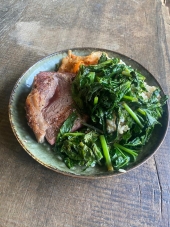
So last night I had a lot of sad veg in the fridge and a jar of peanut butter, I made a maafé type peanut/tomato stew. Today I have a few more tomatoes that need to go, so I'll make savory pancakes stuffed with brown lentils and soy crumbles with a tomato sauce on top, and I have lots of collards in the garden so I'll make a side out of that.

As for your tomato sauce: this is my mother's recipe, she was raised by Italians and it's better than 95% of the sauce I get out.
When I get tomatoes cheap I cook them in the slow cooker, run them through my Omega juicer and then can the resulting passata. I take a jar of that, plus about 1.5 to 2x the same volume of chopped fresh tomatoes, but I also sometimes use 100% fresh tomatoes (you could conceivably use canned tomatoes, my mother does that). If you don't like seeds or skins, you can remove them, you can leave them in and blend the final sauce if you want more fiber but don't want to see them, or just ignore them (that's what I do).
If you want a meatier sauce, you can start by browning sausage or meat in a hot pan. If you don't, start with olive oil. I like onions in my sauce, so I brown some in the oil, add garlic and some fresh spices (thyme and oregano, maybe rosemary, not a lot), if you want to use tomato paste you can put in a bit after the onions are done. Add salt and pepper. Stir around, don't let the garlic burn, and add your tomatoes and passata if using. Stir up anything that might have stuck and let it simmer until the fresh tomatoes are broken down.
Some folks deglaze the onion/garlic with a bit of wine, or add sugar if their tomatoes aren't super sweet, or parmesan cheese rinds or whatever. I stick with the tomatoes, onions, and spices.
I let it simmer for a few hours, usually, with a spatter screen on top until it's reduced a bit. taste for salt, take out the spent herbs and add some new chopped ones if you like.
2 days ago
I also have worked at a few food banks, in the back and also in direct contact with clients.

Ned Harr wrote:the main way it was laid out did seem to be designed around private vehicle traffic.


I've seen this type, I think where I was the vast majority of people still had cars (even if they were living in them), in the US I think you really have to be in a big urban center for most people to depend on a transport mode other than cars, even among people who need food. Public transport is so rare, and cars are so cheap in the US-- you may not have money for rent but you can have a used car (outside the US, things are a bit different). Also, a lot of the clients also may have mobility problems or kids, and the idea of having to get out of the car and herd several children through a food bank situation might be enough to dissuade people from participating.

I also worked at a church one on a very small scale that was the exact opposite. The donations were really random and diverse (from individual donations); all the items were laid out on tables and shelves in a "market" type flow setup by category, and a volunteer accompanied each client so they could choose the items they wanted. There were set limits for each "department": three boxes of pasta/rice, three health/hygiene item, etc. I found that kind of weird, but people definitely had individual preferences and it would have been worse to just give people a random bag with things they didn't want or need. Being a church in a town where everyone knew each other, they also really wanted to build bonds (even though I personally found it amazingly awkward and probably would have preferred to go hungry). Most of the clients were elderly and I think were really looking to talk to someone, so I guess in this case they were responding well to the local need.

About the deserving and the non-deserving. In a past life I directed a nonprofit and did a lot of community-focused work (in case you can't tell by me calling everyone clients). For a time I also had a family health situation (critically ill child) where we were the target of charity. So I've seen it from both sides.

It's really hard for some people to accept help, as you know.
Some donors really want to see "gratitude", and others are really afraid of their clients. This doesn't make it any easier for people who need help to get it.
Other people have absolutely no qualms about taking things they might not really need, for a variety of reasons.
Personally I try to focus on "the gift"- the intention of giving something away. Once the thing I give away is out of my hands, it belongs to someone else. How they use it or why they took it is not my problem, and if it is a problem maybe I need to reexamine my motivation for giving and whether I really want to give things away. If I am giving away several gifts, and one person who might not "deserve" it gets one, it is much more important to me that someone else receives one when they really need it, so I might see it as a kind of overhead or price of doing business. As for right/wrong/good/evil, that's all above my pay grade and for karma, God and Mother Nature to sort out.

Douglas, if you're interested in produce-related food bank stuff I suggest you read through Su Ba's epic threads. She's doing AMAZING AMAZING things for her community and is super inspiring.
2 days ago
so Tuesday Mr Okava plays soccer and if I don't need to work, it's my craft night.
Last night I made a repair that was way overdue. I buy most of my clothes at used clothing shops or at salvage-type stores when I travel (I'm thrilled to see Ocean State Job Lot has spread beyond RI/MA). Neither type of store has fitting rooms, and I occasionally get fuzzy about US sizing, so sometimes mistakes are made!
These were a Job Lot find-- the price was fabulous, these pants are heavy duty and full of pockets (men's pants, obviously), perfect for garden work.
The problem is, they're short. Before I could wear them down low on my hips and it wasn't as bad, but I've recently lost some weight and now need to wear a belt with the pants at my waist, and they stop practically mid-calf. Beside the odd look, my garden is full of insects and stinging plants and it's just a bad situation.

Someone here posted a brilliant repair a few pages back (I want to say involving a John Deere logo) and I figured I'd do the same. The cuffs came off a pair of my husband's trashed workshop pants (he destroys the pockets and the front of the thighs, so the cuffs are usually fine), I just eyeballed everything since these are garden pants and don't need to pass the wear-in-public test. These pants are such an odd color anyway (and have been perma-stained by the red clay in my garden, so even clean they look kind of ratty) that appearances are really the last priority.
I'm thrilled, it was such an easy solution, took me maybe 20 minutes, the biting flies that especially attack feet and legs will have to look elsewhere from now on!
2 days ago