
gift
My PEP Badge Tracker: An easier way to track your PEP Badge Progress
will be released to subscribers in: soon!

John Weiland

pollinator
+ Follow
since Aug 26, 2014
Merit badge: bb list bbv list
For More
RRV of da Nort, USA
Apples and Likes
Apples
Total received
In last 30 days
11
Forums and Threads

Recent posts by John Weiland

Putting the link here for others and for discussion:  https://ember-energy.org/app/uploads/2026/02/Reframing-Energy-for-the-Age-of-Electricity-1.pdf

I live in a region of the US that is quite politically conservative and rich in fossil-fuel advocates.  It becomes quite frustrating to argue points of alternative energies when local opponents continue to cite the legacy of those fossil fuel foundations at providing reliable power to the consumer.  The linked paper does a decent job of indicating the sizable inefficiencies of those power source compared to current and emerging alternative technologies.  I hope some of this information will be helpful for others here also.  An ~11 minute podcast on YouTube providing an overview of that paper is linked below as well.

https://www.youtube.com/watch?v=qokwulKU9Bg
2 days ago

Michael Qulek wrote:
The system potential becomes very important when you're trying to run a very big load, such as a 240V well-pump.  A BIG load like the well-pump could cause so much voltage drop that the inverter shuts off from a low-voltage warning.  While charging, the higher system potential prevents inverter shutdown because the battery has to first drop from a higher potential, and because power is coming into the batteries, the voltage sag will not be as great.
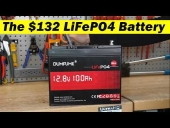


Very good to know as powering a well-pump is a top priority for our homestead and I suspect of that of many others!.....
2 days ago

Douglas Campbell wrote:A completely different option is an EV with vehicle to load option.

John: If connected to the grid the EG4 battery self heat would be a minimal draw.


Thanks for additional comments....and yes, I've enjoyed and gotten good information from many of Will Prowse's videos on LiFePO4 batteries.

Douglas C., the EG4 batteries look interesting and I'd not really delved into the 'Powerwall'-style of batteries at this point.  But with the configuration in mind, I think that could work well for our needs and I will keep researching that angle.  Also, I had not really considered vehicle-to-load option as we don't have an automobile EV per se......but we do have an electric Polaris Ranger for farm chores (48VDC X ~300 Ah).  Just now it's still running on the stock configuration of 8 X 12V lead acid batteries, but the hope with the declining price in LiFePO4 or other advanced battery tech is to replace these old batteries soon.  I had rigged up those batteries to be charged by solar and so already have that battery pack feeding into a plug receptable into which I plug a solar PV/MPPT controller combo for that purpose.  Seems like this circuit could be used to at least feed 48VDC into a hybrid inverter as well for low-level house power.

As always, lot's of good and helpful info running through these threads....much thanks!
2 days ago

Douglas Campbell wrote:We have 3x 10 kWh EG4 self heated batteries.
They work but it is, so far, tough to figure out the power consumption of the self heating.
I think/fear it just keeps the batteries above a setpoint whether charging is imminent or not, which was an issue during a prolonged cold/dark stretch last year.

'BattPack' sells all in one portable units for low temperature.


Thanks for responses to my query.  

The concept I'm thinking of is derived from the fact that (a) I'm a cheapskate, (b) we have a transfer switch at the grid-provided power pole in the yard, (c) wife is hesitant to have a large stack of batteries in the basement of the house when said battery chemistry has even a minor reputation for catching fire, (d) we are both in our senior years and may have limitations on system maintenance, and (e) the garage best suited for batteries is unheated.  Although lately mid-winter temperature has not gone lower than -30F, it is prudent in the region to plan for nights near -40F as this has occurred in the past 30 years of our living here.  I'm looking into placing a hybrid inverter (48VDC) near the power pole and be enclosed within a shed that would house both inverter and batteries.  Initially, the system would run power from the grid into the batteries for back-up and keep them topped-up for times when being on battery power makes more sense (outages, other reasons...).  Solar panels will be added to the system over time, providing prioritized charging power for the batteries.  So if the self-heating circuit is not too demanding, I would be fine....for now....with grid power providing that juice for heating, *provided* that they will be maintained above a threshold temperature at all times so that the battery is not damaged.  Your statement, Douglas C., that "I think/fear it just keeps the batteries above a setpoint whether charging is imminent or not..." is exactly what I was wondering.  In my scenario, keeping the batteries heated and 'safe' is the priority over the fact that they will indirectly be using grid power and hence adding to the electrical bill.  With a properly insulated shed or battery center, however, this draw from grid power may be pretty minimal....?   With the shed positioned near the power pole, I was envisioning simply using the same cable that I now use between gas/diesel generators to feed into the transfer switch  So I will need to determine if the outlet (AC) leads from the hybrid inverter can be wired into a proper receptacle for that cable.  An addition issue, perhaps trivial, is that the generator and cable combination currently provide both 120V and 220V power to that transfer switch....this combo allows low level 120VAC to the house plus enough power for the 220VAC well-pump.  Thanks again!.....additional comments/criticisms welcomed.
3 days ago
Even though the OP here posted about unheated LiFePO4 batteries, I'm hoping a related question on heating might be answered here.  Is it possible when using a heated LiFePO4 battery to program the battery management system (BMS) to maintain the battery temperature above some minimum even when it is not going through a charging cycle?  My impression is that when the charging system is called upon to initiate a charge when batteries are cold, the BMS will prevent initial charging.....first initiating a heating period to bring the batteries up to an acceptable temperature for charging....and then beginning the charging run.  My question pertains to a 48V parallel-connected battery array that would be semi-permanently plugged into grid-powered charging unit that would sense when the batteries were getting below a certain threshold before initiating a charge.  But I'm not clear on whether such a battery array, in an unheated building, could be maintained above a certain temperature simply by virtue of being charger-connected....and in some way using that fact to keep the internal battery heating circuit active to maintain the batteries near the minimum charging temperature.  The point being, having that battery array never dip down for any length of time to a temperature (~ -30F to -50F) potentially damaging to the battery.  Would it be better just to heat the whole enclosure/shed that the batteries were being kept in? Thanks!
4 days ago
Just wanted to add some ideas to these entries based on a recent snowfall.  For sure, my situation is very scaled-down and reachable compared to that describe by the OP, but may be of use.  We had a fairly typical late winter storm move through that started out as sleet, then wet heavy snow, then a larger amount of colder, drier snow.....and then back to near zero F nights for several days with highs in the teens.  Still, the sun has gained some strength and is up for a longer stretch of the day now.  So I used a long-reach truck window brush and squee-gee to clear off the top layer of snow.  With the squee-gee side, I was able to get down to the ice layer across the surface, but this now rendered the panel dark in color versus the reflective white of the snow.  Figuring to use the panel later in the day, I went back into the house for a few hours to work on another project.  At some point less than 2 hr later, I looked out to see the panel completely cleared!  The black background of the panel combined with the design had provided enough heat from the sun not only to melt the ice, but to dry off the surface of he panel.  So **if** you were able to replace the metal scraper head of one of of those long roof rakes with a lightweight shop broom head, you might be able to remove sufficient snow to enable the sun to do the rest in short time.  Just a thought....
1 week ago

Tommy Bolin wrote:....
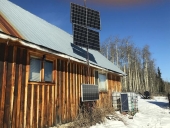
My winter yard faces a frozen lake, our solar gain with snow on the ground is pretty good, so, to me, the idea of 'pitching' fixed panels to maximize gain is short sighted.
....


Interesting!... May consider this approach for upcoming install.  Our roof definitely holds snow, even with a ~45 degree pitch and metal surface.  With roof snow and your design, I'm assuming bifacial panels would make good sense?  It also seems like slightly tilted brackets on top of a sturdy pole would allow some gain back in summer, yes?  Liking this approach!...
1 week ago

John F Dean wrote:...It is much more scary.  I went out to the car to reset the clock.  The car had taken care of that. It had also done a number of other updates. ....



I'm waiting for the day when my car will actually "see" that I'm walking towards it with a stiff and sore back.....and it adjusts the lumbar support accordingly before I even get in!  :-)


1 week ago

Douglas Alpenstock wrote:One thing that might be worth discussing is the maintenance of these mini chainsaws. Sharpening the chain and managing bar wear? Is it possible to lay in a fistful of extra chains? Are they cheap enough to be considered disposable?


Probably on the high end, but just bought an OEM chain for the Dewalt 12" for $24 USD.  The last few times I brought saws in for sharpening locally, it was $12 USD each.  That said, I've seen online that Dremel makes a kit for chainsaw sharpening and my wife already has a Dremel for craft and other uses.....may go that route in the future.
1 week ago
An initial digression that hopefully may find a good fix recommendation here:  20V Dewalt 12" chainsaw recently not delivering oil to the chain.  It has a rather well-known problem of leaking oil when set in the upright position and have remedied this somewhat by storing it on its side....others recommend draining the oil after each use.  But the problem at hand to be addressed is a lack of oil delivery to the bar/chain itself.  With cover and chain remove, I can observe the oil delivery hole when running the motor....no appreciable oil exiting the hole.  Some say use a wire and/or WD40 to remove any debris in the delivery tube...tried the wire to no apparent avail.  Have not yet tried WD40.  Other opinions?  Thanks!..... (and now back to our regularly scheduled program).

Just this week added the Dewalt 60V flex battery version chainsaw to the collection.....seems fantastic. I had a discussion with a Stihl sales rep at a local store who still uses Stihl gas/mix saw for big work, but also has an electric for quick short projects.  While it's possible that gas version might be needed in the future, for us and our particular location, few trees have a circumference larger than 16".  Big contrast not only to the Doug Firs of Oregon in past years there, but also to the maple and oak stands just east of us into more north-central Minnesota.  So the electrics have been just fine for 95% of our recent projects and I suspect will only get better.  The real impetus for the new purchase was trying to get my Stihl gas saw started in the cold weather.  Something is amiss....vapor lock of sorts?....since I can barely pull the starting cord due to high compression.  (If I remove the spark plug, it pulls just fine and you can hear the piston and valve noises within.)  At the same time, I've been curious about the flex-volt batteries as they not only will give 60V to this saw and other Dewalt 60V tools, but the same batteries revert to 20V when placed into a 20V tool.  At any rate, very impressed with power of new saw.  As a side note, the saw comes most often with an 18" blade.  But due to the smaller size of our trees and the availability of both the 16 and 18" versions at the retailer, I opted for the shorter blade....even wife is excited to use it and uses the 20V/12" unit all the time.  She won't touch the gas saw.  

Last note:  I use a Dewalt recip saw as well, but only when I need to cut up trees and firewood that had been protected by fencing and ended up growing around the metal fence material.  Here I use a long demolition blade which will cut through wood and metal alike.  I could go on and on about our electric farmyard vehicles and have in other threads.  Really hoping before my days are over to have an electric commuting car and even better....electric tractor.  Battery tech is just improving so much it appears.  Petrol has its place, but so glad to be around when batteries finally came to the forefront.
2 weeks ago