Catie George

gardener
+ Follow
since Oct 20, 2016
Merit badge: bb list bbv list
For More
Ontario - Zone 6a or 4b, depending on the day
Apples and Likes
Apples
Total received
In last 30 days
9
Forums and Threads

Recent posts by Catie George

Brody Ekberg wrote:

Michael Helmersson wrote:

Brody Ekberg wrote:

Our walls, from inside out are drywall, fiberglass insulation, plywood sheathing, tar paper then aluminum siding with that backer board.


No vapor barrier then?


Not unless the fiberglass insulation backing or tar paper counts. And actually our walls arent just drywall. They seem to be 1” thick made of 2 separate layers. The layer closest to the outside seems like drywall but the layer we can see inside the house seems different. Its harder than regular drywall. Can’t pound a nail in without busting chips out. Its like drywall but harder. And not all uniform thickness. The 2 attached pictures were taken from a single piece I cut out of the wall and theres almost 1/8” different in thickness


I admjt to being lazy about reading this whole thread, ans this might already have been answered, but it looks like plaster over rocklath. I have it too. It was kind of a intermediate step between drywall and plaster, with all the advantages, and disadvantages of both. I actually really like it (when I am not trying to hang something from the wall).

Very off topic but to pound a nail, predrill. Cut any holes with a diamond tipped saw and expect a ton of dust. Do not use drywall anchors. To find studs, buy a 'Stud Pop's magnetic stud finder. The rocklath is secured by nails over the studs.

Back to your actual question...

My solution to uneven heat in a house I try to spot heat with a cheaper source, (pellets/wood), while keeping cold and moisture in check, is to run my boiler for a few hours each day, usually first thing in the morning to bring the house up to temp after I let it cool off overnight and restart the stove. In my case, I do it to prevent freeze, but it would also likely help your moisture issues. I dramatically lower my oil consumption by doing this, vs. running just oil, and IMO the house is more comfortable. Seeing those pics, I wonder if the discolouration in the floors of the two back bedrooms is from the previous people doing what you were doing...

Long term, I plan to add mini split heating to that side of the house, but this works for now and is cheaper than mold issues or a frozen pipe in my basement.  If I were you, and considering installing a basement woodstove, I would put it on the opposite side of the house from the upstairs stove - I have one in the basement and one on the main floor, both on the same side, which STILL leaves the back bedrooms cold even when I run both.

Also - for circulation with fans, push cold air along the floor towards the stove, with fans at floor level, not towards the bedrooms. For warm air, run ceiling fans to wash it down the walls, or fans in the top corners of doorways, pushing warm air to the bedrooms, which, as it cools and sinks, gets returned by the lower fans. You want to create a circulation pattern of air.

I'm also considering insulating my rim joists. I've been mulling just Rockwool, since I also have concerns about spray foam and rot in a humid climate with a house with no vapour barrier... Plus, Rockwool is inflammable and doesn't offgas. Other sources say my plan will CAUSE rot because it causes condensation on the surface of the joist, so I keep mulling it and haven't done it. So this is certainly not advice.

5 days ago
Depending on where you live in the world, your soil has different minerals.

Here in Ontario, for example, my soil is mostly 10 000 year old ground up rock dust, pulverized by glaciers and deposited in a lake bed. Very nutrient rich.

Much of the southern US is on soil that is from millions of years of rock decomposing insitu, which may be less rich. Unless you're in a river Valley, or a drained lake, or ....  It depends!

Over time, water can move soil nutrients lower, and wash them away - or crust them to the surface in excess. Once those nutrients are gone, it's hard to recover them even with the best compost and they might be absent in a large geographic area.

I don't know where you are, what your soil contains, and what types of minerals it was made of, but I have seen people amend with rock dust (glacial or volcanic), which I'd consider if I was worried about soil mineral content.

I would want to have a good idea of what's missing though, as I'm personally not a fan of amending without good reason. I would want to match the compositon of the rock dust (or other amendment) I chose, with the actual deficiencies in my local soil. For example, dolomitic limestone has magnesium, pure limestone has much less. Or volcanic rock would have a wider range of minerals... Etc. you may even want to combine a few amendments.

I'm someone who insists on mixing native subsoil into raised bed mixes, because I believe the minerals in the native soil are important.

You might not even need to pay for a soil test, if you can access local agriculture data (this is where I would personally start).

You may also consider adjusting the pH of the soil, as that can affect nutrient availability, particularly if overly alkaline.
1 week ago
I made relish for the first time this year, and have been eating a ton. I think it's the first time I've ever canned a 'convenience food' that I actually use. I found relish easier to make than pickles, and more useful, to boot!

Some things I use it for:

Relish + mayo + tuna/leftover meat = tuna, chicken, or pork salad sandwich. Also great with rice instead of bread.

Relish + mayo + potatoes - potato salad!

Relish + mayo + eggs - egg salad!

Etc.

I've also been enjoying it when I overcook a roast to make the roast easier to swallow, or on sandwiches, burgers, etc.

I made dill pickle relish and mustard relish. Both delicious, both uniquely flavoured enough I feel like there is variety.

Which made me wonder - are there other relish flavours I could make next year?
1 week ago
My mother is a huge fan of fondue pots for emergency prep. They can be used indoors, which is a huge bonus. You can often find them inexpensively in thrift stores.  Fuel is methyl hydrate.

I call her during power outages, and she's fried up some toast or an egg for breakfast, perc'd a cup of coffee, and heated up soup for lunch or hot water for a hot water bottle, all without going outdoors and getting chilled.

I have a stick stove, and I like it for camping,  but expect to ruin any pot you use on it with soot.
2 weeks ago
If it's colder than normal for your area, and your house isn't well insulated, remember to leave your taps dripping overnight, and sink cabinet doors open to avoid a freeze and an expensive pipe burst! I have been known to use an incandescent lamp (if you have power) to add a little heat to a cold bathroom, utility room, or pump room, though be careful not to knock it over or get it wet!

You can buy electric heaters that turn on if the temp gets below 10C (whatever that is in F), and I have one set up constantly in my utility room in the off chance my boiler fails (again) while I am not home.

Figure out where your water shut-off is, and if it's possible to drain your water at all, well in advance of any power outage.

There is always the 'watch the smoke from a smoldering piece of cotton twine" trick to find drafts.

I hang a curtain up in the winter in my entry with a cheap tension rod , to block cold air as we go in and out. Makes a big difference, and also blocks some of the remaining draft from my well sealed door. In a pinch, duct tape willhang a curtain!  The best curtains go from floor to ceiling without gaps.

For layers - remember it is not the weight of clothes that insulates you, it's the trapped air.

So one pair of fluffy socks that are a bit too big is going to be far warmer than 6 pairs of socks you need to stretch to get on. Same goes for pants, sweaters, jackets, and even boots.

 For bedding - put your heavy layers like an old wool blanket on the bottom, light layers (like a duvet or comforter) at the top of the pile. It does help to cover a fluffy layer like a fuzzy blanket, if it's at the top, with a sheet to trap more air. I grew up with a bedroom that was often below freezing in winter. I learned to wrap a fluffy blanket around my head and neck for insulation.

Do not allow yourself to sweat, if you do not have heat - it's very difficult to rewarm if you are damp, and get chilled. Take off whatever layers you need to, and work at whatever pace you have to in order not to sweat. Similarly, if you are cold - make yourself get up and move, you will rewarm quicker when you are moving.

Do you have a natural gas hot water heater? If you do, it may keep running in an outage. My mom is able to repeatedly fill her tub and kitchen sinks with hot water (town water, so she has pressure) and add a little heat back to the house during an outage that way.
3 weeks ago
At least in Canada, you can still buy Halogen bulbs, which are a type of incandescent with slightly better efficiency and longevity due to invading the filament in halogen.

They still have a full spectrum of light, although are not as useful as a heat lamp.
3 weeks ago
At a certain point, what you are really asking is- "given body reserves of so much fat, and so much protein, how little can I eat so that those reserves will last me 1-2 years".

Again, POWs, prisoners, and people in concentration camps fed starvation diets had high mortality rates and often long term damage to their health, despite some people surviving.

For example, a relative was apparently in a Siberian work camp for 7 or 8 years, and died within a year of going home. Lots of people never made it out of the gulags.
4 weeks ago
I grew up not washing rice, but do now after a CBC Marketplace investigation tested the arsenic levels of rice and rice based products in grocery store. I eat a ton of rice and rice products because I am celiac.

Repeated studies have shown rice is high in arsenic due to the soil it is grown in and washing the rice has been shown to dramatically reduce the arsenic content. if I recall, brown rice often has even higher levels.

I suspect there's a reason that cultures that traditionally eat a lot of rice insist on washing their rice. I have to admit I've grown to like the less sticky texture of washed rice, too.
1 month ago
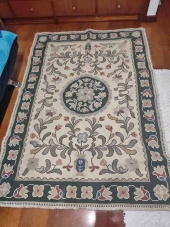
I buy 100% cotton rugs from IKEA. Sadly they are often boring patterned.  They often claim they can't be washed, but mine only shrank a little when I put them through my washed and dryer. They also have wool rugs, I'm not sure if they are 100% wool, and jute rugs.

I bought a cotton rug on Wayfair and the quality was horrible - the rug shifts and skews and stretches as you walk on it. Not worth the money even if it is prettier.

I do find I need either a rug pad, or carpet tape to hold my cotton rugs down in high traffic areas so still not 100% natural. But I like that they are washable and not creating microplastic dust.
1 month ago
Weight loss studies are interesting for this

This has a good review of different studies, but 0.4 g protein/day/lb of body weight was associated with very little muscle loss while losing weight.  So for a 150 lb person, that would be 60g of protein/day.  Significantly higher than your 20g, but an interesting number.

https://legionathletics.com/minimum-protein-per-day/?srsltid=AfmBOor9fL_d0w756Yo0oVhKibDhv3Kn0QMLOuPEzvchvAKfLvBDrT8A

I saw a claim, with no good reference, for 0.25 g/day/lb of body weight for fat, as the minimum. That translates to 37.5 g for a 150 lb person.

This source defines a 'very low fat diet' as 33 g of fat per day in 2000 calories. https://www.ahajournals.org/doi/10.1161/01.CIR.98.9.935

Furthermore, they say ' The importance of the issue is not clear in the absence of established requirements for essential fatty acid intakes at any age. Estimated requirements range from 3% to 5% of caloric intake.75 76 This requirement translates to ≈7 to 11 g for a 2000-calorie diet and is usually met by the inclusion of polyunsaturated fats as a source of linolenic acid.'  I can see how doubling that, because you don't JUST get essential fatty acids leading to 20g as an average figure for total fat required.

So a 'safe' healthy minimum would likely be 30 g of fat, and 60 g of protein for 150 lb person. For survival, likely less,  maybe 20g of fat, no good data on protein, but keep in mind there was significant disease related mortality in POWs being fed these super low fat/protein diets.

This is low enough that it should almost be possible to reach just with things like whole grains and legumes.
1 month ago