Mike Haasl

steward
+ Follow
since Mar 24, 2016
Merit badge: bb list bbv list
Biography
Mike is a homesteader, gardener, engineer, wood worker, blacksmith and most recently a greenhouse designer. He heard about permaculture in 2015 and has been learning ever since.
For More
Northern WI (zone 4)
Apples and Likes
Apples
Total received
In last 30 days
22
Forums and Threads

Recent posts by Mike Haasl

This is a badge bit (BB) that is part of the PEM curriculum.  Completing this BB is part of getting the sand badge in Earthworks.

Swales are an excellent way to Slow, Sink and Spread water on the landscape.  Let's get out the shovel and make one happen!


Here's a video of what we're after:


Minimum requirements:
  - Create 36 feet of swales on sloped land
      - Can be two swales that add up to 36 feet
  - On contour
  - Deep enough so when completely full of water it's at least 8" deep
  - Level berm on downhill side
  - Immediately seeded and mulched
  - Has a spillway

Provide proof of the following as pictures or video (<2 min):
  - Landscape you're starting with
  - Contour marked out with the device you used to ensure it's on contour
  - Excavation underway
  - Depth of excavation (perhaps a level resting on the berm at one end and a tape measure showing depth)
  - Finished swale(s) showing length is at least 36'
  - Seeding the swale and berm
  - Mulching the swale and berm
  - Spillway

5 hours ago
PEM
A pro tip for burning the router grooves...  Use the oxy acetylene torch to put a tiny, focused flame in the groove. You get much less charring outside the lettering so the planer has an easier time cleaning up the surface.  That's how I did the sign you're not supposed to read in the classroom.  In lieu of the oxy torch, I'd use a small propane torch flame and try to just hit the grooves.
That scale is hard to read so the blue color out west might be 3 or 8 on the scale, not 1.
5 days ago
I have solid pallet fences that are about 4.5' high and the chickens don't jump onto or over them.
5 days ago
Nothing specific that I know of.  I believe mainly high winds pushed them over, as opposed to trees crushing them.  So the failure was likely fasteners giving out on the horizontals or rock jacks tipping over. Contributed heavily by the fence being a 12' high sail in some cases.
6 days ago
Hi Esteban, I fleshed out my idea a bit better for easier junk pole fence options.  It might be neat to try a few experimental sections somewhere, put a trail camera on them, and see if they work...   Shorty Junker ideas
This is an idea I had a month ago when high winds blew down some of the standard junkpole fences at Wheaton Labs. I figured I'd flesh it out a bit more in the hopes that this encourages an experiment out there.

Background: My metal wavy fence has kept deer out of my food forest for 5+ years. I have a multitude of other deer fences using pallets and/or metal remesh. The guiding principle is that two fences 4' high and 4' apart won't let deer get through due to their worries about depth perception and not wanting to land on something.  Another principle I use is that if a solid fence is taller than a deer, they aren't going to stand up and look to see what's on the other side.  I'm dealing with white tails where I've heard the 4' high, 4' apart rule works.  My remesh fence is 5' high and 5' apart.  I'd assume for muleys and elk 5-6' high and apart would be a good idea.

Design options:
1. Diggable ground (the Abbey). Put posts in the ground that are 6' tall. Build solid/tight junk pole fence that's also 6' tall. The deer can't see through it so they won't jump it.
   By being shorter
       The pieces are more uniform and easier to keep tight
       The wind can't blow it over as easily
       More fence per lb of junkpole

2. Rocky ground. Build rockjacks and do the same as above.  The rockjacks don't have to work as hard and won't be as easy to tip over

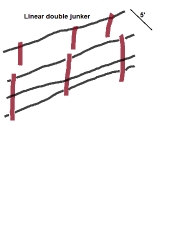
3. Linear double fence (like a standard 4' high 4' apart double fence)
Put up short posts or rockjacks on the usual spacing with a loose junkpole fence.  Just tight enough to keep them from pushing through it.  Then add a second horizontal pole 4-6' inside of that fence.  Kinda like a hitching rack.  They'll see that second fence/obstruction and not jump the outer fence.  The inner one can be held up with more posts in the ground or extensions/structure from the rock jacks.

4. Wavy Shorty Junk pole fence:
Put a post or rock jack on a closer spacing than normal.  Say 8-10 feet.  But lay them out in a zig zag pattern.  Build a low loose junkpole fence following the zigs and zags.  This will keep the deer from poking through.  Take longer junk poles and run them horizontally from alternating posts.  So one pole runs from post 1 to post 3.  Another goes from 2-4.  Another from 3-5.  This gives you two horizontal hitching post obstructions that are 5' off the ground and 5' apart.  For bonus protection, lay an additional junk pole between those two runs.  The zig zag will help the rock jacks or posts support each other.  You might be able to build rockless rock jacks for this system  
1 week ago
Only 6 hours to go!  Get your stocking stuffers for next Christmas all taken care of!  


3 weeks ago
I don't know too much about it but I believe you that fresh is better.  Hopefully I don't have a BB in there that suggests storing it for a while?  I think in a compost toilet system it's a form of storage that's ok because it's converting into something good for plants in the longer term.
3 weeks ago
PEM