

|

|

|

|

|

|
|
|
|
|
|
|
|

there are lots of newer grid tied solar inverters coming online now that support high voltage dc charging or at the very least can support a level 2 charger.Douglas Campbell wrote:Interesting discussion.
I charge my EV at home with a Level 2 240V, powered by grid-tied solar (87% of our total household consumption is solar over the year).
Off grid, daytime solar can support Level 1 120V, drawing about 1500 W. Level 1 is slow, so offgrid feasibility depends upon use-case.
The fix-it-yourself arguments for locally common older cars are strong, but going forward both EV & ICE cars are becoming complicated.
And in my climate, most consumer vehicles older than 15 y rust out including, sadly, my previous Honda CRV.
Thumbs up for a Honda Fit/Jazz, one of our previous favourite cars, although a bit dinky in backroad snow.
I was tempted by the Chev Silverado EV WT, or Ford Lightning F150; quiet power stations on wheels for remote use, but mileage per kW is poor and charging is long.
John Weiland wrote:
larry kidd wrote:It got down to about 20f last night and I never insulated or heated the batteries. Lost power about 2:30am took till about noon to get the cells warmed up to about 35f or 2c and got power back online. Spent the better part of the day after that wrapping the cells with heat tape for pipes and put insulation under and over , still need to go back and insulate the sides. Used 30 feet of heat tape with a 90w draw. It has it's own thermostat on at 35 off at 50 if I remember correctly.
Living where we do in the central US just below the Canadian border, an experience like this is what causes me to hesitate on diving into LiFePO4. I probably will anyway and just keep the investment small to modest. Wife is still tooling around the farmyard with recent ~10 degree F using lead-acid batteries in a Polaris Ranger EV and we are grateful for the robustness of the time-tested tech, even with the known power deficits of these batteries in cold weather.
There was mention recently of Canada leaning more towards solid-state/sodium ion technology, partially because it may be a less expensive battery to produce, but also in large part due to its greater resiliency to cold temperatures. Still that battery too will use a battery management system (BMS) and one hopes these don't turn out to be a weak link in the technology. Larry K, I always wondered if a seedling heating mat would be enough to prevent severe temperature drop in such situations. CLearly if the location is too cold and the batteries unprotected, the BMS will do best to shut down the battery. But in situations where the batteries are housed in an insulated container of sorts, a seedling mat seems to be designed to produce low temperature, low wattage heat to the item(s) sitting on the mat. Perhaps this would be a safe solution for many out there? Also a question for those having installed LiFePO4 batteries going back a decade or two: Have you experienced or heard of situations where either the cells or the BMS itself failed causing need for battery or cell replacement? If the BMS goes bad and the cells are otherwise good, can the BMS be replaced (assuming a battery case whose contents can be accessed) fairly easily? Thanks!
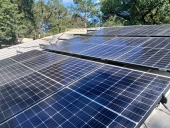
Jackie Lei wrote:Yes, LiFePO₄ batteries really are a big step up. I’m also planning to upgrade, I’m looking at a 16 kWh LiFePO₄ battery for my home loads. The price is surprisingly low, just a little over $1,200. A friend recommended this battery manufacturer to me since I’m not very familiar with LiFePO₄ products myself.
This is the battery I’m considering. 16KWHCould you help me take a look and let me know if the lifespan can really reach 10 years?
David Baillie wrote:
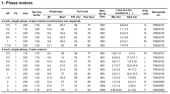
John the magnum is currently discontinued. If you want to stick to the older transformer based units like the magnum then a samlex or victron would do it for you. If you are going lithium choose an inverter meant for them like the lux or sol ark type. I am liking lux these days.John Weiland wrote:I'm hoping to piece-meal together a small system that would be expandable in the future for more off-grid power. Initially, I was hoping to school myself by focusing on two essential items of the homestead-- the furnace (propane) for winter and the well pump for water. As you might expect, non-winter months are not so crucial. Even if the well becomes inoperative for a period, livestock watering can be done from the river near the house.
I've already dabbled a bit with 12V-powered inverters for producing low-wattage 120V AC power. What I'm envisioning for the current project is a 48V inverter/charger (Magnum Energy being one brand of interest) that would keep batteries topped up while grid-power is active, but be able to switch over to powering the furnace motor (120V) and well-pump (220V) if grid-power goes down. A side angle here is the fact that I'm preparing to convert a 36V golf cart to 48V soon and this likely will involve several (3-4?....more?) 48V/30Ah LiFePO4 batteries. Clearly one can get larger individual batteries, but I'm interested in keeping individual battery weight as low as possible so that they can be used in the golf cart (solar PV panel roof) in summer and shuttled easily to the basement for winter.
Questions arise around sizing the inverter/charger and battery bank for powering the furnace fan and the well-pump. The furnace is less of an issue as it should be readily powered by an inverter of 4000-6000W (pure sine wave, peak surge watts nearly double the running watts). If memory serves me, the house well pump was ~2/3 - 3/4 hp submersible running at 220V and while the running amps/watts aren't terrible, the starting amps may be up in the 20s to low 30s. So I'm more concerned about making sure the well pump won't trigger a system shut-down due to either batteries or inverter (or both) being under-sized. A parallel string of 4 batteries each at 48V would yield 120Ah with internal BMS's sized for golf-cart amp surges (80 - 100A per battery...typically double that for short spike surges). As finances allow, I would be integrating solar energy into the system as well as part of the expansion. Input on this vision and design is most welcomed... Thanks!
John the magnum is currently discontinued. If you want to stick to the older transformer based units like the magnum then a samlex or victron would do it for you. If you are going lithium choose an inverter meant for them like the lux or sol ark type. I am liking lux these days.John Weiland wrote:I'm hoping to piece-meal together a small system that would be expandable in the future for more off-grid power. Initially, I was hoping to school myself by focusing on two essential items of the homestead-- the furnace (propane) for winter and the well pump for water. As you might expect, non-winter months are not so crucial. Even if the well becomes inoperative for a period, livestock watering can be done from the river near the house.
I've already dabbled a bit with 12V-powered inverters for producing low-wattage 120V AC power. What I'm envisioning for the current project is a 48V inverter/charger (Magnum Energy being one brand of interest) that would keep batteries topped up while grid-power is active, but be able to switch over to powering the furnace motor (120V) and well-pump (220V) if grid-power goes down. A side angle here is the fact that I'm preparing to convert a 36V golf cart to 48V soon and this likely will involve several (3-4?....more?) 48V/30Ah LiFePO4 batteries. Clearly one can get larger individual batteries, but I'm interested in keeping individual battery weight as low as possible so that they can be used in the golf cart (solar PV panel roof) in summer and shuttled easily to the basement for winter.
Questions arise around sizing the inverter/charger and battery bank for powering the furnace fan and the well-pump. The furnace is less of an issue as it should be readily powered by an inverter of 4000-6000W (pure sine wave, peak surge watts nearly double the running watts). If memory serves me, the house well pump was ~2/3 - 3/4 hp submersible running at 220V and while the running amps/watts aren't terrible, the starting amps may be up in the 20s to low 30s. So I'm more concerned about making sure the well pump won't trigger a system shut-down due to either batteries or inverter (or both) being under-sized. A parallel string of 4 batteries each at 48V would yield 120Ah with internal BMS's sized for golf-cart amp surges (80 - 100A per battery...typically double that for short spike surges). As finances allow, I would be integrating solar energy into the system as well as part of the expansion. Input on this vision and design is most welcomed... Thanks!
Yup, the use case for lead is shrinking all the time. It has proven to be a game changer for many people.Aaron Yarbrough wrote:
David Baillie wrote: Lithium is a game changer as well as you can get full array production since they have low resistance to charging unlike lead and you don't waste time at the high voltage low amperage low production absorb stage. It has forced solar designers to change their ways as we now maximize panel numbers due to low panel costs as our first priority. On the down side you are usually best to repanel completely so you can maximize your strings and the all in one inverters are terrible at lead acid charging as they lack a proper 3 stage charging profile.
We woke up with no power a few weeks ago. One our 6V FLA batteries had a bad cell I think. Fortunately, I had recently received a lithium battery kit and was almost finished assembling it so we we didn't have to limp along for long. The difference between the FLA battery bank and the Lithium Phosphate one is amazing. We're still getting summer temperatures here(two months out from the winter solstice) and I'm running two mini splits, a convection oven, an induction cooktop two fridges and it seems like I can't run the battery out of power. Then with 2-3 hours of full sun it's back to 100% charge. I ordered more solar panels which I will still install but it definitely appears like the weak link of my system was my battery.
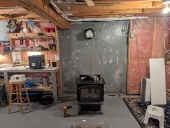
Based on the wett inspections I've had done for clients everything looks good. Is the horizontal pipe leading to the chimney going to be double walled? If not you will want to double check your clearances to the Minisplit tubing. I assume your floor is concrete? If so you are good as you need 18" of non combustible floor in front of the stove. Good luck on the Wett inspection.Sheldon Caulfield wrote:Hey all! I'm in a mad rush to install my new woodstove before the winter.
This is going in my unfinished basement, and you'll see in the attached photo that there are some soft mini split/heat pump tubes and cords strung across the top of the wall directly above the wood stove.
I'm having someone in for the final inspection in a weeks time so that I can safely burn, but it's $350 for the inspection so I really don't want to fial and have to book another one.
Does anyone think those tubes would be a problem? Additionally, are there any other glaring problems you guys can see around the stove that I'm blind to? (Except for the fact that the stove isn't hooked up to the chimney of course, lol)
I've always liked the water analogy for explaining power to people. I usually use pressure for voltage, flow for amperage, and volume for watts... Its not perfect but it gets the point across to people.Miikee Mike wrote:Hi folks. I was very confused by all those heavy electronics videos when i wanted to learn about Voc Isc and Bypass Diodes so i made a video that uses easy water analogies to explain it. It has a follow up video at the end screen going into reverse biased and forward biased Bypass Diodes and strings. They're just meant to get some ideas across. Feel free with feedback or questions.
YouTube