I don't have a lot to say about this, but I'm just sick to my stomach that we seem to be living in a time that a person saying things you don't like is a reason to kill them, or even call for their death. This country can't survive if we can't get back to a point of being able to disagree without hating each other. My soul hurts today.
Josh Hoffman wrote:...
Since it stays very hot here (chill hours are around 450 a year or so) the coop/run is open at the top and on the south side. Since it is on a slight slope, we get some ground water intrusion on the north and east walled side (during torrents) and coming in when the wind blows sideways while raining.
The chickens roost in the rafters and some other lower spots. This allows us to use the same deep litter of wood chips/grass clippings/leaves, etc. for the entire coop/run. We could not do this if we experienced colder temps.
Josh, I love your setup. Excellent job. I agree completely of course. You are in a far different climate than the one I'm dealing with. We get -20 every year, -30 sometimes, and I've seen -40 two days in a row a few years ago. My roost area has to be very tight with no drafts at all while still having a lot of ventilation. Any moisture or drafts on the birds while roosting will cause bad frost bite here. I love the amount of ventilation you are able to provide your birds.
Matt McSpadden wrote:...One issue was that it was on a slight slope....
Josh Hoffman wrote:...But, adding the 2x6's and using the deeper part that collects there has been very manageable and I think most anyone could make it work. If you have a steep area, I could foresee some issues with the material moving along too rapidly. Adding things to slow it down, in closer intervals may be the solution...
The part of my run that I get the most compost from is the 20 or so feet nearest the coop. That area is pretty flat. The rest of the run, 30 or 40 feet, is a pretty steep decline. I put a couple logs across the run to catch some of the stuff the birds knock downhill. I just brought in some trees that I had down on my land. I left a couple branches on one side to keep the logs from rolling downhill. They do a pretty good job of gathering compost on the uphill side. I figure sooner or later the logs will rot and they will become mini terraces across the run. Eventually maybe the whole thing will be stepped rather than sloped, but I'll have to add more logs for that to happen. Right now it's just a couple random logs, I need to add more somewhat on contour for that ever to happen. For now, the couple logs I have are serving a purpose. The chickens also like to dig holes on the downhill side of the logs to dust bathe. Maybe they feel more sheltered doing it next to the logs? Who knows what chickens think.
I use deep litter in my coop as well. It gets cleaned out once a year or so. My experience is a little different than some people have suggested. A properly designed coop will be bone dry all the time, so no real composting happens. The litter/poop/missed food breaks down into really small fine stuff, but doesn't compost at all in my coop. The way I deal with that is to remove all the bedding once a year straight into the (very large) run. The chickens love piles, so they work through it all again and the rain and time actually do it turn into really excellent compost. It still creates a crust like Michael mentioned so I use a garden fork and break it up now and then. Each turn releases a bonanza of worms and gets the chickens working through it all yet again, and makes it nice and loose. Then I go in with a wheel barrow and sift the loosened material. From there it goes straight to the garden. It took me a couple years to get to the point where it was really producing a decent amount of soil, but it's paying off now in a big way. One additional lesson I learned is that you really need to continually add as much organic material to the run as possible if you want to get a lot of compost. I try to add lots of grass clippings and weeds all summer and it really makes a difference. The chickens can't make compost from nothing. The more you add, the better.
Joseph Lofthouse wrote:That type of mega-huge cataclysm seems too big to survive, therefore I don't prepare for it, and don't know of anyone that does. Same way that I don't prepare for a mega-astroid strike, or the sun going super-nova.
Tons of intentional communities prepare for normal disturbances like winter snow, civil-unrest, flood, hurricane, earthquake, drought, etc...
Bingo. I very much believe in being prepared for "normal" disasters, black outs, tornadoes in this area, snow storms that stop travel for a week or two, even civil war. I don't even bother thinking about truly monstrous events like this.
Steven Lindsay wrote:although the US 'stick-build' framing technique is frowned upon by some, it developed precisely because there was a shortage of 'time and money', and highly trained tradesfolk and resources, but a huge need for new housing.
It's probably your cheapest, most flexible option; you can easily add elements such as insulation, windows, power etc as needed over time, it can be constructed without heavy machinery or even power tools if required, and be completed at your own pace (the only really time-sensitive elements being concrete or other settings materials). You can also design it to fit in whatever available space there is without adding much to the cost or complexity per sq.
It's so well established there are heaps of instructional resources and everything needed is probably readily available, maybe even free, used or reclaimed.
I'm with Steven here. I keep exploring "alternative" building techniques and in the end I keep coming back to regular old stick built construction. It's easy, fast, easy to learn, you don't really need any equipment other than a saw and a hammer. As Steven said, there is a very good reason 99+% of people build this way. It isn't because they didn't consider the alternatives.
You are totally right…there actually is ventilation right now via gable vents, but it’s not enough. He is actually planning to change out the windows to provide more. I have not heard that rule of thumb but thanks for sharing that. He is also planning to make a few other improvements as well. I’ll post updates here once we have new photos!!
It is a really beautiful setup and I think you will do well selling them.
The easiest way to add ventilation without adding drafts is usually to take out the part right beneath the roof line. It's high enough that the chicken will roost under the draft, but if you take out that section on both ends of the coop, you get nice ventilation passing through the highest part of the coop. Depending on the number of chickens you are keeping in the coop, that may or may not add enough ventilation. If you use the windows, you can get more ventilation but you have to keep careful with the placement because it's easy to introduce drafts on the roost area. I added a crude picture to show where I mean.
I forgot to add, I did this to my coop and covered the windows with a dual layer of hardware cloth. One layer is 1/2" and the other is 1/4". It keeps the rain out surprisingly well and if you put trim boards over the edges of the screen and attach them with screws all the way around that pass through the trim board, through the screen, and then into the coop walls, it's very secure and it looks nice. We have heavy raccoon pressure and they have never been able to get through the double layer screen.
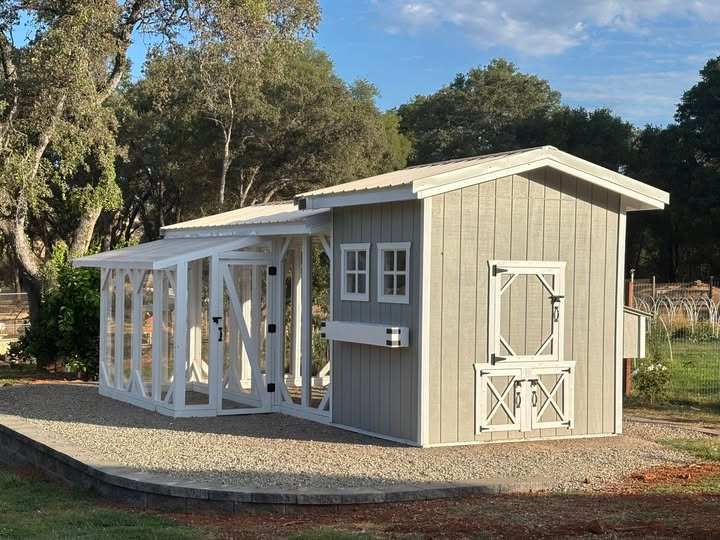
Juju Guerra wrote:My husband recently built a combination greenhouse chicken coop in our backyard/orchard area and we are planning to sell them. The greenhouse is attached to the side of the chicken run and is 4x9 - check out our site for more details: www.sierragardencoops.com. I'll share a photo here as well!
That is a beautiful coop and greenhouse design. I would urge you to consider adding ventilation to the coop, both your own and the coop you are designing to sell. Ventilation is the most important feature of a chicken coop, arguably after security. The rule of thumb is one square foot of ventilation per chicken. I don't know that I've ever seen a commercial chicken coop that had that amount. Having enough ventilation while having no drafts on the chickens can be challenging, but it's absolutely worthwhile for the health of your chickens.
I have most planted in my food forest, so those are surrounded by all sorts of other plants. I have 4 that I planted in the yard and mulched heavily with wood chips, so those have no competition at all. I planted two in areas that my wife has flowers in, so they have some, but minimal competition.
Christopher, the problem is every year with apples I have planted. My wild apples grow and produce every year. I may have to try Jay's suggestion and graft some branches from the known varieties onto my wild apple trees and see what happens.
I'm having a hard time with my apple trees. Our property has wild apple trees all over the place so I know apple trees grow well here. It's the ones I have planted that I have issues with. Some of them have been in for 5 or 6 years and haven't produced yet. Some of these had little apples already growing on them when I planted them, and haven't produced since. The ones that have produced a couple apples have produced ones that look terrible. They are covered in scab, misshapen, and just look awful. These are in my food forest with lots and lots of other kinds of trees, bushes, support species, pollinator species. I don't know how anyone is getting edible apples without spraying them, and I'm not willing to do that. I'm ready to give up on apples entirely at this point. Anyone have suggestions before I just throw in the towel?
Kay Strayer wrote:
I'm sorry, I'm just seeing these messages somehow. I mean to pay $15,000-$20,000 for the home. Total and with payments over the course of 1-3 years. With a down payment as incentive to sell to me. The problem I keep running into is that even if the home is decent, and the owner only wants $15,000-$30,000; they also want all of the money upfront. It seems odd to me because that's not how most people purchase their homes. They pay mortgages over the course of 20-30 years. Basically it seems like a call to investors only.
I know it's their home. I simply mean the housing problem only gets worse when families aren't living in them. Investors scoop up everything and owners hold out. 10 million vacant homes in the US. It doesn't make sense.
I'm not greedy. A piece of acreage I can build a couple of tiny homes on is sufficient. I'd even take a decent mobile home on some land. For the right price, I only need one (size taken into consideration). You can't sleep in two houses at once.
I'm surprised you can find any home at all for $30,000, money up front or otherwise. Most people pay mortgages over 20-30 years because they are paying $100,000+ for the home. I'm in a very rural area and here an older trailer house on 2 acres of land sells for $150,000 and up unless the trailer house isn't really livable.
The "ten million vacant homes" thing is really misleading. That figure includes homes that are currently for sale or rent, homes that have sold but aren't occupied yet, vacation homes, homes where the person has died but the will hasn't settled yet, homes that are condemned, and on and on. It isn't a case of a perfectly good home sitting somewhere that the owners just don't want anyone to live in.
I don't want to dampen your hope, but I think you are asking for something that isn't really realistic unless you did something like complete the PEP 4 on this site find someone that has no one to leave their land to. Even very cheap houses now sell in the $150,000 range unless you buy a house that needs a lot, really a lot, of work and that is going to cost you a lot of money in materials and a lot of time.
You said this, but don't really understand what you mean. "The most home I can afford is $15-20,000. That's why i am appealing to someone who just needs to sell a home and isn't looking to get rich quick." I don't think people are trying to get rich quick, but why would someone sell their home to a stranger for $20,000 when they can sell it to someone else for 10x that? Just as you don't have $150,000 to throw away, most other people don't either, but that's kind of what you are asking them to do. Most people have more than a little compassion, but realistically, they can't afford to do that.
If I were in your position, I would try to find an acre of cheap land in a mild climate somewhere that I could dig a well myself. I would buy the largest shed I could afford and I would live in that while I could take my time and finish the inside myself. Those things will set you back about $10,000. With found materials you could do an excellent job of finishing the inside and making it livable. Construction sites are excellent for finding cutoff lumber, insulation pieces that can be used, etc. Craigslist and Facebook marketplace have people giving things away every day, so furniture, lamps, wiring, landscaping supplies, things like that can all be had. With your "can't give up" attitude, I'm sure you can make this work. You didn't say how many in your family, but it sounds as though you may have some help. The gardening part of this is cheap, or even free, it just takes time. All the best to you.
Erika House wrote:That makes a lot of sense. Thank you!
Would it still work the same way if the inner barrel was just an open bottom set onto the "floor" of the outer barrel?
I've done it that way. As long as the inner barrel sits pretty flat in the outer barrel, it works fine.
The holes are put on the bottom because as the wood inside the retort heats up, the escaping gases lift the barrel just slightly and the gases are burned off as they exit. When the wood inside the inner barrel stop off-gassing, the barrel settles back down and cuts off oxygen getting to the wood inside so it doesn't burn up. If the holes are in the top of the barrel, enough oxygen still gets into the barrel to turn your charcoal to ash.
Blake Lenoir wrote: Good evening friends! Blake wants to find out if the skirret, Caucasian and French Mountain spinach are safe to plant in our native food forest or edible gardens. Also asking y'all the same thing for the perennial onions and stuff. Wanna target more better and flavorful plants to harvest this fall in a short run as well as the long. I don't wanna hurt my native gardens, but also wanna plant some Eurasian and Latin American types to commemorate my community's past as long as they're not invasive and behave well in them. Heard of perennial kale before? Please shoot back if you need me. Take care!
I'm north of you and walking onions do great here. They do "spread" and walk around, but they are very easy to control if you want to cut back on the number of them. Just eat them before they go walking
Once, many years ago, I decided I needed to start cooking instead of eating out all the time. I was young, newly in the military, and pretty much could only cook toast or frozen pizza. I did what anyone would do, went to the library (no internet in those days), got a cookbook, looked at the pictures and decided to try garlic chicken. The recipe called for two chicken breasts and a clove of garlic. Well, I love garlic, so I decided two cloves would be better right? Problem is, I thought a bulb was a clove, so I chopped up two full bulbs of garlic and covered my chicken breasts with it. I couldn't even eat it. The house stunk like garlic for a week or so. Fast forward to about 15 years later, my brother starts telling me how he decided to try this recipe he saw that called for a clove of garlic...
I would like to do this on my land, but I am worried about cave-ins, and I don't know how to protect against that. I would think not having wide flat expanses of ceiling would help, but anyone have any thoughts about this?
Sorry I don't have any information that will help about your ventilation issue.
My fantasy is hiking the Appalachian Trail with just my dog for a week or two or a month or just until I want to rejoin the world. It will likely never happen, but I still think about it often.
Jeff Marchand wrote:If you live on a farm and want your dog to be with you while doing chores I highly recommend just about any herding breed. They are homebodies.
My first farm dog was a German Shorthaired Pointer. What a mistake. Id turn my back and he would be gone hunting, what a hunting dog is bred to do!
Mistake was mine. I had had a GSP in the city and wanted another not considering my circumstances had changed.
My current dog is an Australian Cattle Dog/Pitbull mix. Absolutely a wonderful dog. Loves every human he sees, helps herd my cattle. Devoted family dog.
We have a dog we foster-failed with. He's getting close to a year old. He is primarily German Shepherd and Australian Cattle Dog, and he is just as you described. He is a great little guy, sticks around with you really well when working outside, comes running with a big grin on his face any time he is called, loves everyone. Always wants to be with you. He is just a great dog. On a side note, Australian Cattle Dogs are widely considered one of the healthiest breeds of dog, and as near as I can tell, this guy is near bullet-proof. Nothing fazes him. Highly recommended if you want a little higher energy dog.
John Weiland wrote:
Actually, although chipper shredders have had mixed opinions on Permies.com, I'm just on the verge of getting one for the property (tractor-mounted).
Woodmaxx chippers are outstanding. I have a larger one, the WM-8H chipper, but they have a smaller one that is closer to the price range you are talking about. I don't have direct experience with the smaller one.
You guys have convinced me that I need a flail mower now... I need something that can offset a couple feet to do the sides of my 1/4 mile driveway, as well as my orchard and food forest areas. I wish every attachment wasn't another $3-4000 though.
Attachments I currently have are a bucket, a brush mower, the chipper, a snowblower, rototiller, a small plow blade, and pallet forks.
I finally have my chicken composting down. When I clean out the deep litter coop, usually only once a year, I scoop the litter right out into the run where the chickens go through it all again. It gets rained on. I spread feed out in it for them to dig around. I add lots of grass and weed clippings to it, every couple days when I can. After a few months of doing that, it is turned into amazing soil. It's rich, black, smells amazing, and no turning on my part. It gets sifted and goes straight to the gardens.
That sounds wonderful, but it reminds me of the story of the grasshopper and the ant. I don't at all want to infringe on your dream, but I'm wondering who the ants will be in this story?
I'm not sure I understand your ask. To clarify, you are looking for a house, can put $15-20,000 down and would like the owner to carry the rest of the loan for you? I bought a trailer house that way when I moved back here. I didn't even put any money down. A friend had a trailer house on two acres of land, he sold it to me, he carried the loan for me. You my be able to find some kind of deal like that. It was basically a land contract, but with a trailer house and two shops on it.
bob day wrote:A neighbor has a hardy " orange" tree, and it's not just a great lemonade producer, but has thorns like crazy and seeds will grow in a New York Minute.
Those trees are really a little out of my climate zone, but I'd love to plant some and see how they do. Happy to buy some seeds from you if you can grab some extras.
Dave Bross wrote:
Pit Bulls or Pit Bull crosses - Dangerous and unpredictable. Had to put down one of them for doing serious harm to the other dogs. 98% of the dogs in the shelters here are these.
I didn't mention pitbulls because I knew this debate would start. Pitbulls can definitely be dog aggressive sometimes. That said, I raised them for many, many years, and in my experience they are one of the best breeds in the world. Bad breeding and bad owners can make any breed "dangerous and unpredictable" but pitbulls are one of the best family dogs there are as far as I'm concerned. I've had literally dozens in my life and never had one that was dangerous or unpredictable. They are an extremely lovable breed that wants very much to spend all their time with their owners. Just my experience, and the experience of every vet and dog trainer I have ever discussed this with.
I have a lot of questions about this as well. In theory, I'm about the perfect candidate for an EV. I live 8 miles from my job and rarely make long trips. I have gas vehicles if range becomes an issue for a trip or something, but as I said, that is rare. A big issue for me is exactly as Matt said. What about disposing of the batteries? That isn't a small issue for me. Tires, made from fossil fuels, wear out 20% faster on EVs. Tire wear is a source of pollution. It isn't an issue yet, but we know we don't have the infrastructure for charging if a big percentage of people switched to EV right now. Remember what happened to CA with the large sweeping brown-outs? The state probably most promoting EVs told people not to charge their vehicles. Phil made the point about mining materials for EV batteries being a one-time thing, but it's one time for each battery, and the amount of mining is 500,000 lbs of material mined to make ONE battery. Ecologically, mining enough material for one battery is terrible.
Just to clarify, I'm ready and willing to make the jump to EV if the battery technology changes. There are several companies now that are very close to make batteries that have a 700ish mile range, and that use different materials than currently needed. I think EVs are the future. I just don't think we are there yet.
Timothy Norton wrote:...
I find that there are times of the year that I am flush with either carbon rich materials or nitrogen rich materials but it never seems to be at the same time. ...
This used to be the biggest struggle for me as well. The solution for me was buying a wood chipper. Ramial wood chips are pretty much the perfect composting ratio as is, so I don't need to worry about greens to browns. I also get piles of wood chips from a tree service that I use for mulch and pathways and slowly breaks down into compost, but lots of it just sits in a giant pile and breaks down over the years. I understand that isn't an answer for everyone. I have a pretty large amount of land, so space isn't the issue for me it would be for many people.
I need a lot of compost. I have 50ish chickens that make a lot of compost for me, but that took a couple years and it's just this year really taken off. I also have a 5 bin system that I am making into an 8 bin system.
My gardens are no till. For people that don't make compost, how do you add fertility to your gardens?
Quick and easy cure for peach leaf curl is garlic spray. You don't have to worry about waiting until leaf drop, you just spray the tree any time. Garlic spray is readily available on Amazon, etc. Garlic Barrier and Mosquito Barrier are two brand names. Both work great for keeping mosquitoes out of sprayed areas as well. A little bit of the spray goes a long way. The spray is diluted 100:1 with water. After spraying, you should see new leaf growth within a few days.
Christopher Weeks wrote:It took me five minutes on Zillow to find a currently available property near me that's roughly $1K per acre: https://www.zillow.com/homedetails/25464-560th-St-Palisade-MN-56469/447914965_zpid/ It's a little more expensive than that but comes with some junk you might want, and the price is always negotiable.
It seems like undeveloped 40-acre parcels with nothing particularly desirable about them are going for $60-80K around me, but there aren't that many on the market.
But the only reasonable answer to the question in the subject line is: any price is fair if both the seller and the buyer are happy with it.
You can still find low marshland similar to that here in WI too. Problem with it is that it's really hard to build on or do anything with other than hunt. My parent's land has 10 acres or so of that in the far back of their property. The water table is measured in inches rather than feet :) It's good hunting, but you couldn't realistically do anything else with it.
thomas rubino wrote:In 1986, when I bought land in NW Montana, it was running $1000 an acre; a few years earlier, in 1980, when I arrived, it was no less than $1500 an acre!
It cost me $28,000 to buy this old homestead on 13 acres, on a county dirt road with buildings, power, water, fences, and timber. (I immediately removed the power and installed solar)
In 2025, my tax bill says this is now worth $280,000, and I could easily get somewhere over $300,000 if I were to sell it... (not happening)
Land is ridiculously expensive unless you're looking at huge parcels or barren desert scrub.
I feel sorry for young folks just starting out.
With simple houses on a tiny lot selling for $300,000 to $500,000, how can they afford even to get started?
We bought our land just over 5 years ago, 80 acres at $3200 an acre. Average was $3k, but the previous owner put in a quarter mile long driveway and it cost $30k. We wouldn't sell for $8k an acre now. The only way I know regular people can afford to start now is to buy a chunk of land in a remote area and live in a tent or camper and start building as they can afford to, or inherit.
Nathan Klark wrote:https://www.zillow.com/homedetails/2002-Willick-Rd-Gaylord-MI-49735/106571565_zpid/
Here’s one example of such a property. Consider UP Michigan though, it’s much much better. Buy more land for less than 1K per acre and you are set.
That example you gave is to buy a 1/4 share of that property, shared with 3 other owners. The days of $1k an acre land are pretty much gone here. $10k an acre is more the going price and that is for 80 acre and bigger parcels. If you go way up in northern WI where there is nothing and you have the money to buy 100 acres or so you can sometimes find land for $2k an acre. You can find few examples of land under $1k in the UP but I've only seen it on land around 2-300 acres and many times it has access or other issues. It's still possible to find deals like that, but they are getting very scarce now and most people don't have $200k to spend on just land with no housing or even out buildings.
I am looking at land right now that is really, really remote in northern AZ out in the desert and you can still find land there for less than $1k an acre, but it has exactly nothing on it but a little scrub brush.
People have touched on the reasons I think most people don't make biochar. It takes a lot of material, there is a time commitment, people aren't sure there is enough benefit. All those are true, but I think the biggest hurdle is that people are just intimidated to try. Before I made it the first time, I did what most people do and searched for ways to do it on the net. Just the analysis paralysis kept me from trying it for a couple years. That vanished immediately after the first time I tried it and it became really fun experimenting on doing it in different ways. Each way of making charcoal has it's own pro's and con's. I find a beauty in that, There seems to be a way that will work for everyone. I love the tilted barrel method, but I can see digging a trench at some point for longer material. I still have my TLUD barrels, as well as my retort in case I want to revisit those. The last two times I made biochar, I made it in the firepit in our backyard. I just kept the fire going, but kept in mind that it was going to be biochar, so I layered it as it turned to coals and I quenched it with the hose when I wanted to be finished. Both times I ended up with 7 or 8 gals of charcoal. It would be great if we could convince people to just take that first step and try it. Like me, they would quickly find out how easy it really is.
Very cool operation you have. I never thought of selling the plants already started. I assumed they would get too beat up shipping. I only sell roots, and then I've only sold them on here or in person by word of mouth. Good job taking this up a level.
Christopher Weeks wrote:I'd be inclined to put down rings of fence and plant radishes, moving and repeating maybe three times per season. But your run has to have enough room built into it to handle losing the space.
I might try that with mangel beets. It would be great if they would grow to some huge size for the chickens and to break up the pan.