gift
My PEP Badge Tracker: An easier way to track your PEP Badge Progress
will be released to subscribers in: soon!

Leigh Tate

author & steward
+ Follow
since Oct 16, 2019
Merit badge: bb list bbv list
Forum Moderator
Leigh Tate currently moderates these forums:
Biography
My dream has always been to live close to the land. My goal is simpler, sustainable, more self-reliant living. In 2009 my husband and I bought a neglected 1920s-built bungalow on 5 acres, which we've gradually built into our homestead.
For More
Southeastern United States - Zone 7b
Apples and Likes
Apples
Total received
In last 30 days
65
Forums and Threads

Recent posts by Leigh Tate

I've made milk kefir for many years and I've both rinsed the grains between batches and not rinsed.

My first instructions said nothing about rinsing, so I didn't. They even suggested adding a little of the previous batch to the new to kickstart it.

Later I read to rinse the grains to avoid off flavors. So I started rinsing between batches.

My experience is that when I rinse the grains, the new batch of kefir is flat. When I don't rinse, the new batch is effervescent. I really prefer it like that.

I know kefir grains contain both yeast and bacteria. I'm assuming the bubbling is due to its yeast. I'm wondering if rinsing the kefir grains also somehow rinses off the yeast. But that's just a speculative guess.

What's your experience? Do you rinse or not-rinse your kefir grains before making a new batch? Does it seem to make a difference in batches? Which do you prefer?
1 day ago
My weaving goal this year is to learn more about design. That's a huge topic so I decided to qualify that goal by using nature for my design inspiration. I figure that gives me a lot of creative leeway as I explore color, texture, shapes, and patterns; and how to translate them into weaving.

To start, I chose stripes because stripes are basic and universal in the textile arts. I've been taking photographs of anything even vaguely stripe-like. What soon became obvious is that straight lines are rare in nature! Even so, I'm finding bands of color in sunrises and my landscape, which I'm counting as inspiration for stripes.
2 days ago


Summary

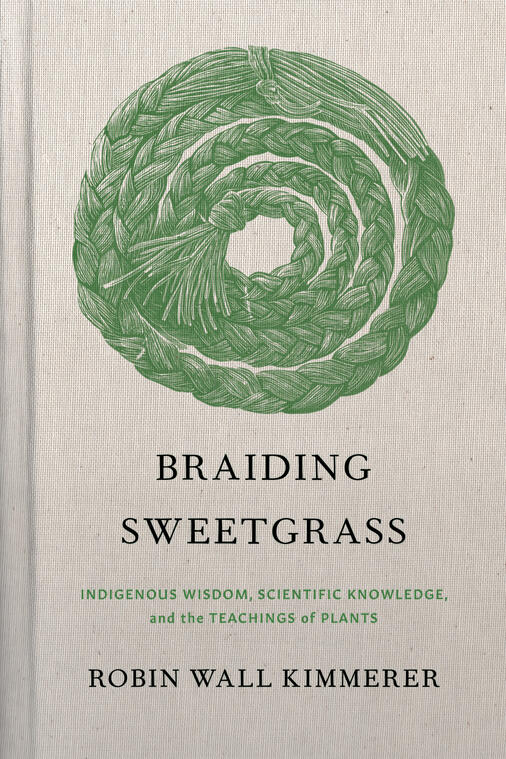
Drawing on her life as an indigenous scientist, a mother, and a  woman, Kimmerer shows how other living beings—asters and goldenrod,  strawberries and squash, salamanders, algae, and sweetgrass—offer us  gifts and lessons, even if we’ve forgotten how to hear their voices. In a  rich braid of reflections that range from the creation of Turtle Island  to the forces that threaten its flourishing today, she circles toward a  central argument: that the awakening of a wider ecological  consciousness requires the acknowledgment and celebration of our  reciprocal relationship with the rest of the living world. For only when  we can hear the languages of other beings will we be capable of  understanding the generosity of the earth, and learn to give our own gifts in return.

About the Author

Robin Wall Kimmerer is a mother, scientist, decorated professor, and enrolled member of the Citizen Potawatomi Nation. She is the author of Braiding Sweetgrass: Indigenous Wisdom, Scientific Knowledge and the Teachings of Plants, which has earned Kimmerer wide acclaim. Her first book, Gathering Moss: A Natural and Cultural History of Mosses, was awarded the John Burroughs Medal for outstanding nature writing. Kimmerer is a SUNY Distinguished Teaching Professor of Environmental Biology, and the founder and director of the Center for Native Peoples and the Environment,

Where to get it

Amazon US
Amazon CA
Amazon UK
Amazon AU
Milkweed.org

Related Videos


Related Podcasts

Interview on Wisconsin Public Radio

Related Threads

Braiding Sweetgrass book discussion
Robin Wall Kimmerer...scientist and proponant of traditional ecological knowledge

Related Articles

"Corn Tastes Better on the Honor System" by Robin Wall Kimmerer

Related Websites

Robin Wall Kimmerer's website
Braiding Sweetgrass discussion guide

1 week ago

Sam Shade wrote:I like my Nigerian Dwarfs quite a bit. . . Haven't really tried milking them but some friends told me it's kind of a pain.


That's been my experience as well. Short teats and too low to the ground to get a milking bucket under them. They don't produce a lot of milk either. But they do have the sweetest personalities which makes them very lovable.
1 week ago

Leora Laforge wrote:I have been crossing Cashmere goats with Boer goats for the last last couple years. . .


Leora, does your cross produce any fiber? (Thinking as a handspinner now)
1 week ago
I keep a small herd of Kinder goats. While Kinders aren't one of the best known breeds, they has a lot of wonderful homestead qualities. When someone new to goats asks about recommendations, I'm always quick to point these qualities out: mid-size goat well suited to smaller homesteads, dual purpose for both milk and meat, rich creamy milk, excellent feed to muscle conversion for solid weight gain, and fantastically friendly personalities. Advantages to their mid-size stature mean they eat less than standard goats yet are excellent producers. Also, they're tall enough to milk easily.

Their biggest disadvantage is that since they are less popular, they are sometimes difficult to find.

That's me, but I know other goatkeepers have different favorites. So my question is, if someone is thinking about getting goats, which breed would you recommend and why?
1 week ago