Permies likes critter care and the farmer likes looking for pics/video of winter chicken coops permies
  Search | Permies Wiki | Recent Topics
Register / Login


permies » forums » permaculture » critter care
Reply Bookmark "looking for pics/video of winter chicken coops" Watch "looking for pics/video of winter chicken coops" New topic
Author

looking for pics/video of winter chicken coops

paul wheaton
steward

Joined: Apr 01, 2005
Posts: 9446
Location: missoula, montana (zone 4)
I have footage from two different ways of housing chickens in the winter.  I would like to get a few more clips to put together a video.

If you shelter your chickens in a different way in the winter:  so you have warm season chicken shelter, and cold season chicken shelter, please give me some pics or, even better, video of your winter chicken shelter.

I especially like stuff that does something earth bermed, or is insulated (but well vented). 

I think some good points on a good winter shelter strategy is:

1)  if the chickens are warmer, they require less feed
2)  noticeable improvement in egg production
3)  water doesn't freeze
4)  probably lots of things I have not thought of

For more details about sending me video clips or pics, please see this thread.


thanks!


sign up for my daily-ish email
paul wheaton
steward

Joined: Apr 01, 2005
Posts: 9446
Location: missoula, montana (zone 4)
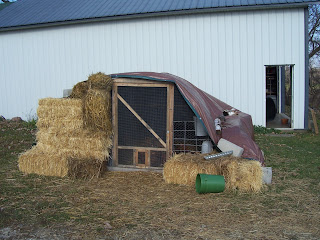
Two winter chicken coop designs. Both are designed to warm the chickens so that the chickens won't need as much food.

One is an earth berm design. The other is a portable design that is parked for the winter and surrounded by straw bales.


Erica Wisner
steward

Joined: Feb 10, 2009
Posts: 397
Location: Okanogan Highlands, Washington
Our chicken setup is fairly static, but the chickens use it differently in summer and winter.
If this would fit your idea, or if you want pictures of it for a conventional contrast, we're up for it.

It belongs to my in-laws, so I just help with barn chores occasionally.

Their main coop is insulated, they always have access to outdoors, and to the covered feed and 'play' areas. The outdoor area is something like an acre of fenced, small trees and stumps and brush. They make little trails through the trees near the house, and sometimes the far-away ones. Feed is a plain cracked grain, I believe it's corn, oyster shells, and all the bugs they can catch. We also bring them leftovers: pasta, veggies, stews, fatty scraps from meat. I have even been known to cook them some potato peelings since I learned that raw potatoes aren't good for them.

Here's how their situation changes with the seasons:

Summer: they hang out in the trees outside, and we unplug the water dish. At night, they still roost in the main coop, and they eat outside or from the undercover feeder area. I could take a picture of the trees full of chickens as the summer "coop" area. When it looks like it could plausibly be summer, which would be in a few months.

Winter: They get a warmed water dish in their indoor coop, fresh hay in their boxes (though many prefer the pole-roosts across the room), a single incandescent light bulb that stays on at night (I suppose something else would be better for their psyches, but they seem to do OK and it is a good infrared heat source), and we make a point to bring them table scraps from the same higher-energy food we eat, like bacon ends, stale biscuits, or leftover beef-barley stew. Ron says protein is key, it makes feathers as well as eggs. We feed the dinner scraps the next morning, so they don't go to sleep before eating it all and leave anything to attract nocturnal predators.
The brave ones go outside and the others follow if the snow is not too deep. They also spend a lot more time in the covered play area with fresh hay on the ground and a couple of boxes and branches for different levels.

The young ones started producing eggs this fall, and we were getting the new "baby" eggs well into November; now everybody is up to size, and we either have 15 laying hens and 10 lazy ones, or everybody is laying roughly every other day. This is not a place where non-laying hens have to worry about job security, so we don't make them punch time cards.

I suppose this isn't a super-efficient way to produce eggs, but it seems to be a reasonable way to make a bunch of chickens feel like coming back every time one jumps the fence.
The animals around here are more pets than people. We use the poopy hay in our compost mixes, it is easier to handle than the straight poop.

-Erica


Play with nature, make nifty stuff:

Ernie and Erica's DIY Ecology
http://www.ErnieAndErica.info
Devon Olsen


Joined: Nov 28, 2011
Posts: 226
paul wheaton wrote:Two winter chicken coop designs. Both are designed to warm the chickens so that the chickens won't need as much food.

One is an earth berm design. The other is a portable design that is parked for the winter and surrounded by straw bales.


i like the idea of the sepp inspired one
cheap and very simple to construct and uses the earth to keep things warm
my only concern is the lack of height for them to roost and in a situation when you may not have trees that are of significant size yet it may be a great place for predators... anyone have any idea on how this could be solved

not trying to thread jack by any means i would support doing the sepp inspired ones myself, particularly if you have yourself some sort of solution to the predator issue

good luck with your chicken coop ideas OP


My Small Permaculture Farm
http://www.permies.com/t/13512/permaculture/OFFICIAL-permaculture-farm-journey-thread#122569
kent smith


Joined: Sep 05, 2010
Posts: 169
Location: Pennsylvania
I just move our portable chicken house / tractor into the end of the barn for the winter and give the hens a small yard to scratch in outside.
kent


Kent
letsbuildadream.blogspot.com
Jackson Barnett


Joined: Apr 21, 2011
Posts: 34
Location: Foothills of SW Maine - Zone 5a
What great design on that built coop... Gonna steal some ideas, no doubt.
You could build some mighty fine hugelkultur beds with that bird wagon...

Be Well and Happy... It's more fun!
Jackson
tel jetson
steward

Joined: May 17, 2007
Posts: 1683
Location: woodland, washington
insulating is well and good, but do give some thought to ventilation. without a substantial amount of air exchange, chicken shit and dander and dust will cause respiratory damage and illness, even if it isn't immediately obvious. this is true even if there's plenty of carbon and/or deep bedding in the coop. something to think about.

there are also plenty of folks who think getting cold is good for the birds. I'm not really sure what the reasoning is there. my own strategy is to keep drafts to a minimum, but not worry about insulation. doesn't get terribly cold here, though.


find religion! church
kiva! hyvä! iloinen! pikkumaatila
get stung! beehives
Clifford Reinke


Joined: Nov 26, 2010
Posts: 60
Location: Puget Sound


My coop is an open air design I modified from a 1919 book on chicken coops. This type of coop was used as far north as Alberta Canada with -20 degree weather. Chickens have nice down coats, and do not mind the cold. The large front windows are covered in 1/4 inch hardware cloth. I have a trap door that leads to the "daylight basement/dusting area". I lock them in every night because we have weasel problems. I use a four paddock system with the solar powered, 160 foot, electric poultry netting which I move once a week. There is no artificial light in the hen house (although I may add solar powered lights later). Food consumption does rise with colder weather, and if it freezes I change out the water more frequently so it does not ice over.

I replace the straw under the roost every week with the straw from the nesting boxes and the front of the coop. New straw is placed in the nesting boxes and the front of the coop. I use the pooped on straw as mulch around my fruit trees. My compost pile is on the border between two of my paddocks. So two weeks out of four, the chickens get to turn my compost pile for me eating bugs and worms. The other two weeks allow the bugs and worms to recover. The compost pile is on a slope, so we throw the new stuff on the top of the hill and shovel the good stuff from the bottom of the hill.

I have 13 Barred Rock chickens, two roosters and 11 hens. I'm averaging 9 eggs a day, even though it is winter. My chickens seem very happy and healthy, the coop does not smell bad, stays dry, takes five minutes to clean once a week. I think for me, I've finally found the right combination.


Cliff (Start a rEVOLution, grow a garden)
Raven Sutherland


Joined: Nov 09, 2010
Posts: 116
Location: Massachusetts
noticed: no natural light provided in the wood chicken house
a radical difference seen on the next photo showing
much incorporated glass....

even horses need some light (lightbulbs) in a barn
i would think chickens need some too.


Digging around on a piece of ground in my home town
waiting for someone or something to show me the way.
wayne boardman


Joined: Jan 08, 2012
Posts: 2
Location: Southern Maine
I built a chicken tractor/ark that I move each night across my lawn as long as the grass is green. Then for the winter, I park it on a raised bed with the same footprint on the southeast side of my house where it's protected from the prevailing west wind. This photo is from January of 2011 because this winter we've had practically no snow. The coop is designed to keep the weather off them, but has plenty of ventilation, and I use no supplemental heat in the winter (zone 6a).


I used plans from CatawbaCoops.com, and you can see some of my modifications at http://catawbacoops.com/the-catawba-converticoop-chicken-coop-image-gallery.html. With 7 hens, I decided to add a pen extension of about 4' x 6' (shown below). The coop itself has a footprint of about 4' x 8'. There is a ramp inside that I pull up every night for safety sake. I keep several bags of chopped leaves and grass that I spread on the ground under the coop and never let it get packed down. When I moved them off the raised bed last spring, I covered the bed in a couple of inches of compost and planted squash and tomatoes. It produced an abundant harvest.

Three of the hens are Red Star and four are Easter Eggers. I ran a string of LED rope lights inside the upper roosting area and have it on a timer to give 14 hours of light during the darkest months. If we're around before sunset, we sometimes let them free range for an hour or two.

The seven hens seem very happy, giving us 5-6 eggs through most of the year and probably 4-5 eggs all winter. They will be 2 years old this spring.

wayne boardman


Joined: Jan 08, 2012
Posts: 2
Location: Southern Maine
By the way, is there some corollary to Murphy's Law that says when you let the chickens out to roam for an hour, that they immediately go scratch out the mulch around the blueberry plants and other shrubs that you really want to stay mulched? I've tried to discourage this behavior by placing branches and evergreen boughs around the plants during the winter months, but that only makes the birds more determined to dig it all out. Oh well...
paul sanass


Joined: Mar 18, 2012
Posts: 9
some of these designs look great
 
 
subject: looking for pics/video of winter chicken coops
 
Threads others viewed
Chicken coop insulation?
submitting stuff to me for use in a video
Earth-sheltered chicken coop
deep bedding for chickens in winter
upcoming videos
cast iron skillet 49er

more from paul wheaton's glorious empire of web junk: cast iron skillet diatomaceous earth rocket stove sepp holzer raised garden beds raising chickens lawn care light bulbs flea control missoula electric heaters permaculture videos permaculture books