

|

|
|
|
|

|
.png)
|

|

|

|
 8
8


"Although the world is full of suffering, it is full also of the overcoming of it." - Helen Keller
--
Jeremiah Bailey
Central Indiana
Seed the Mind, Harvest Ideas.
http://farmwhisperer.com
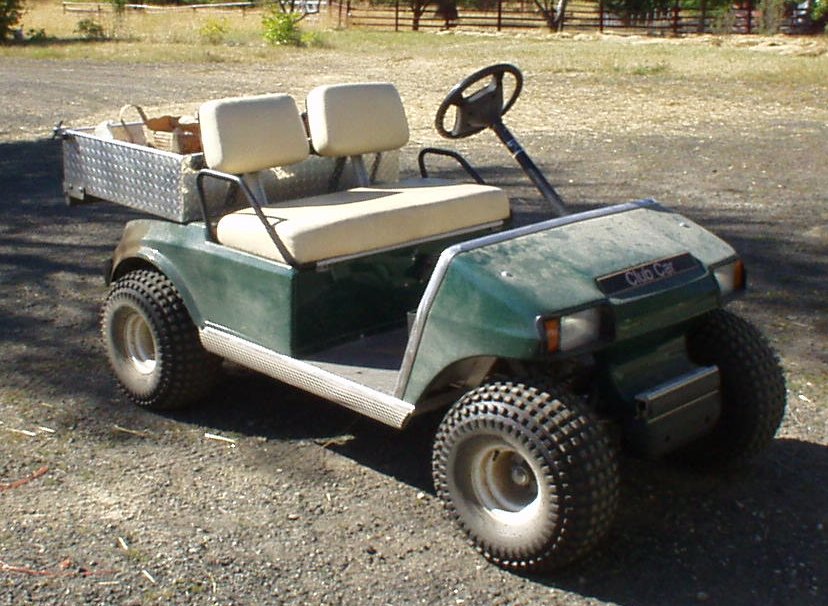
If you do a Youtube search for John Howe Solar Golf Cart
 2
2
Seed the Mind, Harvest Ideas.
http://farmwhisperer.com
1
3
Seed the Mind, Harvest Ideas.
http://farmwhisperer.com
1
Seed the Mind, Harvest Ideas.
http://farmwhisperer.com
2
Standard tractors usually fill the big tires with a liquid that gives the tractor more weight.
find religion! church
kiva! hyvä! iloinen! pikkumaatila
get stung! beehives
be hospitable! host-a-hive
be antisocial! facespace
3
tel jetson wrote:
I'm no electrical engineer, so forgive me if this is a dumb question, but could the charger (plugs into 120-volt AC) be modified to flow the other direction as an inverter? using an electric chainsaw today would have saved me a pair of pants (don't ask).
2
Walk wrote:
Nice analogy!
[font=Verdana]Thanks![/font]
Inverters, though, are often built with on-board chargers. The Tripp-Lite APS 3636VR on our Elec-Trak E-15 tractor can charge the tractor's batteries at 20 amps OR it can run two AC circuits at 15 amps each. That translates to two electric chainsaws running at the same time, full power. Not that I'd need it but it's nice to have some reserve capacity to ensure durability. The biggest downside is modified sine-wave output instead of true sine-wave. The cheaper option was over $700. As bad as that was, the sine wave option is REALLY pricey!
Bob.
1
2
Walk wrote:
We use an electric tractor made by G.E. back in the early '70s. We bought it for $100 but it had been abused with overfilled batteries, corrosion from that, and miswired relays. It's a 36-volt model running on GC-2 golf cart batteries and it charges from our home's PV panels. We added a bit more weight (70 lbs.) by bolting on a 36-volt inverter to run an electric chain saw. Mostly we use it for cutting the 1 cord of boxelder firewood that we use in a year and to mow some trails and orchard. It has a 42-inch mower, a grading blade, a 1-bottom plow, tire chains, and a 30-inch rotary tiller. The tiller is nice for cutting up a green manure crop after mowing it, but I'd never think about tilling on bare ground since a shovel or fork works so much better without over-fluffing the soil. You can see the tractor by clicking on our web page at http://www.geopathfinder.com/9659 , or there are more details found on links at that page.
Bob Dahse
Mangudai wrote:
One human on a bicycle can sustain 300W of power output all day long.
1
paul wheaton wrote:
??
I remember in high school a guy had rigged a 60 watt light bulb up to an exercise bike. I remember that to get the light to glow even a slightly reasonable amount, you had to REALLY pump on that thing!
Is there a video showing a bike and a bunch of bright light bulbs perhaps?
find religion! church
kiva! hyvä! iloinen! pikkumaatila
get stung! beehives
be hospitable! host-a-hive
be antisocial! facespace
2
1
Mangudai wrote:
One human on a bicycle can sustain 300W of power output all day long.
5
brice Moss wrote:
so over 12 hours the power output would be 3600w/h which converts to 3095Cal thats output now assuming that we convert food to output at about 33% efficiency which I am sure is overgenerous the man doing this would need a 10,000 calorie a day diet
just playing with the math
find religion! church
kiva! hyvä! iloinen! pikkumaatila
get stung! beehives
be hospitable! host-a-hive
be antisocial! facespace
2
Walk wrote:this figure includes all of the high-frequency transistor switching noise that motors and transformers simply convert into heat and vibration ("hum").
"the qualities of these bacteria, like the heat of the sun, electricity, or the qualities of metals, are part of the storehouse of knowledge of all men. They are manifestations of the laws of nature, free to all men and reserved exclusively to none." SCOTUS, Funk Bros. Seed Co. v. Kale Inoculant Co.
1
1
jmy wrote:
Not to rain on your parade , but the electric tractor .. like a lot of myths on the Internet is a non starter if one thinks it is going to replace any existing fossil fuel tractor.
I have 3 EV's and in my opinion the watts are just not there to rip, plow , disc, cultivate or any other job that a regular tractor does.
2
paul wheaton wrote:
I think it is probably easy to create an electric tractor that sucks. And, my impression so far, is that it is almost as easy to create an electric tractor that kicks butt on gas or diesel tractors.
If that is not the case, I would really like to understand why/how.
1
Click on play and then as soon as the video starts to play, click pause. The video will carry on loading (slowly) but not playing. Open another browser and carry on surfing the internet. Check back periodically to see if the video has loaded. When it has, you will be able to watch the video without any problems.Ken Peavey wrote:
My connection speed is way too slow to watch videos.
www.thehappypermaculturalist.wordpress.com
3
"When there is no life in the soil it is just dirt."
"MagicDave"
1
 I like the design of this tractor because it is much like an old VW Bug. The weight is over the drive wheels. Because of the demand it is nearly impossible to get high amp hour 96 volt Lithium Iron Phosphate batteries though. I would love nothing better than using a photovoltaic array as a roof so I could just go out and run the tractor driving "in the shade." LOL
"When there is no life in the soil it is just dirt."
"MagicDave"

|
Get meta with me! What pursues us is our own obsessions! But not this tiny ad:
Come Visit Wheaton Labs!
https://permies.com/wiki/367505/Visit-Wheaton-Labs
|


