

|
Author
|
care of food grade wood stuff | (Read 3746 times) |
|
|
|
Marilyn Queiroz
Administrator
Posts: 59
|
 |
June 07, 2007, 02:01:37 AM |
|
I read a study one time on wood cutting board vs other types (plastic, for example). People thought the plastic would be easier to keep clean, and thus, safer. But it turned out that the wood cutting board actually tested out to have less bacteria. It appeared as though the wood had some sort of "antibiotic" properties. I wonder if coating the wood with oil, wax, etc. might diminish that property.
|
|
|
|
|
Logged
|
|
|
|
pennielinkpc
convergence
Posts: 276
|
 |
June 11, 2007, 02:05:10 AM |
|
Hadn't thought much about rancidifying oils on woodenware, quite frankly, though I did opt out of mineral oil years ago upon realizing what it is. Now that I'm reading this, food oil certainly seems worth considering. Just for the record, I have used olive oil all along, though a thin coat as infrequently as possible (once a year or so?), We are 2 adults and 2 kids (now 15 and 13) and we get light colds about twice a year.
|
|
|
|
|
Logged
|
|
|
|
ktobscure
Posts: 1
|
 |
August 08, 2007, 06:37:02 PM |
|
I've talked to someone who recommended dipping food grade wood in molten beeswax as a solution. From personal experience any time you're dipping anything into molten wax of any kind you should: a; use a double boiler, b; have a fire extinguisher on hand, c; not walk away from any part of the process. Newsprint works to lay the dipped product down on, and you can then use it as a fire starter as most wax is flammable. Stearic acid can be used to raise the melting point of many waxes, but it can also raise the melting point to too near the flash point for comfort (said college age friend luckily had time to clean the most visible surfaces in the kitchen before his folks got home).
|
|
|
|
|
Logged
|
|
|
|
jenn
Posts: 56
|
 |
April 26, 2009, 09:00:05 AM |
|
I set a child down with all the wooden utensils once or twice a year and a bottle of olive oil and have her massage it into all of them (and her hands) while watching TV. Most of my utensils are olive wood.
I mix beeswax and olive oil to polish our unfinished (or no longer finished) wood. Doesn't hold up so well on a boat on salt water (just the trim, all above water line!) but holds up for months indoors.
To mix in solids you need them at same temp as all ingredients so I heat olive oil and beeswax in two separate metal bowls in same pan water then mix them to get my pasty at 70F beeswax/olive oil combo. DO NOT TRY WITH LINSEED OIL I presume. I have put beeswax shavings into linseed and other oil and all you have is shavings floating in the liquid which do not get into wood until melted by your fingers trying to rub the gook in.
|
|
|
|
|
Logged
|
|
|
|
paul wheaton
Administrator
Posts: 5600
missoula, montana
|
 |
April 28, 2009, 11:33:38 AM |
|
Wouldn't olive oil turn rancid?
|
|
|
|
|
Logged
|
|
|
|
paul wheaton
Administrator
Posts: 5600
missoula, montana
|
 |
May 24, 2009, 05:12:35 PM |
|
Wouldn't olive oil turn rancid?
To rephrase. I'm pretty sure olive oil will turn rancid, so it probably shouldn't be used.
|
|
|
|
|
Logged
|
|
|
|
|
|
Jocelyn Campbell
Administrator
Posts: 521
Western WA
|
 |
May 26, 2009, 02:48:53 PM |
|
Olive oil - I buy in bulk and keep most of it in the fridge. I keep a small amount in a bottle by the stove which I use up quickly so it doesn't go rancid. Surprising how many people don't know olive oil can go rancid. That goes for whole grains, too--especially brown rice.
Paul certainly does his research. Currently, I use the free, cheap, no oil version. Though one of these days I will try the walnut oil idea.
|
|
|
|
|
Logged
|
|
|
|
|
|
elenafea
Posts: 9
|
 |
June 22, 2009, 09:33:37 PM |
|
I've put my wooden spoons and slotted wooden spatulas thru the dishwasher for years. None of them have cracked. I use 7th Generation liquid auto dish detergent. Am I lucky or ignorant or both? I have a few chips and some burn marks but no cracks. I love wood cooking utensils. So what do you do to keep your wood utensils clean besides oiling them with walnut oil - handwash them? ?
|
|
|
|
|
Logged
|
|
|
|
paul wheaton
Administrator
Posts: 5600
missoula, montana
|
 |
June 29, 2009, 12:42:27 PM |
|
I wash them by hand and try to minimize the time they are exposed to water.
Wow - a dishwasher ... Do you use the drying cycle? Do you oil your wood?
I would think that the super hot water would really pull the oils out of the wood.
So .... I'm surprised you are not having problems. The water in your washer does get super hot, right?
|
|
|
|
|
Logged
|
|
|
|
elenafea
Posts: 9
|
 |
June 29, 2009, 06:31:17 PM |
|
I assume the water is really hot and I use the dry cycle and I have never oiled the wood. Maybe they are made of really good wood. maybe it's because the auto dish detergent is 7th generation. maybe it's because my wooden utensils know I love them. 
I do not even remember where they came from I have had them so long.
But I will start oiling them now. What Walnut oil do you use ( brand)?
|
|
|
|
|
Logged
|
|
|
|
paul wheaton
Administrator
Posts: 5600
missoula, montana
|
 |
June 30, 2009, 03:25:33 PM |
|
I have used two different brands so far. As long as it is organic, I'm not worried about brand.
|
|
|
|
|
Logged
|
|
|
|
elenafea
Posts: 9
|
 |
June 30, 2009, 09:08:13 PM |
|
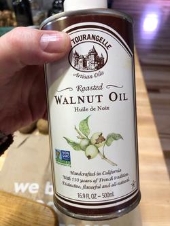
thanks for the info and down the road a ways I'll let you know how it works out- I saw some walnut oil today in Publix but it said made from roasted walnuts and I was not sure whether that is what I should be getting...
|
|
|
|
|
Logged
|
|
|
|
|
|
Joel Hollingsworth
Posts: 1623
zone 10: Oakland, CA
|
 |
January 07, 2010, 01:04:38 AM |
|
I use walnuts, in the style of an oil pastel. They squish and grind to a pulp as they're rubbed against the wood, more so the rougher the wood is.
Rancidification is the same thing as curing. It smells the way it does because the linseed or walnut or tung or clove etc. oil is going through chemical changes that make it a solid, insoluble polymer. The whole point of adding walnut oil is that it will quickly "dry" (aka "cure", aka "go rancid"), leaving an inert, non-toxic coating.
Any odor was gone long before I noticed it. It is potentially a problem for a good friend of mine with life-threatening nut allergies, but I don't serve her food that's touched wood.
|
|
|
|
|
Logged
|
"the qualities of these bacteria, like the heat of the sun, electricity, or the qualities of metals, are part of the storehouse of knowledge of all men. They are manifestations of the laws of nature, free to all men and reserved exclusively to none." SCOTUS, Funk Bros. Seed Co. v. Kale Inoculant Co.
|
|
|
elenafea
Posts: 9
|
 |
January 07, 2010, 06:48:56 AM |
|
Thanks! Now I know the point, and I have walnuts, so I'll give it a go! The spoon/cutting board has to be "cured" before it is used?
|
|
|
|
|
Logged
|
|
|
|
Joel Hollingsworth
Posts: 1623
zone 10: Oakland, CA
|
 |
January 07, 2010, 11:32:03 AM |
|
It cures over the course of about a week. Last time, about a year ago, if I had to wash something before it seemed fully cured (i.e., there was noticeable liquid oil), I sometimes put another light coat of oil on right after it dried.
|
|
|
|
|
Logged
|
"the qualities of these bacteria, like the heat of the sun, electricity, or the qualities of metals, are part of the storehouse of knowledge of all men. They are manifestations of the laws of nature, free to all men and reserved exclusively to none." SCOTUS, Funk Bros. Seed Co. v. Kale Inoculant Co.
|
|
|
paul wheaton
Administrator
Posts: 5600
missoula, montana
|
 |
January 11, 2010, 04:32:17 PM |
|
Joel,
You're going in a direction that is warping my brain.
Polymerizing oil is the same as oil turning rancid?
I know that this is what you just said .... and I could see it being true ... I guess I am riddled with doubt and am hoping that you will say magic words to help me understand it better.
|
|
|
|
|
Logged
|
|
|
|
Joel Hollingsworth
Posts: 1623
zone 10: Oakland, CA
|
 |
January 12, 2010, 07:25:00 PM |
|
Quite often, especially in the case of biological substances, polymerisation releases something as it occurs. Silicone caulk releases acetic acid as it cures (hence the vinegary smell), and your ribosomes release water as they string amino acids together into strands of protein.
In the case of drying oils (linseed oil is a good example, but raw, expeller-pressed canola is a "semi-drying" oil...more on that later), omega-3 fatty acids react with one another to become a solid mass of linoleum, or a priceless artistic masterpiece, or a disgusting skin on your bottle of oil. And the reaction overall releases a range of strong-smelling chemicals, depending on what sorts of fatty acid, and which of several reactions each one participated in.
In a bottle of oil, these chemicals build up, and the smell becomes unpleasant. Even if it's open to air, the reaction takes a while, because there's such a great depth of oil. The half-polymerized oil might not be very good for you (although conjugated linoleic acid can be good for you, so like everything else, it's complicated). Food processors strip the omega-3s out of any oil they sell ("deodorized" canola), or choose species that don't produce much, to prevent this from happening.
In a painting or an oiled piece of wood, the oil coats every fiber or speck of pigment, and has a very large surface area, so the reaction happens quickly. Thick impasto on some paintings takes decades to cure through its depth, but with a thin coat, the reaction is done and the smell has dissipated after a reasonably short time.
|
|
|
|
« Last Edit: January 12, 2010, 07:33:56 PM by Joel Hollingsworth »
|
Logged
|
"the qualities of these bacteria, like the heat of the sun, electricity, or the qualities of metals, are part of the storehouse of knowledge of all men. They are manifestations of the laws of nature, free to all men and reserved exclusively to none." SCOTUS, Funk Bros. Seed Co. v. Kale Inoculant Co.
|
|
|
elenafea
Posts: 9
|
 |
January 12, 2010, 09:43:27 PM |
|
Joel,
I never would have known this. Thank you for taking the time , here, to explain it!
So, if you use the the walnut itself, all the reactions take place on the surface of the wood instead of in the bottle of oil?
Elenafea
|
|
|
|
|
Logged
|
|
|
|
Joel Hollingsworth
Posts: 1623
zone 10: Oakland, CA
|
 |
January 12, 2010, 10:43:46 PM |
|
Some of these reactions start as the walnut is forming on the tree. They're slow, but are part of the reason good walnuts are expensive: they have a short shelf life. A living nut, though, with the shell intact, will last pretty well, maybe better than a hulled nut packed in a plastic bag filled with nitrogen.
Stale walnuts, that have begun to taste rancid, will be roughly equivalent to old-fashioned boiled linseed oil. A bottle of oil that has begun to turn would also be perfectly appropriate for wood care, perhaps slightly more so than a fresh one.
The main reason I use whole nuts is that they come in a convenient, single-use package. 
Oh, and you're very welcome. Explaining things is one of my favorite activities, some say too much so...
Speaking of which:
Modern-day "boiled" linseed oil isn't boiled at all, it just has some metal catalyst particles mixed in. These make the reaction happen faster. I think black iron oxide is the catalyst they use most often, but most oxides work. This is another aspect of oil-based paint: that thick impasto wouldn't cure even as quickly as it does, without the action of pigments on the oil.
Another common strategy food packagers use against rancidity is to mix in disodium EDTA. EDTA is also used in chelation therapy, for the same reason: it binds to metal ions, and tends to be more fond of the more-toxic ions. It is the antidote to metal catalysts, in other words: mixed into "boiled" linseed oil, it becomes ferric EDTA or ferrous EDTA, and the catalyst particle is isolated from the oil.
|
|
|
|
« Last Edit: January 12, 2010, 10:57:07 PM by Joel Hollingsworth »
|
Logged
|
"the qualities of these bacteria, like the heat of the sun, electricity, or the qualities of metals, are part of the storehouse of knowledge of all men. They are manifestations of the laws of nature, free to all men and reserved exclusively to none." SCOTUS, Funk Bros. Seed Co. v. Kale Inoculant Co.
|
|
|
elenafea
Posts: 9
|
 |
January 13, 2010, 07:28:40 PM |
|
having fun this week with walnuts on wood cutting boards and utensils, will report results in a week ..I get walnuts in the shell in the fall when the new crop shows up around Thanksgiving- I find they last a month or more. Have wondered if putting them in the freezer in a sealed container would help preserve them? About nitrogen packed walnuts- or nitrogen packed anything- I was told years ago nitrogen packing destroys enzymes. In your understanding, is this true?
Sorry to get way off topic here, but when you mentioned EDTA, I wondered if you have any thoughts on powdered zeolite. We have jet & auto fall out in the Tampa Bay area and a friend recently had her dogs tested for heavy metals - the tests came back "off the charts." It actually had not occurred to me before, but our pets- cats esp ecially hang out under cars walk on the ground and in cleaning ingest probably more than people do of environmental heavy metals. I started giving my own brood powdered zeolite because I really couldn't find anything anywhere that would suggest not doing this.
Sorry Paul, I know this is way off topic, but just had to ask Joel if he has any thoughts on zeolite while I can...
|
|
|
|
|
Logged
|
|
|
|
Joel Hollingsworth
Posts: 1623
zone 10: Oakland, CA
|
 |
January 14, 2010, 01:13:16 PM |
|
Freezing definitely helps walnuts stay fresh, in my experience. Everything happens slower in the cold. And a good seal helps, but that's mostly an odor thing: walnuts are oily enough that the dryness doesn't seem to harm them.
Nitrogen shouldn't destroy the enzymes at all. It's used because it is so inert. I could imagine slightly fewer enzymes in food that's been stored for an extremely long time, and that long storage was made possible by packing in nitrogen...but anything that might keep for so long will be dormant, such as an un-sprouted seed, and those sorts of food aren't a great source of enzymes to begin with. But they make enzymes very vigorously if brought out of dormancy.
I tend to trust my own glands and gut flora to produce enough enzymes in most cases, and fermentation cultures in almost every other case. Or maybe you mean something different by the word "enzyme," in which case what I've said might not apply.
I mostly encounter zeolites in an entirely different context, and don't have much of an opinion about internal use to treat heavy metal exposure. I'd be careful about breathing them in.
Sadly, few other mammals live as long as we do, so some of the problems we develop from heavy metal exposure might not have time to develop in pets. I think making sure there's enough calcium in their diet would help a lot, whatever other measures you take.
|
|
|
|
|
Logged
|
"the qualities of these bacteria, like the heat of the sun, electricity, or the qualities of metals, are part of the storehouse of knowledge of all men. They are manifestations of the laws of nature, free to all men and reserved exclusively to none." SCOTUS, Funk Bros. Seed Co. v. Kale Inoculant Co.
|
|
|
garyd
Posts: 26
|
 |
August 16, 2010, 04:40:25 PM |
|
I just got an old used butcher block with legs. Do I need to sand the top and then cure it with walnut oil or will just cleaning it with soap and water really good them disinfecting it with a diluted clorox solution be enough before oiling it? The top is smooth with no cut marks.
|
|
|
|
|
Logged
|
|
|
|
Joel Hollingsworth
Posts: 1623
zone 10: Oakland, CA
|
 |
August 17, 2010, 01:30:57 PM |
|
I'd disinfect some way other than chlorine bleach. Strong oxidizers are bad for wood, and chlorine sometimes reacts to form scary long-lived toxins.
Maybe steaming it with a clothes iron, if you're really worried. Lemon juice is not a bad disinfectant, either.
|
|
|
|
|
Logged
|
"the qualities of these bacteria, like the heat of the sun, electricity, or the qualities of metals, are part of the storehouse of knowledge of all men. They are manifestations of the laws of nature, free to all men and reserved exclusively to none." SCOTUS, Funk Bros. Seed Co. v. Kale Inoculant Co.
|
|
|
 articles by paul wheaton: [diatomaceous earth] [raising chickens] [lawn care] [Sepp Holzer] [flea control]
|