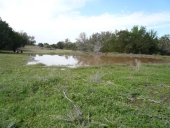

I bought some property with a dry pond. We had a good rain and it filled up but two days later it was dry again. I had heard about using pigs to seal the pond. Has anyone tried this and if so did it work? Any thoughts on this matter would be greatly appreciated. Thanks
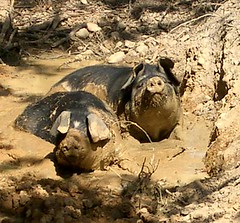
There's something about the shape of a pig's hoof that makes such a great pond seal. Plus, with a little damp once in a while, pigs will really pack the clay!
Lots of farmers don't want to put pigs on pasture because the water will then run off of the pasture instead of getting soaked in.
Sepp Holzer (permaculture god) talks about pigs creating a seal, but he doesn't use them to seal his many ponds. He uses a track hoe to jiggle the dirt and press it down.
I know that I had a lots of sandy soil with some clay. The water didn't puddle much - until I put in pigs. Then there were some small puddles that would hold water for weeks of sunshine!
I do know that I've read that this is something that farmers used to do, but I haven't heard of any specific success stories.
How big is the pond?
I think it would be good to throw a bunch of food on the ground around the pond in different places for the pigs over a period of six months or so.
The pond has a circumfrence of 40-50 foot its about 10 feet deep at center and the ground soil is lots of rock and red clay dirt. The pond Im guessing was dug 5- 10 years ago as there is one tree growing in the middle of it about 2 inches in outer diameter and a bunch of grass and small shrubs. Im guessing it may have never held water for more than a day or two.
I've always found it really hard to get a sqeeling, wiggling pig into a small hole and harder still to make one stay there once inserted. Pond liners as simple as plastic sheeting or more expensive rubber liners work better. A good layer of clay might work too.
Logged
John Meshna (owner) DIRT WORKS 1195 Dog Team Road New Haven, Vt 05472 Ph: 1.802.385.1064
Whenever possible I would recommend avoiding pond liners for two reasons. 1. Pond liners all eventually leak and must be drained, diagnosed, and repaired. 2. Someday pond liners won't be available (neither will the repair goop) so we might want to get used to clay-lined ponds.
I like the pig idea too. The theory here relates not just to the pig's nifty hooves, but also the fact that those pigs will be crapping as well. This can become sort of an anaerobic soup called 'gley' that is then compressed by the pig's hooves. That is how pigs were used successfully (I believe in Scotland originally) to make ponds. Check out someone else with gley experience at http://resources.alibaba.com/topic/41782/How_to_create_a_pond_with_gley.htm.
An alternative would be to get a few yards of clay brought in and mush it around with some heavy equipment to smooth it out in a layer (maybe a bulldozer/compactor combo). You could even combo this with the pig method and see what happens.
Another option that may be a bit pricier, but seemingly effective is offered by a company called Seepage Control (http://www.seepagecontrol.com/). They have a soy-based liner product that can be applied while the pond is empty or after it is full. Check out their site for more details.
If all that fails, I'd say go for the liner. From the sound of it you're probably looking at around $1600 worth of EPDM. Having water in copious quantities is, in my opinion, a really, really good thing.
Anyway, that's my two cents. We put in a liner pond last year and will probably do it again this year (all we have to work with is glacial till and bedrock). I say the more the merrier!
I've seen this method spelled as "glie" - maybe that will help the googlers.
I heard that it was a popular russian technique. Usually filling a pond bowl with cow manure or hay. Sometimes several feet deep, then channeling in such a large volume of water that the organic matter must stay submerged (I would guess this would be through fall, winter and spring).
I once saw a home where the septic drain field was buried five feet deep (instead of the recommended 18 inches). The owner also had a drain field drain into a gully (illegal). I suspect that what happened is a glie layer formed and the septic system backed up. So the owner added the illegal drain.
The (legal) depth of 18 inches facilitates aerobic breakdown.
.... as for squealing, wiggling pigs ... pigs respect a single wire of electric fence .... a lot ...
.... as for the pig manure .... mmmmmmmaybe. When pigs are given enough space, they usually keep all of their manure in one spot.
Dave,
Any chance of a glie project at bullock brothers farm?
It's worth using pigs if you've enough land around the pond to keep them healthy and happy and pigs are very easy to keep and eat almost anything.
We dug a pond for ours which at first was a mud bath which dried out quickly. We were lucky in that the earth in and around the pond had a lot of clay in it.
A few weeks later it was holding more and more water.
Now finally it seems to have stopped leaking.
« Last Edit: June 15, 2010, 02:32:13 AM by Irene Kightley »
Logged
Our permaculture off-grid, housebuilding and smallholding BLOG
I've heard of folks sealing a pond by running pigs in it.
I would like to find an example of a pond that did not hold water, and then pigs are run in it, and then the pond did hold water. When you first dug the pond, did it hold water?
It was a good puddle after heavy rain and the pigs quickly moved in for a wallow. The water drained away within a few days and this was repeated over a few months after each rainfall - aided by water from the adjoining roof which we now use for gardening or refilling the pond if it ever needs it. We haven't needed to use the roof water since last summer.
We've five parks we use for pigs and this pond was left to its own devices for about five months after the pigs had spent a summer wallowing in it.
Logged
Our permaculture off-grid, housebuilding and smallholding BLOG
So .... just to make sure I'm not being silly I want to run this back by you as a rather direct question ....
So .... you dug a hole in the ground and when it would rain, there would be a puddle. But the puddle would drain away within a few days. And then you ran pigs in there. Now, when it rains, the water appears to not drain away. It would seem that running pigs in there has sealed the pond?
Kids and consenting adults with wellies do a good job too if it's done regularly and there's a thick enough layer of clay !
In Scotland we call it "puddling" a pond and traditionally sheep were used to do the job - but pigs are faster because they're heavier and use their whole body to slide over the clay.
Once the pigs have gone, it doesn't take long before the plants, amphibians and insects take up home.
Logged
Our permaculture off-grid, housebuilding and smallholding BLOG
This is such fantastic news, I shared it at another forum where there were two more comments along the same lines:
Quote
My parents dug a pond, it leaked from the start, we tried several things when I still lived at home, but none worked. After I left home, they ran pigs in it, just fenced it in with electric fence. The pigs when in there a couple of years, the pond started holding the next spring, and has held to this day. Pigs have been gone four years now.
It is pretty common practice around here if a pond will not hold. I don't know if it not working.
Quote
Quite a few years ago we built a pond that did not seal. We fenced it in and ran hogs for three years at the suggestion of my Uncle. The third year one of the piglets drowned in the pond. We moved the hogs. That pond is still holding water. I know of several other ponds done the same way. As seagullplayer says, pretty common practice around here.
The mighty .... the glorious .... the amazing .... Sepp Holzer ...
Sharing with us the techniques for sealing a pond without the use of a pond liner. Further, he has built hundreds of ponds without liners - some of them in very sandy soil, with no added clay!
i'd try the pig, and remove the tree, dump some clay over the stump area when the tree is removed, and pack it down really well..
you might be able to bring in more clay as well..the pond is small enough that a couple of truckloads of clay spread out around the top and then trampled down well should seal it pretty good
On page 131 of the Rebel Farmer, Sepp Holzer describes his system of vibrating the bottom of the pond as it is filling up to seal it "naturally."
With about a foot of water in the pond, he has an excavator with a narrow bucket to take as deep a bite as possible under the water (18-36" deep) and shake the soil much as you would shake up a jar of water and sediment so that the particles separate causing a layer of clay and fine particles to form at the bottom.
My understanding is that pigs and to a lesser extent, other livestock, actually do a similar function in muddy places.
It seems to me that the poor of money could do a similar thing with a long tile shovel like they used to use to lay down field drainage tiles.
I have heard this story from a guy who ran a lawnmower repair. I had heard this before, but did not provoke him to talk about it, we were just talking about goats and animals and eventually the conversation turned to pigs. He said that the pigs also actually ate out the willow roots that were coming into their pond and they cut down the willows and then yes the unsealed pond became sealed.
It should also be noted that, if trucking in clay wouldn't be economical, but there is some clay component to the local soil, Sepp recommends wet agitation followed by skimming to remove coarse materials that have risen to the top, and addition of more local soil.
That is to say, it's a tradeoff between finding a local pure source, and refining the material in place. If you have a local use for the sand/gravel, that might also figure in.
Logged
"the qualities of these bacteria, like the heat of the sun, electricity, or the qualities of metals, are part of the storehouse of knowledge of all men. They are manifestations of the laws of nature, free to all men and reserved exclusively to none." SCOTUS, Funk Bros. Seed Co. v. Kale Inoculant Co.
Looking up permaculture on you tube i found a video of a man getting his two children to do what the pigs are doing here, i did not then understand what he was up to. Though there seems to be more information glei in some ways and in others less on this thread here, still i think chelle should be credited with beiing the first to inform on gley. I looked up farm ponds or some such in google and found an article that mentioned that in medieval farms there was a pond in each feild. rose
I've seen this method spelled as "glie" - maybe that will help the googlers.
I heard that it was a popular russian technique. Usually filling a pond bowl with cow manure or hay. Sometimes several feet deep, then channeling in such a large volume of water that the organic matter must stay submerged (I would guess this would be through fall, winter and spring).
Rather google "gley". This is the English word for glei - the original Russian word.
I would literally throw in a single bag of bentonite, into the deepest part of the pond (by memory). It'll expand (hilariously) and get sucked into the leak.
.... as for squealing, wiggling pigs ... pigs respect a single wire of electric fence .... a lot ...
Be careful with single wire fencing for pigs. One of our vietnamese potbelly pigs ran right through the electric fence we set up as if it wasn't even electrified. She's a bit of a tornado among pigs though.
Also, a nearby farmer lost all his pigs because the charge turned off, the oinkers figured it out and made a break for the forest. Luckily they came back several days later.
I heard Sepp Holzer in Paul's Video (part 3 - sealing ponds) saying that the special ingridient to make a pond water proof is water itself. And, Sepp Holzer says, the soil has to be loosend many meters deep. The translator made a poor job at this one. Sepp's explanation is completly logical to me. Everyone who made a soil test in a bottle of water knows, that when the soil is wet the sand and stones fall down first because they are the heaviest materials in soil. The clay is light weight and takes a long time to sink. In the end the pond with Holzer's method is sealt by "pure" clay.
« Last Edit: August 16, 2010, 02:43:25 PM by Dunkelheit »
Logged
Life that has a meaning wouldn't ask for its meaning. - Theodor W. Adorno
I've always found it really hard to get a sqeeling, wiggling pig into a small hole and harder still to make one stay there once inserted. Pond liners as simple as plastic sheeting or more expensive rubber liners work better. A good layer of clay might work too.
Scatter a bunch of loose corn into the hole and you'll have no problem getting the pig into the hollow and keeping him busy once he is there. He'll pack down the bottom while searching out every last kernel of corn.