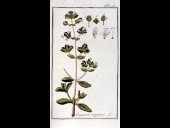
This is a sedum and probably the most well known of the species. It is also known as Live Forever, but that name is also used for a few other plants, especially a member of the succulent family also known as “hens and chicks.” Both plants are used in herbal medicine, but Orpine and several other sedums are popular wild edibles. One sedum I would caution against eating in large amounts is Rose Root or rhodiola. That is a potent medicinal herb. While I would consider many of the other sedums interchangeable, it would be best to do some research before eating any with which you are unfamiliar. The leaves of Orpine can be eaten raw when young and tender. They make a nice cooked vegetable using the steam/saute method, added to soups, etc. The roots may be harvested fall through spring, making this a valuable plant in times of food scarcity. They are not an emergency food though, as the roots must be soaked for a few days before eating. Then, they can be cooked and eaten or pickled.
Because Orpine is a succulent, the taste and texture is somewhat similar to cactus. If you like nopales, which are a popular ingredient in some Mexican and South American cooking, you will probably like Orpine. I’m a big fan of nopales, so I like the leaves of Orpine prepared with similar flavors. Orpine is much easier to harvest than cactus, as it does not have spines. The downside though, is that the leaves of Orpine are too small to grill like I would cactus pads, but they are small and tender enough not to need blanching, which is how I cook cactus pads on the stove. I like to give them a quick char along with onions and peppers on a hot cast iron pan and use them to make fajitas. Any browned meat or seafood works for fajitas, or you could even just use cheese. It is the charred flavors of the vegetables and a good, hot salsa or pico de gallo that makes them special. I’ll give a very basic recipe, but you can use most any wild edible in this book or anything from the garden that you like.
Basic pico de gallo:
Chop tomato, onion, garlic, hot peppers and cilantro. Combine with salt, pepper and lemon or lime juice.
Basic salsa:
Same as above but char the veggies first for the best flavor. You can substitute tomatillos for the tomatoes, and that is especially good if you are using both pico and salsa.
Basic guacamole:
Mash avocados with all the stuff you would use in the pico, and I like to mix in some sour cream.
Restaurant style red rice:
Add some olive oil to a pot and bring to medium heat. Pour in your rice – let’s say about a cup, and stir it gently until the rice becomes pearly and slightly browned. Add ½ cup of pico and 1 and ½ cups of either chicken broth or water and cook as you would normally cook rice. Salt and pepper to taste.
So, you see that the basic pico is the essential ingredient for my version of this meal. I have no Mexican heritage, and I know many who do who would object especially to my guacamole. But, this is the way I like it. Next, we’ll make the refried beans.
I always start with dry beans, usually either pintos or black beans. Soak them overnight. Pour off the soaking water and then add enough fresh water to cover. Some folks say that cooking your beans in salted water makes the skins tough, but I have never noticed any difference. I add chopped onion and garlic, crushed red pepper, cumin, avocado leaf and (if I have any), epazote to my beans. To my taste the avocado leaf is really essential. But, I know Mexican folks who would say the epazote is the essential flavor. Either way, it needs cumin. Salt and pepper to taste. When the beans are tender, add as much lard as you like and gradually cook almost all of the water out of them. Mash the beans into a paste.
How you prepare the meat or seafood really depends on what you are using. If I use flank steak or tough game meat, an overnight brine in salt, hot pepper, a little sugar and citrus juice with any spices you like helps. You can add a little wine or even soy sauce to the brine. I don’t usually bother to brine chicken or seafood, but that is up to you. For red meat or pork, the brine tenderizes it. But, for any meat it will also help season and brown it. I generally just season fish and fowl with dry herbs, spices and salt. Either way, slice everything into bite sized pieces and give it a good char on the pan. Cook it to the doneness that you prefer, but make sure the meat gets a nice char – the hotter the pan, the easier this is to accomplish, or you can use a grill. I usually cook mushrooms with the meat, being sure to get them nicely browned.
Char your veggies. I usually add some of the marinade to the veggies as they cook. The steam helps them cook through quickly and adds flavor. But, most modern health experts would probably not approve. So, if you want you can make up some fresh marinade or just use salt. Even a splash of beer will work... as I found out by a happy mistake!
Flour tortillas are the norm for fajitas, but you can use fresh corn tortillas if you like.... they will taste great, but some may object to still calling them fajitas. I often grill corn and other veggies to go inside, so flour tortillas work better for me. Either way, warm your tortillas.
The assembly can be just your meat and veggies with some hot sauce or salsa, with the beans and rice on the side. But, I always try to shove everything in there – the flavor combination in each bite is what I love! I spread a spoonful of beans and rice on, then the meat, mushrooms, cheese and veggies, guacamole and pico, and then dip or pour salsa over them as I eat.
Anything from Orpine to the ferns we will discuss next will be absolutely delicious in a fajita... only the purely root vegetables would be difficult.
This article is an excerpt from
The Spring Foraging Cookbook:
https://southernappalachianherbs.blogspot.com/2024/01/the-spring-foraging-cookbook.html
Available for purchase on Amazon:
https://www.amazon.com/dp/B0CRP63R54
Also, I am back on Youtube. Please subscribe to my channel: @judsoncarroll5902 Judson Carroll - YouTube
Read about my other new books:
Herbal Medicine for Preppers, Homesteaders and Permaculture People:
https://southernappalachianherbs.blogspot.com/2021/10/herbal-medicine-for-preppers.html
Available on Amazon: www.amazon.com/dp/B09HMWXL25
Medicinal Ferns and Fern Allies, an Herbalist’s Guide
https://southernappalachianherbs.blogspot.com/2022/11/medicinal-ferns-and-fern-allies.html
Available for purchase on Amazon:
https://www.amazon.com/dp/B0BMSZSJPS
A Daily Catholic Devotional Reflections on the Daily Mass readings July-December, 2025
https://southernappalachianherbs.blogspot.com/2023/12/a-daily-catholic-devotional-reflections.html
Medicinal Weeds and Grasses of the American Southeast, an Herbalist’s Guide
https://southernappalachianherbs.blogspot.com/2023/05/medicinal-weeds-and-grasses-of-american.html
Available in paperback on Amazon:
https://www.amazon.com/dp/B0C47LHTTH
and
Confirmation, an Autobiography of Faith
https://southernappalachianherbs.blogspot.com/2023/05/confirmation-autobiography-of-faith.html
Available in paperback on Amazon:
https://www.amazon.com/dp/B0C47Q1JNK
and
Medicinal Shrubs and Woody Vines of The American Southeast An Herbalist’s Guide
Read about Medicinal Shrubs and Woody Vines of The American Southeast An Herbalist’s Guide:
https://southernappalachianherbs.blogspot.com/2022/06/medicinal-shrubs-and-woody-vines-of.html
Available for purchase on Amazon:
https://www.amazon.com/dp/B0B2T4Y5L6: by Judson Carroll
Visit my Substack and sign up for my free newsletter:
Judson Carroll, Master Herbalist
Herbal Medicine
Type your email...
Read about my new other books:
Medicinal Ferns and Fern Allies, an Herbalist’s Guide
https://southernappalachianherbs.blogspot.com/2022/11/medicinal-ferns-and-fern-allies.html
Available for purchase on Amazon:
https://www.amazon.com/dp/B0BMSZSJPS
The Omnivore’s Guide to Home Cooking for Preppers, Homesteaders, Permaculture People and Everyone Else:
https://southernappalachianherbs.blogspot.com/2022/10/the-omnivores-guide-to-home-cooking-for.html
Available for purchase on Amazon:
https://www.amazon.com/dp/B0BGKX37Q2
Medicinal Shrubs and Woody Vines of The American Southeast an Herbalist’s Guide
https://southernappalachianherbs.blogspot.com/2022/06/medicinal-shrubs-and-woody-vines-of.html
Available for purchase on Amazon
https://www.amazon.com/dp/B0B2T4Y5L6
and
Growing Your Survival Herb Garden for Preppers, Homesteaders and Everyone Else
https://southernappalachianherbs.blogspot.com/2022/04/growing-your-survival-herb-garden-for.html
https://www.amazon.com/dp/B09X4LYV9R
The Encyclopedia of Medicinal Bitter Herbs:
https://southernappalachianherbs.blogspot.com/2022/03/the-encyclopedia-of-bitter-medicina.html
Available for purchase on Amazon:
https://www.amazon.com/dp/B0B5MYJ35R
and
Christian Medicine, History and Practice:
https://southernappalachianherbs.blogspot.com/2022/01/christian-herbal-medicine-history-and.html
Available for purchase on Amazon: www.amazon.com/dp/B09P7RNCTB
Podcast:
https://www.spreaker.com/show/southern-appalachian-herbs
Blog:
https://southernappalachianherbs.blogspot.com/
Free Video Lessons: Herbal Medicine 101 - YouTube
Disclaimer
The information on this site is not intended to diagnose or treat any disease or condition. Nothing on this site has been evaluated or approved by the FDA. I am not a doctor. The US government does not recognize the practice of herbal medicine and their is no governing body regulating herbalists. Therefore, I’m just a guy who studies herbs. I am not offering any advice. I won’t even claim that anything I write is accurate or true! I can tell you what herbs have “traditionally been used for.” I can tell you my own experience and if I believe an herb helped me. I cannot, nor would I tell you to do the same. If you use any herb I, or anyone else, mentions you are treating yourself. You take full responsibility for your health. Humans are individuals and no two are identical. What works for me may not work for you. You may have an allergy, sensitivity or underlying condition that no one else shares and you don’t even know about. Be careful with your health. By continuing to read my blog you agree to be responsible for yourself, do your own research, make your own choices and not to blame me for anything, ever.