|

|
|
|
|
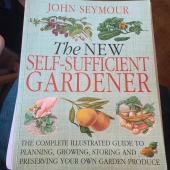
Deedee Dezso wrote:Well, i can't list just 1 book.
As a young gardener, back in my 20s, i was gifted a great resource of a book titled "The Self Sufficient Gardener- the compleat illustrated guide to planning, growing, storing and preserving your own garden produce " by John Seymour. It was, and still is, my #1 for the growing requirements of many food plants, as it lists each type with headings like soil and climate, soil treatment, propagation, pests and diseases...I now have and use "The NEW Self Sufficient Gardener "...The book begins with an introduction chapter covering organic gardening, small animals (rabbits and chickens for meat, eggs and manure), and how nature's cycles effect growing. And I love the Illustrated Index of Vegetables, Fruits and Herbs.
I have done alot of notations in this book to help keep vital information in one book. The table of contents lists plants according to family and that confuses me, so I added what I'd understand. For example, fabaceae is the legumes, and brassicaceae is the cabbage/broccoli family. This book is not listed in the above mentioned list of great resource books.
My 2nd most referenced book is Carrots Love Tomatoes by Louise Riotte. This is my companion plants resource. I've taken the vitals from this volume and copied them into the inside covers of my copy of Self Sufficient Gardener, listing companions, allies and enemies for my preferred crops.
And because one cannot be self-sufficient in raising your own food year after year without saving seed, another gifted resource book is Suzanne Ashworth's Seed to Seed. Before this book i didn't realize the level of cross pollination between crops in the same family groups. I learned the hard way.
I'd saved seed from a zucchini and shared some with a Facebook friend. When hers fruited, those zucchini were the right shape but wrong color; they were white! I was grateful that I had kept a map of what was planted where. Referring to it, I saw that I'd put a white patty pan squash beside the zucchini. I looked up the 2 squash in Seed to Seed and discovered both are pepo types and that in the squash tribe, any 2 in the same sub-tribe can and will cross. So 2 pepo, 2 maxima, 2 moschata, etc. will cross pollinate and the seed saved will often show the effects of this.
I now don't buy squash seed if that sub-tribe information isn't present. And if I plan to save seed with the idea of continuing the variety, I'll only plant 1 variety. 1 pepo, usually a zucchini; 1 moschata, often butternut, etc.
Of course I have other gardening books. My personal library of physical books is far more extensive than I have room for since our cross country move, but these are the volumes I made sure to have available after settling in.

bruce Fine wrote:all of my trees have come from state department of forestry seedling programs.
if anyone is near what was previously the West Virginia state tree nursery, clements tree nursery in Mason county west Virginia, prior home to Samuel clements (mark Twain's) grandparents
there should be a large stand of American chestnut trees there and maybe even Chinese chestnut trees that the state used to offer for sale.
im still curious what ever became of the place since the West Virginia legislature shut it down.

M.K. Dorje Sr. wrote:I was checking out the Good News Network this morning and found an amazing article and documentary about the return of the American Chestnut in Maine, thanks to Dr. Bernd Heinrich, author of Ravens in Winter and many other great books. Check this out:
https://www.goodnewsnetwork.org/once-wiped-out-by-blight-thousands-of-american-chestnut-trees-are-thriving-on-biologists-land-in-maine/
The American Chestnut was decimated by chestnut blight in the early 1900s, which killed million of trees through the eastern United States. But thanks to Dr. Heinrich, they are making a comeback in Maine. This article was very inspirational for me because I just planted and began stratifying several dozen chestnut seeds a few weeks ago. I'm planning on planting, selling and donating lots of chestnut seedlings once they begin germinating. Chestnuts are amazing trees and can live for hundreds of years. And they are delicious roasted!
Anyone out there growing chestnuts? What species do you grow and where do you live?

Chris McClellan wrote:Cindy, That is an excellent idea. I will run it by the author and seewhat she says.
--Mud