Nicole Alderman

steward
+ Follow
since Feb 24, 2014
Merit badge: bb list bbv list
Biography
Five acres, two little ones, one awesome husband, 12 ducks (give or take), and a bunch of fruit trees and garden beds. In her spare time, Nicole likes to knit, paint, draw, teach kids, make fairies & dragons, philosophize, and read fantasy. She doesn't HAVE spare time, but does like to fantasize about it!
For More
Pacific Northwest
Apples and Likes
Apples
Total received
In last 30 days
52
Forums and Threads

Recent posts by Nicole Alderman

Having merino on the top layer does seem to help with a "smoother" (rather than fuzzy) final look. I don't end up using it much, because I'd rather invest in multi-purpose bulk wool colors I can use for both the body and details.

I'm a bit different from other felters, in that I'd rather make an animal out of one color/type of wool, rather than felting a core out of cheaper white wool, and then covering it with another color of wool. The white likes to poke it's way back out, and isn't very useful in the felting thinner things, like dragons.

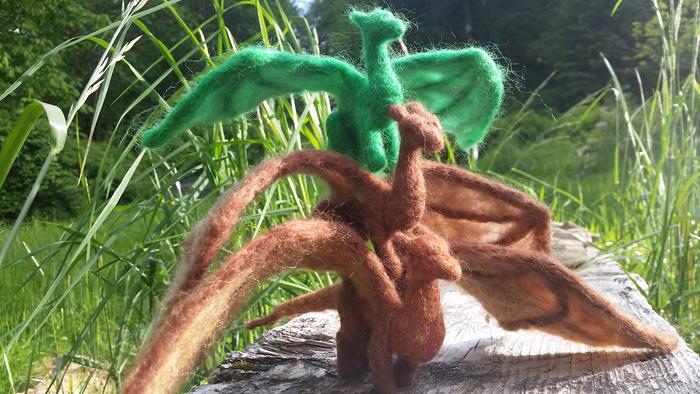
The last time I worked with Merino was when I made blue Pern dragon. It was a pain to make, because the merino took so long to felt. But, I already had the blue merino on hand from when I first purchased wool roving years ago. As you can see, it didn't end up very fuzzy:


The relative lack of fuzziness is easier to see when compared to the other dragons of Pern:

you can see more pictures in the Dragons of Pern thread


The lack of fuzziness is something many people like about merino. And, some people say you can felt it quicker with a fine needle than with a medium or large needle. But, I heard that after I made the blue dragon, so I haven't tested it out for myself.
3 days ago
Those are so cute! I usually order my wool from weircrafts here in the US. Hopefully someone else can chime in where Canadian sources of wool. I would personally avoid merino wool for needle felting. It takes forever to felt because it's so silky! I usually look for Corriedale or Romney wool.

3 days ago

r ransom wrote:Today's quest has been frustrating.

The goal - find out what ochre and other earth pigments look like in nature.   All I get are ads for buying paint.  

Maybe it's all around me and I'm not seeing it.


Ah! A great source for that is the Ancient Pottery channel on youtube!

This is the video I showed my history students:


He goes through the process of finding where the ochres are and then goes out and shows the different colors of the ochres found in the wild.

Down here, where the glaciers did a big number on our clay soils (i.e. we don't have any), I never see anything like what he's going after.

Another video I've seen showing ochres in the wild is the Secrets of the Castle series by BBC.  It's a lot more wet in France where this castle is being built, so the look of their ochre is more like what we'd probably find:

3 days ago
art
I managed to download it without any issue. I've attached the file down below (that should also help prevent it from disappearing like so many things disappear on the internet.)
3 days ago
art
I received these hair cutting scissors last Christmas, and I have found them quite sharp. I, however, do not have thick hair, and usually use mine for trimming split ends. When I trimmed my son's hair (which is thicker), I didn't have any issues.

Previously, I've also cut hair with my Gingher fabric scissors, and I'm pretty sure my mom trimmed my hair with Fiskars fabric scissors.
1 week ago

r ransom wrote:I think you're right.  Having lived with the swatch for a day, I don't see many places to use colbalt blue in my painting.

Maybe one day, if it's on sale, but not this time.

Now, smalt, on the other hand...


I had to look smalt up, because I wasn't sure what it was made of. It looks like it actually has (or at least originally had) cobalt in it! From Pigments through the Ages:

The cobalt ore was roasted and the cobalt oxide obtained was melted together with quartz and potash or added to molten glass. When poured into cold water, the blue melt disintegrated into particles, and there were ground in water mills and elutriated. Several grades of smalt were made according to cobalt content and grain size. In the complex ores in Saxony, as they were first roasted, much of the arsenic was volatilized. The oxides of cobalt, nickel and iron were then melted together with siliceous sand, and the resulting product called Zaffre or Zaffera were, in part, sold to potters and glassmakers.

Another modern recipe is heating of quartz, potassium carbonate and small amount of cobalt(II)-chloride to 1150°C and inserting the still hot product into cold water. The disintegrated glass is then homogenized in a mortar.

The principal source of cobalt used in the preparation of smalt in Europe during the Middle Ages appearing to be the mineral smaltite, one of the skutterudite mineral series. In the seventeenth and eighteenth centuries other associated cobalt minerals were probably used as well (erythrite and cobaltite).

1 week ago
art
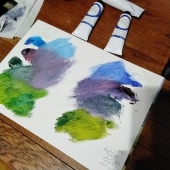
The cobalt seems more of a greenish blue (warm), while the ultramarine is more purplish (cool)...which isn't what I was expecting. But, I guess it makes sense, because ultramarine used to come from ground lapis, and lapis isn't a greenish/warm blue.

It makes sense that you'd get more vibrant greens with the greenish cobalt/pthalo than you do with ultramarine. And, it makes sense that you'd get more vibrant purples with the purpler ultramarine.  

I wonder if anyone has done side-by-sides of quality cobalt with quality pthalo blue? I found this image (from In Search of the Lost Cyan: Manganese Blue):


Honestly, looking at that, cobalt blue seems a lot less vibrant than the pthalo blue. It seems more grey, rather than more green or purple in hue--less saturated overall.


I'm seeing a bunch of pros and cons to buying the paint. My head is a bit full, so I'm just going to list them to see if that helps.

Pros to Buying CobaltCons to Buying Cobalt
Authentic color: easier to paint historical paintingsExpensive
Authentic color: great for learning about historyToxic
Fun and unique Christmas present to selfMight support sad working conditions for people
You only need a little bit of cobalt paint to have a good timeMight be more destructive to the environment than other hues
You can mix a similar hueIt's hard to mix paints the same each time!
1 week ago
art
It looks like cold wax is also called "encaustic wax" (the same stuff that Roman Egyptians used to make their mummy portraits by adding pigment to the wax and "painting" with the pigmented wax). The encaustic wax can be made of dammar resin and beeswax. I found a recipe at Earth Pigments:

Ingredients

  • 10 parts Beeswax
  • 1 part Dammar Resin lumps

  • Dammar Resin has a higher melting point than beeswax, so it should be melted first, then the beeswax added. Neither should be heated over an open flame, or to temperatures above 250 F. Stir to blend while melting, then pour the mixture into aluminum foil muffin pans for cooling. Although the dammar resin will contain some impurities, these will fall to the bottom of the mixture as it hardens. Each contained portion can now be mixed with pigments or stored to be melted again with pigments.


    They also note that many people use very different ratios of beeswax to resin:

  • A leading encaustic paint manufacturer consistently uses a ratio of 4.5 parts beeswax to 1 part dammar. This would be considered at the top end of the range by most artists, producing a hard paint.
  • An average among many working artists is a standard ratio of 6 parts beeswax to 1 part dammar.
  • AMIEN (Art Materials Information & Education Network) hosted by the Intermuseum Conservation Association, recommend a ratio of no higher than 1 part dammar to 10 parts beeswax, citing evidence that dammar is brittle and can yellow over time.


  • I thought about trying my hand at making cold/encaustic wax....but I really don't want to mess it up.  Learning new skills is awesome and fun....but I've already made a lot of mistakes on these little orange peal containers, and don't want to risk making even more.  Soooooo, I ended up ordering JJacquard Dorlands Wax. It says that it's a mixture of beeswax and dammar resin, though I'm not positive that they didn't mix in other stuff. Fingers-crossed that they didn't!
    1 week ago
    art
    I haven't been on permies much the last few months because it's been pure insanity in my life. My husband was disabled for three months due to a Crohn's flare up, and I'm teaching more classes at my kids' school. Just before Christmas, though, some of my friends worked together to make a big gift basket for my family, full of goodies my husband (who can't eat much due to his crohn's) could eat...including some big tasty oranges. It was such an amazing, kind gesture.

    I needed some way to thank them, and I had recently seen Sally Pointer's videos on making orange boxes:


    I didn't have any wheat flour to make the traditional gluten-based papier-mâché paste. So, I decided to try using gum arabic (because I didn't want to use Elmer's PVA glue. Why make a container out of all natural materials and then coat it with a type of plastic?). I'm pretty sure gum arabic wasn't the best choice, though, because it reanimates really easily!  It was also finicky to work with, because it was such a thin liquid.

    I then painted the boxes with my homemade watercolors. Usually my watercolors are pretty water resistant...but maybe because they're on a surface already coated in gum arabic made them reanimate too easily?

    I went outside to get a pictures of the orange boxes, and the tiniest amount of moisture from the frozen snow caused my paint (which had been dry for days) to smear!

    I guess that means I need to seal these somehow...but with what? I don't want to seal the inside, because then it wouldn't have it's lovely orange scent. But, the outside obviously needs to be sealed in some manner so the paint doesn't smear when touched with wet hands or a tiny amount of water!

    What is a natural sealing method that won't reactivate the water color?
    1 week ago
    art