
Nicole Alderman

steward
+ Follow
since Feb 24, 2014
Merit badge: bb list bbv list
Biography
Five acres, two little ones, one awesome husband, 12 ducks (give or take), and a bunch of fruit trees and garden beds. In her spare time, Nicole likes to knit, paint, draw, teach kids, make fairies & dragons, philosophize, and read fantasy. She doesn't HAVE spare time, but does like to fantasize about it!
For More
Pacific Northwest
Apples and Likes
Apples
Total received
In last 30 days
27
Forums and Threads

Recent posts by Nicole Alderman

Chris McClellan wrote:Don't bother with the sand just get your clay really wet and sticky and beat in the shredded paper mechanically. Fill it with microfibers. Without sand you need a lot more fiber. Clay is just glue. It has little compressive strength and tends to expand and contract so much with humidity changes thst it csn turn itself to dust without structure (aggregate) to stick to. Fiber or sand will work as aggregate. For daube fine fiber is better than sand as aggregate.


I have a bunch of raw cotton fiber. Do you think that would be good to add to the daub mixture? (We're building this houses again this year--this time as fairy houses!)
10 hours ago
cob
When we made them five years ago (thread here), my kids actually realized that the tip of another feather fit quite nicely as a handle:


I actually brought some feathers into my history class (we've been learning about the Renaissance) and showed them how to make paint brushes. They were really into it and all wanted to make their own. I sadly didn't have enough feathers to go around, as my goose hasn't molted yet. (And the other feathers I'd saved up were all used up by the class to make feather dusters...)
6 days ago
art
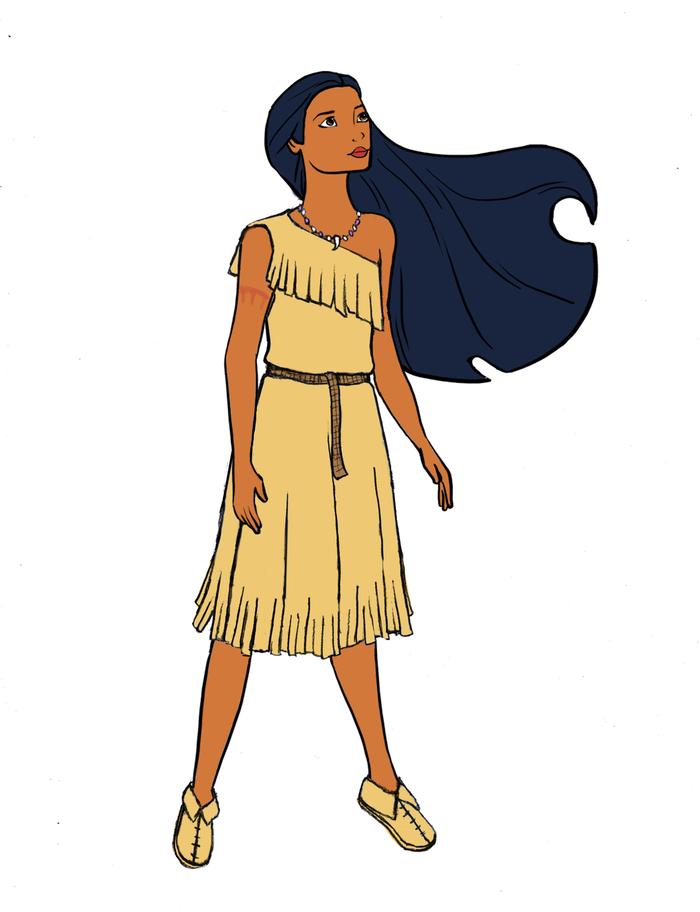
Oh! I forgot! I did art yesterday. I made a more historically accurate Pocahontas, and then colored her digitally:

trying to take the cartoon version and make her 10 years younger was not easy!


I'm hoping she looks enough like the movie version for kids to recognize her, while still being more accurate...and 10 years old.
1 week ago
art

Jay Angler wrote:The book I mentioned above has a section on making homemade paint brushes. I don't have any animal hair that I think would be suitable, nor do we have any long leaved Pine trees - just short firs leaves.

However I do have a collection of flight feathers from ducks and geese. I was wondering if the barbs from the feather would stand in for the hair? Has anyone tried this or read anything suggesting it won't work?


You can make fine brushes with the tips of feathers. Let me see if I can locate the video.... Ah-hah! Found it!

1 week ago
art
Maybe this counts as arting? For Christmas, I received an ink stone and ink stick. I decided two nights ago to try it out (since my Ancient History class will be learning about China). In my folly, I added too much water. Then I found out that the ink goes yucky if you don't use it all. I decided that meant I should try to learn Chinese calligraphy. I filled up three pages like this, because I didn't want to waste the ink I'd spent 15 minutes grinding!
1 week ago
art
I've been dreading drawing Pocahontas since I first started this project. She's an actual, historical person, and part of a group of people who historically have been objectified and misrepresented by others. We sadly on have a depiction of her in English clothing, years after the events at Jamestown.

The only depiction we have of Pocahontas


Thankfully, there's a lot of resources out there--by Algonquin speaking people--for how women in the Powhatan tribe would have dressed. I leaned very heavily on these resources.

Here's the videos I used for her clothing's style. I really appreciate the work that Jamestown Museum has done.


This one is from a bit further north in Massachusetts, but both the Wampanoag and Powhatan tribes are Algonquin speaking and similar.


I also learned that they did weave belts from plant fibers. it seems that they usually used dogbane "hemp" for the weaving. I'm not positive, though. I also changed her necklace, as they didn't have turquoise in the region (they did have copper jewelry, so maybe it's oxidized copper. But, it seems that they liked the shiny copper color better than the oxidized blue-green). I used purple and white, reminiscent of both wampum shell beads as well as natural pearl colors. I added a "tooth" as a pendant. There is actually a museum on a reservation that has necklace listed as Pocahontas' necklace...but I'm not sure how accurate it is. Sadly, the website I found a picture of the necklace died (thanks, Dead Internet). Thankfully, I'd already saved the image, so I attached it down below

The other struggle I had was trying to make Pocahontas look 10 years older. In the movie, she looks like she's 20...and Pocahontas was only about 10 or 12 when she saved John Smith's life. I also wanted to make sure that the drawing resembled the Disney Princess enough that kids would be able to recognize her. To do this, I kept her general proportions, but dropped her waist and removed her curves. I also tried to shorten her face by lowering her eyes, shortening her nose, and removing some of the "botox" look from the cartoon's lips. She still doesn't look 10, but she doesn't look quite as old.
1 week ago
I love mixing wet felting and needle felting! I often find myself needle-felting a general shape, then wet felting to firm it up, then needle felting to refine it. I love how wool can be worked in so many ways, and that needle felting and wet felting can work so well together.
1 week ago

John F Dean wrote:I don’t know the time frame you are working in. If I was in your position, I would contact the paint manufacturer for a donation.  Trust me, they have seconds.  Proceed with the concept of infecting young minds with the hobby of painting and positive vibes for the company.

Over the years I have gotten for myself or others AEDs, vehicles, power tools, and one Viking 6 burner kitchen range.


Sadly, I need it by next week, which is when we're starting the unit. (I know, I know, I should have figured this out months ago, but I'm teaching 4 different courses, and I'm designing all the curriculum, slides, and activities for each. There's too much to do, and not enough time to do it!)
3 weeks ago
art

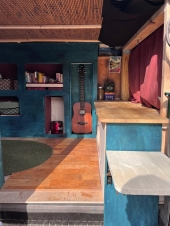
s ritter wrote:I was having similar questions while building out my van... I wanted something non-toxic, easy to work with and affordable. I ended up purchasing 100g of concentrated pigment from Earth Pigments and mixing it with linseed oil and river clay that I sifted, dried and sieved. The color came out as a rich deep teal, and the application was super easy. You can adjust the color by adding more or less pigment, but I found it was forgiving enough that I just eyeballed my proportions when making subsequent batches. I also found that the river clay wasn't necessary, so for the simplest approach you could just mix pigment and linseed oil and start painting! Also - 100g was more than enough to cover a large wall and some cabinetry in my van (~40sq ft) at a pretty rich ratio of pigment to linseed oil.

Attached is a picture of the final product - you can kinda see the striations of the wood beneath the paint, but I find that I like that look!


I love Earth Pigments! I've used it to make milk paint and watercolors in the past (I literally just made some watercolors with it a few hours ago), but I've never made oil paints. How did you mix yours up? The videos I see on making paint always say I need to use a muller and grind the paint to thoroughly mix the paint. But, I mix all my watercolors by just putting the pigment and water+gum arabic+honey together in my watercolor tray, and then I mix it with my brush. Do you think I could do that with oil paint, too? I'm sure it won't be "perfect" like professional artists use...but my watercolors are nicer than anything I've ever bought, and they aren't mulled.

Also mixing the pigment with oil in class will let the kids see how it's done, too! But....oil is thicker than water, so I'm not sure how it'll work. How did you mix yours?

I absolutely love the color you achieved on your wall. It's so lovely!
3 weeks ago
art
One of my history classes will be learning about the Renaissance, and I thought a fun way would be to do an oil painting. BUT, the school doesn't have oil paints, and I don't have enough at home to use for 24 students. Plus, I wanted to have a more traditional palette with colors that the painters likely would have had back then. My questions are these:

    (1) What colors should I have? (Colors that look like: lamp black, raw umber, red iron oxide, red lead, vermillion, yellow ochre, lead yellow, green earth, malachite green, verdigris, ultramarine, white....I'm probably missing some, too.)
    (2) Is there a brand that's affordable that isn't full of fillers and has more historical hues?
    (3) Can I make my own oil paint without a muller and that paint scraper thing? Will it work in small batches if we just mix the dry pigment powder with the oil? I already have a lot of historical-ish hued pigments.

3 weeks ago
art