Glenn Herbert

Rocket Scientist
+ Follow
since Mar 04, 2013
Merit badge: bb list bbv list
Forum Moderator
Glenn Herbert currently moderates these forums:
Biography
Early education and work in architecture has given way to a diverse array of pottery, goldsmithing, and recently developing the family property as a venue for the New York Faerie Festival, while maintaining its natural beauty and function as private homestead.
For More
Upstate NY, zone 5
Apples and Likes
Apples
Total received
In last 30 days
7
Forums and Threads

Recent posts by Glenn Herbert

John, I read. A lot. Anything that comes into my hands. Especially anything to do with history, geology, archaeology, paleontology...
John, it may sound alien to someone from an ancient, mostly dry continent, but many areas such as Appalachia in the eastern US are full of steep rugged terrain, and when an extreme rain event hits, it can percolate to bedrock, loosen the bond of many feet/meters of soil, and let the entire hillside (sometimes with trees and buildings intact) slip downhill to crash into the valley below and jumble everything into a heap, or bury houses in the valley.
Daniel - As mentioned, you can find heating requirement calculators online. Once you have a number, batchrocket.eu has information on system sizing for the requirements, for batch box designs. J-tube designs need to be scaled as mentioned above, with an 8" J-tube being similar to a 6" batch box. When you do have a system size determined, all the chamber proportions are determined by that, and described in numerous sources including batchrocket.eu. In general, oversizing a system a bit only means that you need to run it less often; if you undersize the system a bit, you need to run it more times a day in extreme weather which may be inconvenient. Greatly undersizing can be a real problem.

Self-feeding experiments have been done by many people, but they are all experiments. I would not advise trying to do such things in a system you want to just work out of the box. Also, self-feeding implies continuous or long-term burning, which is not required by the concept of a fast, hot fire that heats a mass for continuous gentle heating.  I recommend you go with mainstream designs, and with a bell or stratification chamber rather than piped mass, to make your build as reliable as possible. To be clear, if you do not have unusual conditions, recent common designs can be expected to work reliably if followed. As far as specific layout, proportions and surfaces of your installation, those can be tailored to your situation as long as you follow the basic technical rules.

2 days ago
Sophie - this forum is designed with all posts sequential, not responses grouped under individual posts. The idea is to always be able to see the latest post and not miss a new answer to a previous question. Threads should be limited to one basic topic so different conversations don't get tangled together.
2 days ago
So the Montgolfier brothers used wood to heat their balloons, and had issues in an early flight with sparks threatening to burn the balloon.

A J-tube rocket of lightweight insulating material could provide more heat for the fuel used, and with full combustion may give less danger of sparks. A complication would be inflating the balloon to start with, as the rocket would not be able to blow hot air into the flattened balloon; not sure how modern balloonists do this, with just a fan or with the propane flame directed sideways...
1 week ago
It will be a whole lot easier to separate the inner bark while the wood is green.

I have made a number of utensils from black cherry. The wood I have used has always been seasoned, though I could cut a green tree if I wanted.There is one I intend to harvest for lumber that I could set aside some carving wood from.

I like to find a piece that has a bit of bend in it for spoons and spatulas. Spatulas especially benefit from a bend so the grain is straight in the handle and the blade.
2 weeks ago
The question is whether the emergency shelter is to ride out an extreme event, or shelter after the event. If it has to survive the extreme event, it probably has to be already up and secured, not temporary. The structure described would need much more construction to be even semi-permanently up and in the weather.
3 weeks ago
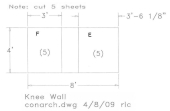
I notice that, aside from the unavoidable waste from panel geometry, the panels could all be made a couple inches bigger from the 4x8 sheets, making the whole structure maybe 6" bigger in diameter.

I do think that in terms of usable space beyond raw floor square footage, you could get pretty close to the same with ten sheets of plywood making an 8' x 8' cubish structure with a gable roof and 6' eaves and 8' ridge. The parts would be much easier to make and quicker to assemble, and very easy to waterproof. With 12 sheets, you could make an 8' x 10'-8" structure with 6' minimum walls.
3 weeks ago
This kit could be assembled by one person with only one temporary brace. The ground ring is self-supporting as soon as you fasten two panels together, and it would be easy to hold the first two in alignment. The first angled panel would require a 6-8' pole to brace it in place, but once the second angled panel is attached, the assembly is self-supporting.
4 weeks ago