I found this paper which covers some of what I've been thinking about -
Integrating legumes to enhance cereal production: The relative inputs of fertiliser nitrogen and legume biological nitrogen fixation in major wheat and maize producing countries
I pulled out some of what seem to me to be the most pertinent bits and posted them below...
****************************************************
Cereal crops dominate arable agriculture and underpin global food supply. Cereal grain yield is closely related to crop nitrogen (N) uptake.
An increased role for legumes
Legumes can contribute significantly to redesigned systems of cereal production. Not only would species diversity be increased in otherwise cereal-dominated cropping sequences
(i) Produce quality high-protein grain and forage without the need for fertiliser N). This is due to biological N2 fixation (BNF) through symbiotic relationships with soil bacteria, rhizobia, which typically satisfy between 40–80% of a legume’s N requirements depending upon the legume species and farming system.
(ii) Emit less GHG’s than N fertilised cereals during growth and, depending upon management and rainfall, systems that utilise legume residues as a source of N for subsequent crops generally have a lower risk of N losses than where fertiliser-N is used.
(iii) Induce beneficial changes in soil biology, structure, nutrient and water availability, as well as slowing the decline in soil organic C compared to cereal monocultures, and in some cases encouraging C sequestration and.
(iv) Reduce the N fertiliser requirements for, and improve the N fertiliser use efficiency of, subsequent crops.
This paper aims to:
1. Describe the varied uses of legumes in agriculture and their global inputs of BNF,
2. Summarise the impact of different legume systems on cereal grain yield, biomass production, and N uptake across different geographic regions,
3. Compare the net inputs of legume N as BNF and in legume residues to cropping soils in the major wheat and maize producing countries to the amounts of N removed in grain and applied as fertiliser,
4. Calculate the extent to which areas of legumes would need to be increased in each country to match the current N offtake in wheat and maize grain or the N supplied by N fertiliser, and
5. Outline a range of prospective strategies that might be required to facilitate more legumes being grown by farmers in cereal-based cropping systems.
The effect of legumes on intercropped cereals
Intercropping wheat or maize with legumes frequently results in improved stability in the productivity of both cereal and legume crops, increased cereal uptake of N per plant and higher cereal grain protein contents than when the cereal is grown as a sole crop . It has widely been speculated that legumes contribute to the N nutrition of cereals in intercropping and mixed cropping systems via the direct transfer of legume N to cereals growing in the immediate proximity. Many different above- and below-ground mechanisms have been proposed that might conceivably facilitate such transfer. Various 15N-based technologies have been deployed in an attempt study these potential pathways for legume N. However, the interpretation of data can be complex and controversial as in reality N transfer is probably occurring in all directions; from legume to legume, from legume to cereal, and from cereal to cereal.
Legumes in major cereal producing countries and their N dynamics
The net inputs of fixed N play a key role in determining the rate of depletion of the soil N reserves over time and affect the organic N fertility of cropping soils. However, it is likely that the amount of N remaining in legume residues at the end of a growing-season will be a more important source of N contributing to soil mineral N status and the rotational benefits for following crops. The N removed in grain represented around half of the total amount of N accumulated by pulses and oilseed legume crops. The estimated amounts of N remaining in the above-ground legume vegetative residues and nodulated roots at the time of grain harvest in the 15 main wheat and maize producing countries corresponded to 23.2 Tg N.
Discussion
...estimates of BNF by grain legumes were found to be greater than the amounts of N removed in harvested legume grain in all 15 countries except the Ukraine. In other words, assuming no major post-harvest losses of N, grain legumes generally added to, rather than depleted, the N reserves of cereal cropping soils. The other main observation was that Brazil was the only country where net inputs of fixed N exceeded cereal grain N offtake and fertiliser-N supply, although the amount of residual legume N remaining after grain legumes either approached or surpassed cereal N demand in USA, India, Brazil, Argentina and Canada. Across the other ten countries, there were substantial shortfalls in the estimated annual amounts of legume residue N, especially in Pakistan, France and Germany where returns of legume N to cereal cropping soils represented < 10% the N harvested in wheat and maize grain N or applied as fertiliser.
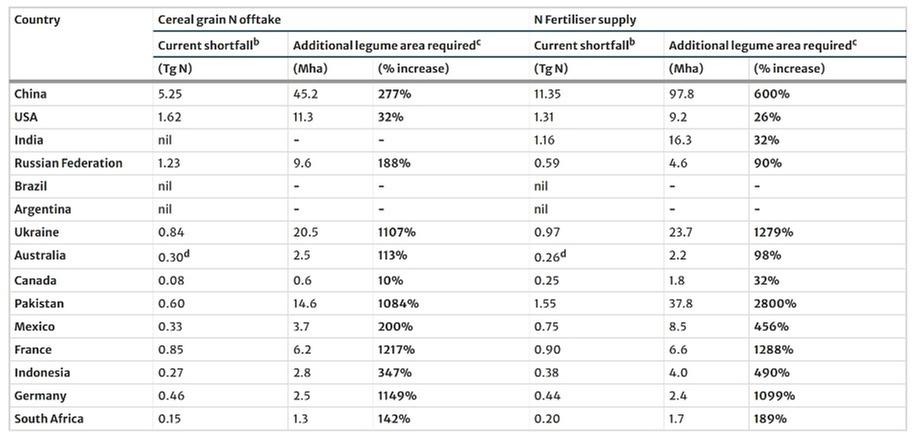
Given that the 15 countries producing the bulk of the world’s wheat and maize grain also consume over 80% of the total N fertiliser applied to those two crops, the frequency of legumes in cereal-based cropping systems will need to increase in all the major cereal producing countries except Brazil and Argentina before legumes can make any meaningful global impact in reducing applications of fertiliser-N in future cereals systems. The size of this challenge is illustrated in the data in Table 8 which shows the degree to which the areas of grain legumes would need to be expanded to redress the present imbalance between legume and fertiliser sources of N to meet cereal N demand. These values have been derived from calculations of the shortfalls in the amounts of legume N returned to cereal cropping soils by assuming the increased legume areas consisted of the identical mix of legume crops currently grown in each country using the similar agronomic and stubble management practices as present, with the same rates of residual legume N return depicted in Table 6. The additional residual legume N achieved from a 10–32% increase in legume areas grown in India, USA and Canada was calculated to be sufficient to match current cereal N offtake and/or fertiliser-N supply, and possibly a doubling of the area of grain legumes might be necessary in the Russian Federation and Australia (Table 8). This conceivably could be achieved through fallow replacement, intercropping or the substitution of legumes in the place of minor small grain crops. However, in the case of the three to seven-fold increase in grain legume area needed in South Africa, Indonesia, Mexico and China, and the 12 to almost 30-fold greater area of legumes required in France, Germany, Ukraine or Pakistan (Table 8) any meaningful attempt to redress the current imbalance would entail a reduction in cereal area.
Table 8 Estimates of how much the area of legumes would need to be expanded in the future for returns of residual legume N to match current wheat and maize grain N demand or the amounts of N fertiliser applied by the 15 major wheat and maize producing countries. The additional legume area values are expressed in terms of Mha and as a percentage of the average areas grown in each country during the five-year period 2018–2022.
 Conclusions
...in the absence of supplementary N fertiliser, wheat and maize grain yields, biomass, and N uptake are all higher in the first cereal grown following legumes compared to where the preceding crop had been a non-legume. Improvements in productivity and crop N-dynamics were also observed in the second cereal crop, albeit smaller than demonstrated in the first cereal, and there was evidence that legume rotational effects can persist into the third cereal cropping year.
However, integration of legumes into cereal cropping systems will need to be substantially increased in most countries before such benefits can be exploited to reduce the dependence of cereal production on synthetic N. To achieve this, it will be necessary to reverse the policy and trade-related decisions and shifts in consumer dietary preferences responsible for the long-term stagnation or decline in the global areas of some pulse species
*********************************************
It seems to me that Brazil and Argentina are doing something right!
And that the USA, India and Canada have it totally within their grasp to replace nitrogen fertiliser with increased legume prodution.
Whilst China, Ukraine, Pakistan, France and Germany are going to have their work cut out for them if the nitrogen fertiliser supply dries up!
My final take on this -
EAT MORE BEANS!
I think I need to start a thread on favourite pulse recipes...