
BIG NEWS...
Appears they are doing it in the lab now...
DEEDS WILL DO THE TALKIN' SOON! ...
BIG MONEY BACKING...
GOOGLE, BP, GE, NRG, ConocoPhillips, Constellation Energy, Shea Ventures, and North Bridge...
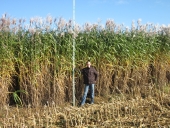
Giant Miscanthus November 2011
January 2012
Hines Farm test plot - 3 years - grows to 14'-16' - does not go down in winds.
This process can change the world!!!
We know and grow giant miscanthus on a testing, small scale basis... Can average 20 tons to the acre. It is a perennial and grows with very little input. Nitrogen all goes back in ground in fall. Harvest once a year in winter/spring. Starts growing in late April and stops in November. Has 15'-30' roots. Grows on rough marginal lands. Does not have to interfere with crop land. Grows only by rhizome (problem/ benefit) - controllable but 3 years to populate.
University of Illinois has and is doing much research ($50 million grant from BP)
Beauty of this is that it has to be implemented locally due to the bulk/weight of crop, requiring short transportation distances to be effective.
Joined: Feb 22, 2010
Posts: 243
Location: Federal Way, WA
posted
0
Very exciting, Monte! Thanks a bunch ;) I think the major parts of this system are well known - C4 plants (as Pollan explained in 'Omnivore's Dilemma') and biochar. You've shown that an optimal plant can grow in Zone 5, as well as the test plot in Missouri ;) The unique element seems to be Cheiky's 'fractionator', with it's special catalysts. Well, he also mentions fungal biochar treatment, but I doubt it's that special.
This brings to mind the Max Planck Institute's 'thermal carbonization' catalysts - used to convert any carbonaceous material to pure carbon, which can be reduced to micro particles that can fuel cars. This happens under high pressure, with the said catalysts (maybe citric acid?), and heat.... but the process itself also generates heat.
And then there's MIT's Nocera's electroysis of water into oxygen and hydrogen, using electricity from sun/wind/etc, in ambient conditions, and also using special catalysts (see Sun Catalytix).
Is Cheiky's fuel oil or alcohol? I'm assuming an alcohol product would result in spent carbon material, miinus it's original sugar/starch constituents, ready for conversion to biochar.
Would this result in monoculture on steroids? If the soil and atmosphere are enhanced, would the only downside be displaced animal life? Hmmm....
Now the question is will Cheiky opensource his 'secret catalysts' ? Or will the investors become the owners of proprietary, patented catalysts (which will then be bought out by the big energy companies) ? I.e., will the usual 'free market' capitalist story play out...as the plutocrats have the financial wherewithall and political 'freedpom' to commoditize and maximize all possible profits to their continued enrichment?
It's time to get positive about negative thinking -Art Donnelly
Monte Hines
Joined: Dec 14, 2011
Posts: 190
Location: Andalusia, IL. Zone 5a
3
posted
0
Nancy,
Really appreciate your thoughtful input... All great points...
Would this result in monoculture on steroids? If the soil and atmosphere are enhanced, would the only downside be displaced animal life? Hmmm....
This troubles me also. I think that (for maximum benefit) planting of Giant Miscanthus or other biomass grasses should be done on sloping lands ("so called marginal land") in a Sepp HolzerPermaculture manor! We plan to try this on our farm with strips of Giant Miscanthus along with mutual beneficial species, thus maintaining a permaculture/polyculture where animal life flourishes... We will see... I know there will be economic pressure that push some to try the monoculture way, but lots of farmers know that is not best... ==> http://www.permies.com/t/13214/permaculture/Soil-Dirt-Lifeline-Fred-Kirschenmann
(btw, I wonder if miscanthus g. has been patented yet!)
Of course universities/corporations/people are going to try to make money off of it and make it their own, just like they try to do with "wild rice" and everything else"...
See Google search "patented miscanthus" results: http://tinyurl.com/85slpj8
I don't think they can call "ours" patented because we got from an open source 4 years ago...
and it grows only by planting rhizomes...
Monte Hines
Joined: Dec 14, 2011
Posts: 190
Location: Andalusia, IL. Zone 5a
3
posted
0
Josiah Hunt - Biochar and the Future of Farming
Tools In Our Toolbox - permaculture, polyculture, hugelkultur, pyrolysis of wastes, biochar, low input, high yield perennial grasses, fire science, rocket mass heaters,...
We have the technologies and knowledge to change our environment to one that works with nature and create abundance for all.
All it takes are individuals/groups in garages/shops/anywhere to put it all together so it breaks through to the masses...
Joined: Jan 25, 2012
Posts: 573
Location: Toronto, Ontario
5
posted
0
Is there a how-to anyone knows of for backyard-scale biochar production? This is a bit of a stretch, but I'd like a trailer-sized biochar kiln that will take the 2'x3.5' pallets (untreated) that we end up throwing out for lack of space. I do use some for hugelkultur, but biochar lets me use more, and get more out of them. I was also wondering if anyone knows about the potential for using a kiln to turn human waste into biochar as a way to treat it for agricultural use. Would that make it safe for use on food plants?
-CK
Monte Hines
Joined: Dec 14, 2011
Posts: 190
Location: Andalusia, IL. Zone 5a
3
posted
0
Is there a how-to anyone knows of for backyard-scale biochar production? This is a bit of a stretch, but I'd like a trailer-sized biochar kiln that will take the 2'x3.5' pallets (untreated) that we end up throwing out for lack of space. I do use some for hugelkultur, but biochar lets me use more, and get more out of them.
There are a multitude of open source technologies for making biochar.
I was also wondering if anyone knows about the potential for using a kiln to turn human waste into biochar as a way to treat it for agricultural use. Would that make it safe for use on food plants?
It is possible. There is great example with chicken manure. It is not a backyard system, however!
With the high moisture content and handling problems (exposure to disease), I would think the Humanure method would be more practical ==> http://humanurehandbook.com/downloads/Humanure_Handbook_all.pdf
Monte Hines
Joined: Dec 14, 2011
Posts: 190
Location: Andalusia, IL. Zone 5a