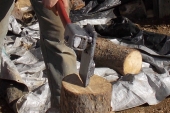
Just read, "Leverage Axe" in Farm Show, Vol 35, No 2 which shows a picture of the axe. There is no friction involved, which gives it more splitting power than a conventional axe. It hits the wood at an incline, which gives it torque and multiplies the splitting force. It goes on leverage, doesn't stick in the block, and there is no abrupt shock to your hands/joints.
Joined: Jul 28, 2010
Posts: 694
Location: rainier OR
posted
0
I split a lot of wood back in Michigan only thing that works in the hard stuff is a big heavy maul and wedges, real rounds are springy and bounce back closed. in that vid you can hear how dry the log is, I never met one that easy
John Polk
steward
Joined: Feb 20, 2011
Posts: 4060
36
posted
0
If anybody gets one to try, I would caution to be very careful until you get used to the feel. I would imagine that the inertia of the off center handle would try to twist itself out of your hand if you used it as a conventional axe. It could be easy to sprain/break a wrist before you got the "feel" of it.
Saybian Morgan
volunteer
Joined: Apr 22, 2011
Posts: 578
Location: Lower Mainland British Columbia Canada Zone 8a/ Manchester Jamaica
7
posted
0
Wow he make's it look like he's dicing up celery. I wish I had a reason to buy one, that tire also as the video show's seems to be critical to not exploding the wood threw a window. Leveraxe is the name, no wonder I couldn't find it when I searched. I need to find a need for one, doesn't seem justified to attack blackberry with one.
John Polk
steward
Joined: Feb 20, 2011
Posts: 4060
36
posted
0
Yeah. The tire "holder" certainly saves a lot of stooping.
For 155.74 euro ($220) it better stack the wood for me too. That's a little pricey for a splitting axe. I might try to make one though. The principal involved would put less strain on the eye which makes the whole tool a lot simpler.
As for splitting up giant rounds, ... why?! Smaller trees split easy, dry faster and are less work to drop/drag. Large trees are for timber and boards, branches and baby trees (<10" are for burning.
On that note, I'm really curious about this rocket stove idea, specifically it's using brush as fuel. Does anyone use one? Know someone who does?
Luke
"If we didn't make up problems, when would we use our tools?" -?
Brice Moss
Joined: Jul 28, 2010
Posts: 694
Location: rainier OR
posted
0
why the big knotty rounds?
because the sawmill cuts them out and rolls them to the side so that twisted up grain doesn't throw off their grading, you also get big rounds that don't split nice or make good lumber from tree with heartwood rot
wisdom McCoy
Joined: Jul 18, 2011
Posts: 4
posted
0
John Polk wrote: If anybody gets one to try, I would caution to be very careful until you get used to the feel. I would imagine that the inertia of the off center handle would try to twist itself out of your hand if you used it as a conventional axe. It could be easy to sprain/break a wrist before you got the "feel" of it.
The Leveraxe has been on the market over 5,5 years. It is the very first Axe-like tool, that stops on the block automatically. This is because of it's unique design where the centre of gravity is not on the striking line as in the conventional axes and mauls, but it is far away aside of it. in addition to this, there are certain safety elements build in to the blade that stops the axe blade on the block or slows down the speed so, that it is fully under control of the user. The friction is almost non existent because the blade starts to lean to the right at the very moment when the blade touches the surface of the block. The blade penetrates into the block only 5 millimetres ( a quarter of an inch) on an optimum strike. All the kinetic energy you can create downwards turns to the left in a fraction of a second and spreads the wood up to 8 centimetres (3.5 inch). All this happens fully automatically so fast that you cannot see it. The striking technique is as follows. "Hold the handle as gently in your hands as possible and let it ROTATE in your hands. DO NOT resist the rotation". You will NOT get any shocks to your hands and body. As you can imagine, this is totally different way to split the firewood. During the existent of the Leveraxe there has happened NO ACCIDENT. Attached slow motion video 1000 frames per second. Here you can see what really happens. http://www.youtube.com/watch?v=E9_9wmjK3j8
I consider it very unfortunate that in the beginning I got to know the person who made this review. The truth is that he did not ubderstand anything about the technique of the Leveraxe. Most probably he squeezed the handle so tight that there was no possibilities for the blade to do it's work as planned. By looking at the pictures in the review I can right away see that no strike has been done correctly. I am very sorry that this kind of reviw ever came to daylight, because obviously many people believe in it and that is why they still make their firewood in the oldfashion way. Look at the attached video and you can see the difference.
It is worthwile to look at the other videos as well. There are many in Youtube.
Joined: Nov 28, 2011
Posts: 930
Location: SE Wyoming -zone 4
3
posted
0
the first link the results weren't perfectly matched because the other guy didnt have a tire, but it was definately faster to split in the first place
so you PERSONALLY knew the guy who did that review and are sure he did it wrong?
i like the axe but would wanna make sure its worth buying before taking the leap given the hard wood i deal with around here...
also i would LOVE to know how fast this thing can chop up a quart of wood, if anyone know an answer or formula
wisdom McCoy
Joined: Jul 18, 2011
Posts: 4
posted
0
Devon Olsen wrote:the first link the results weren't perfectly matched because the other guy didnt have a tire, but it was definately faster to split in the first place
so you PERSONALLY knew the guy who did that review and are sure he did it wrong?
i like the axe but would wanna make sure its worth buying before taking the leap given the hard wood i deal with around here...
also i would LOVE to know how fast this thing can chop up a quart of wood, if anyone know an answer or formula
Hello.
Here you can read the whole story.
As you can see, there is a lot of speculation, because this new way to split the firewood is so different comparing the conventionan way.
I have many times faced even hostile reactions for unknown reasons. The axe has been, as it is today, nearly the same as it was in the stone age.
Initially the wedge was made by stone, today the same wedge is made by iron. There are still no safety elements and that is why there happens numerous accidents.
The Leveraxe is the first axe-like tool in the human history where the friction is nearly non existent. The initial splitting force is even 30 times bigger than in the conventional axes. This is because of the leverage that happens in a fraction of a second fully automatically.
This is very difficult for some people to understand. Maybe that is why this invention saw the daylight so late.
Look and listen to the videos in Yuotube. (Leveraxe) In some of them I try to speak English to explain the function of this tool.
I did not or do not know personally the person who made the review.
A regular single bit or double bit axe of average weight is a more versatile tool and can be used with the same torque to throw the wood apart. This young lady demonstrates quite well, and in green stringy Beech to boot.
The way I made sense of it and learned was when someone said to actually swing the axe straight down but with the bit at a 30 degree angle. When you hit the billet, it doesnt penetrate/stick and you only need to help it along the rest of the twist, the weight of the poll or opposite bit is already going that way.
Rather have a bottle-in-fronta-me than a frontal-lobotomy.
R Scott
Joined: Apr 13, 2012
Posts: 723
Location: Kansas Zone 6a
6
posted
0
Eric Callahan wrote:A regular single bit or double bit axe of average weight is a more versatile tool and can be used with the same torque to throw the wood apart. This young lady demonstrates quite well, and in green stringy Beech to boot.
The way I made sense of it and learned was when someone said to actually swing the axe straight down but with the bit at a 30 degree angle. When you hit the billet, it doesnt penetrate/stick and you only need to help it along the rest of the twist, the weight of the poll or opposite bit is already going that way.
"First they ignore you, then they laugh at you, then they fight you, then you win." --Mahatma Gandhi
"Preach the Gospel always, and if necessary, use words." --Francis of Assisi
Tom Allyn
Joined: Dec 22, 2011
Posts: 17
Location: Maple Valley, WA
A couple things to note in that video. First is that she's using a 'cruiser' axe. That's a relatively light axe, probably not more than 2-1/2 lbs. with a 28"-30" handle, not generally considered a splitting axe. But the twist technique turns it into a great splitter. Also notice that she has intentionally set up much of the wood on rocks. Using the normal splitting technique would ruin the bit of the axe when it broke through the wood and struck the stone. But with the twist technique the force of the blow is converted to sideways splitting energy and the axe stops dead on top the remaining half of the log. No need to buy an expensive single purpose splitting axe when any old axe can do the same thing and much more.