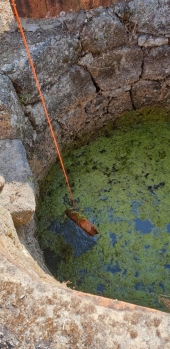
We're looking at buying a property, but the disclosure on the well showed a manganese level is 172 ug/L - typical is 10 ug/L and the legal level is 50 ug/L in California - so 3.5X the legal limit. I know we can buy a filter for the house, but we would also need one for the livestock and not sure if there are any issues with irrigating a garden, etc. If anyone has dealt with this before I would like to hear what you did or is this a deal killer.
There is not currently a method to single handedly remove select elements economically at a consumer level. You are limited to removing most or all minerals from the water with current technology. Personally, I like electrodeionization but also consider that your water will have no minerals so you will need to supplement. The quality of water in a well designed filtration system is much better than municipal supplies.
Joined: May 17, 2007
Posts: 2682
Location: woodland, washington
39
posted
0
we have a lot of iron and manganese in our well water. I don't remember the numbers involved, but there was a lot of black manganese sludge involved. a slow sand filter solved the problem for under $100. this page has some good information.
Joined: Nov 11, 2010
Posts: 444
Location: Piedmont, NC - Woodland - Clay - Zone 7
4
posted
0
we have a lot of iron and manganese in our well water. I don't remember the numbers involved, but there was a lot of black manganese sludge involved. a slow sand filter solved the problem for under $100. this page has some good information.
Sand is usually an inert material and cannot remove ions from water. Soluble metals are chemically bonded to water and cannot be removed mechanically. Not even a magnet will remove iron ions from water. I would retest your water because I think your sand trap gave you a sense of false security if you iron and manganese levels are too high. Otherwise, both are beneficial minerals at the right concentration.
a more hi-tech method is with ozone/filter
how much water are you going to use?
An ozone filter does nothing but kill microorganisms. You can use active carbon to remove ions from water because it is very reactive but you do need to cycle the filter. I do not know the measure of its effectiveness but it is not as effective as reverse osmosis or deionization.
tel jetson
steward
Joined: May 17, 2007
Posts: 2682
Location: woodland, washington
39
posted
0
Amed Mesa wrote:
Sand is usually an inert material and cannot remove ions from water. Soluble metals are chemically bonded to water and cannot be removed mechanically. Not even a magnet will remove iron ions from water. I would retest your water because I think your sand trap gave you a sense of false security if you iron and manganese levels are too high. Otherwise, both are beneficial minerals at the right concentration.
it's not the sand that's doing the filtering, it's the slime that grows on it. you're right that the sand is inert, but the layer of slime (biofilm or hypogeal layer if you want to sound fancy) is not.
the major disadvantage is the slow rate of filtration. we solved the problem with a 500-gallon storage tank that gravity feeds to the rest of the land.
the major advantages are that it's almost ridiculously cheap, easy to build, and extremely effective. removes most biological, chemical, and metallic contaminants. even removes ions.
I don't have our before-and-after water test results on hand, but they are dramatic. so I'll pitch a slow sand filter again. great way to remove manganese.
tel jetson
steward
Joined: May 17, 2007
Posts: 2682
Location: woodland, washington
39
posted
0
Amed Mesa wrote:
An ozone filter does nothing but kill microorganisms. You can use active carbon to remove ions from water because it is very reactive but you do need to cycle the filter. I do not know the measure of its effectiveness but it is not as effective as reverse osmosis or deionization.
both manganese and iron are oxidized by ozone, at which point they become far less soluble and drop out of solution. it's just a matter of letting it settle out of water after that.
Joined: Feb 05, 2010
Posts: 118
Location: Nortern New Mexico, Zone 5b
posted
0
I like backwashing filters with filox/catalox/pyrolox media for manganese and iron. The upfront cost for a whole house/well filter would be about $1000 to $1500 depending on the amount of water to be filtered, but they are quite effective and have lower operation and maintenance hassles than other filters. I would steer clear of greensand filters since you have to backwash with potasium permanganate for effective long term filtration.
172 ug/L manganese is plenty to stain white laundry and such, but should be fine for irrigation. I have the filter backwash going into a mulched basin. The backwash by its nature has much higher iron and manganese than the water being filtered, but the plants don't care.
It isn't a deal breaker IMO. Manganese is fairly easy to deal with. If there was high heavy metals, radionuclides, nitrates/nitrites, organic compounds, etc. - then I would think twice.
tel jetson
steward
Joined: May 17, 2007
Posts: 2682
Location: woodland, washington
39
posted
0
Ardilla Esch wrote:I would steer clear of greensand filters since you have to backwash with potassium permanganate for effective long term filtration.
I agree. permanganate is nasty stuff.
just to be clear, a slow sand filter or biosand filter is a very different animal than a greensand filter. the only maintenance required is occasionally refreshing the sand as the infiltration rate starts to decline. depending on the load in the water and the size of the filter, this might have to be done four times in a year, or once every ten years. the basic idea is to scrape off a thin top layer of sand and replace it with new sand. when I do mine, it takes between five and fifteen minutes every four months or so.
as for Filox et alia, the frequent backwash requirement wastes a lot of water. Pat JFree doesn't mention much about the location other than that it's in California, but that's not exactly the wettest state in the union. sure, the backwash can be used for irrigation, but chances are good that it would quickly clog up any drip emitters it was run through. if there's some good slope to the land, the backwash could be used to passively irrigate, maybe after running it through some reed beds. still looks like wasted water to me.
another issue with that stuff is the expense of replacing the media when it's finally used up. Filox lasts a long time, but it's very expensive to replace. might still be the best option if the low-tech, DIY solutions don't appeal, though.
Ardilla Esch
Joined: Feb 05, 2010
Posts: 118
Location: Nortern New Mexico, Zone 5b
posted
0
Typically the backwash volume isn't too bad, especially if it is controlled by volume filtered instead of by days/hours elapsed. My filter backwashes less than 10 gallons per week. The amount of backwashing required depends on water chemistry and how much water you use.
I agree you shouldn't try pushing the backwash through drip emitters. Treat that water as if it was grey water and there shouldn't be problems.
This kind of filter isn't the best choice for everyone. I recommend finding out what the rest of the basic chemistry looks like before choosing a treatment method.
tel jetson
steward
Joined: May 17, 2007
Posts: 2682
Location: woodland, washington
39
posted
0
ten gallons in a week isn't bad. certainly less than a leaky faucet. I would guess that your water has relatively small iron and manganese loads to begin with. or that you conserve water very well. or both. at any rate, that's not bad at all.
Patrick Freeburger
Joined: Nov 09, 2009
Posts: 35
posted
0
Thanks everyone. The land is just south of San Jose, CA in the hills and we get about 15-18 inches or rain a year. The land has several springs which I assume has the same level of Manganese (the other chemicals are ok). I am hoping to keep my irrigation to a minimum, but it's good to know it will still go through a drip line. I did a worst case water usage for livestock (or best case farm depending on how it goes) and it is not as bad as I had feared. It looks like exposing the ground water to air (oxygen) eliminates the manganese so a figure eight water flow may be an option for some things, but most of it will need to go through one of filters you mentioned.
Amedean Messan
Joined: Nov 11, 2010
Posts: 444
Location: Piedmont, NC - Woodland - Clay - Zone 7
4
posted
0
both manganese and iron are oxidized by ozone, at which point they become far less soluble and drop out of solution. it's just a matter of letting it settle out of water after that.
Thanks, I did not know this until now and I will look this up. From what I recently read filtration would be required for the non-soluble micro particles. I do not know how effective as far a efficiency this process compared to the other options but I am interested.
tel jetson
steward
Joined: May 17, 2007
Posts: 2682
Location: woodland, washington
39
posted
0
Amed Mesa wrote:
both manganese and iron are oxidized by ozone, at which point they become far less soluble and drop out of solution. it's just a matter of letting it settle out of water after that.
Thanks, I did not know this until now and I will look this up. From what I recently read filtration would be required for the non-soluble micro particles. I do not know how effective as far a efficiency this process compared to the other options but I am interested.
those two also oxidize fairly rapidly on exposure to oxygen in the air, which is why the flowforms Pat JFree mentioned work. last I checked, pre-made flowforms were pretty expensive, but not as expensive as most filtration equipment.
and, for what it's worth, the slow sand option filters insoluble iron and manganese oxides very well. I'll stop the broken record routine now, but I've been really impressed with this simple, effective, appropriate technology.
subject: Advice on treating Manganese contamination in well water?