I hope I'm asking this in the right place.. I wasn't quite sure but since I feel like making use of trees is a permaculture-thing I thought I'd try it here.
I was thinking of asking if anyone knew of a one man 'pit-style' rip saw (ie. with real rip teeth) but at this point, I've kind of figured out that they don't exist.
My specific problem is that I have a 5' log of deodar cedar that's about 12" in diameter and I'd like to get some boards out of it, by hand. No chain saws, etc etc. At least I'd like to try it first that way and fail
I realize that there are several types of teeth patterns - has anyone had any success with one type of tooth pattern over another?
Honestly, I'm kinda stunned that I can't find (online) any solution to the problem of making boards out of a log with hand power. It doesn't seem too crazy a question. Am I looking in the wrong places? Hmm...
Thanks!
ps. Anyone have one I can try out around Eugene Oregon?
tel jetson
steward
Joined: May 17, 2007
Posts: 2634
Location: woodland, washington
39
posted
0
you might have better luck with wedges and a sledge.
tel jetson wrote:you might have better luck with wedges and a sledge.
I've tried that on a bigger doug fir log I have (24" diameter, 4-5' long) and while I had decent success, it seemed to be more wasteful of the wood. Also, I think I'll need an adz in order to smooth out the bumps, so to speak. It seems to me that logs don't split all that evenly. Of course, I might not be that good with a sledge & wedge.
Paul Krum
Joined: Dec 22, 2011
Posts: 9
posted
0
I believe a froe and mallet is another traditional method. Your log will need to be straight grained. Also something like the crotch of a tree was used to hold the log. Best done when wood is still green and full of moisture. Good luck with that.
Deb Suran
Joined: Jan 13, 2012
Posts: 4
Location: Coast of Maine
Joined: Feb 16, 2010
Posts: 444
Location: Kirkland Lake, Ontario, Canada
posted
0
Chuck Freeman wrote:Those are for ripping boards they will never work on logs
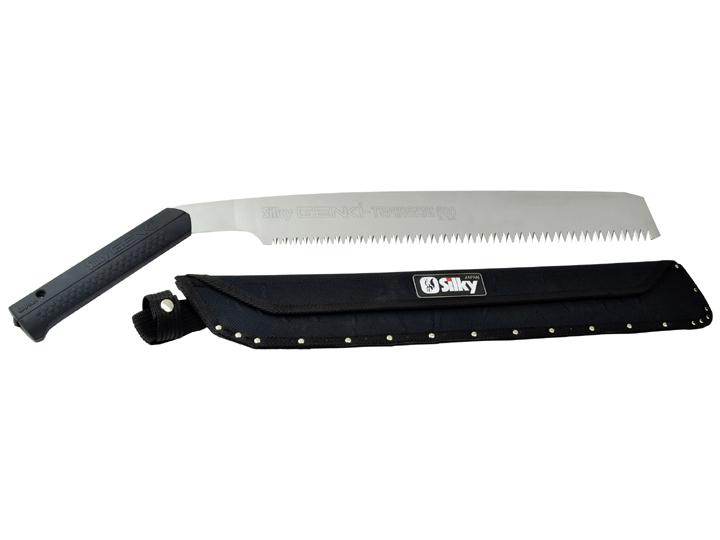
The 28" rip saw would work with a lot of effort however having used a similar styled antique saw and the Japanese rip saw from the previous post the 16" (420mm) Japanese saw works better, faster and with less waste.
It can be done!
Matthew Fallon
Joined: Jan 07, 2010
Posts: 294
Location: long island, ny Z-7a
posted
0
thre are several videos on youtube on how to use wedges and a froe to split rough planks, then flatten with adze,draw knife ,scrub plane,joiner plane,jack plane and so on...
You have to watch new saws as they are all punched from flat stock. Old ones are ground so the back is thinner that the front(the side with the teeth). Filing and setting rip saw and crosscuts is an art and the tools to do it don't come cheap either. If it was me and I really wanted to use hand tools to work with I would do the research then bite the bullet and go with the old stuff. There also some very books put out by the Forest Service that tell how to use and maintain crosscuts and axes. One is The Crosscut Saw Manual the other one is Saws that Sing. There is also a good one on Axes called An Ax to Grind.
This is the only address I can find but I'm sure you could Google them up pretty easy:
USDA FS, Missoula Technology and Development Center
5785 Hwy. 10 West
Missoula, MT 59808–9361
Phone: 406–329–3978
Fax: 406–329–3719
E-mail: wo_mtdc_pubs@fs.fed.us
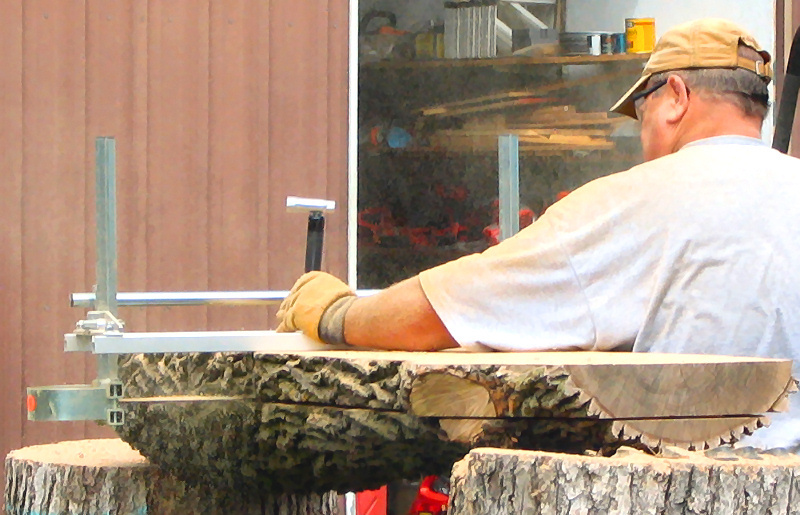
I've ripped planks with rip saws, split them with wedges and froes, and used band saws and chain saw mills. It is just my opinion but for all round milling you can't beat an Alaskan Chainsaw Mill.
Monte Hines
Joined: Dec 14, 2011
Posts: 190
Location: Andalusia, IL. Zone 5a
3
posted
0
Any one of these might work with lots of hand effort...!!!
http://www.woodworkersinstitute.com/page.asp?p=967 Ripsaw- Rob Stoakley tries out the new ripsaw
I was unaware that such beasts were still made, so it was a pleasant surprise to find a brand-new one to test. My workshop's small-capacity machines cannot saw through thick boards so ripping down the grain is a bit of a challenge, especially when a large lump of timber is involved... not anymore though. This one sailed through 75mm-thick elm with the minimum of effort and was a real pleasure to use.
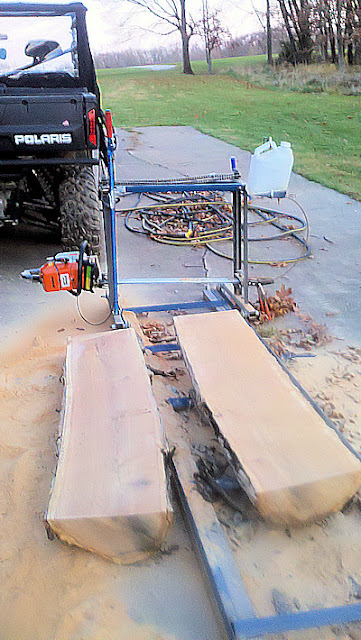
Monte what kind of chainsaw mill is the one on the carriage? Not the Alaskan mill but the second one?
Monte Hines
Joined: Dec 14, 2011
Posts: 190
Location: Andalusia, IL. Zone 5a
3
posted
0
Mine is 30" Panther Pro carriage with 12' track
I use STIHL MS460 saw with 32" bar which seems to work well...
http://pantherpros.com/pantherPRO.html Kim Kasten - Owner / Builder
Phone : (352) 263 - 4254
15345 Peach Orchard Road
Brooksville, FL 34614
They sell on eBay but I bought mine direct.
Bought a couple years ago.
Took about 6-8 weeks to make and get.
I am well satisfied with it.
Light weight and easily moved, but strong where it needs to be.
I use a portable battery 18v drill to raise and lower saw height. Fast and easy...
Kim Kasten was very good to work with...
My opinion is that it good value...
Thanks I'll have to do some looking when I have some time, looks like a cheap alternative to a bandsaw.
Matthew Fallon
Joined: Jan 07, 2010
Posts: 294
Location: long island, ny Z-7a
posted
0
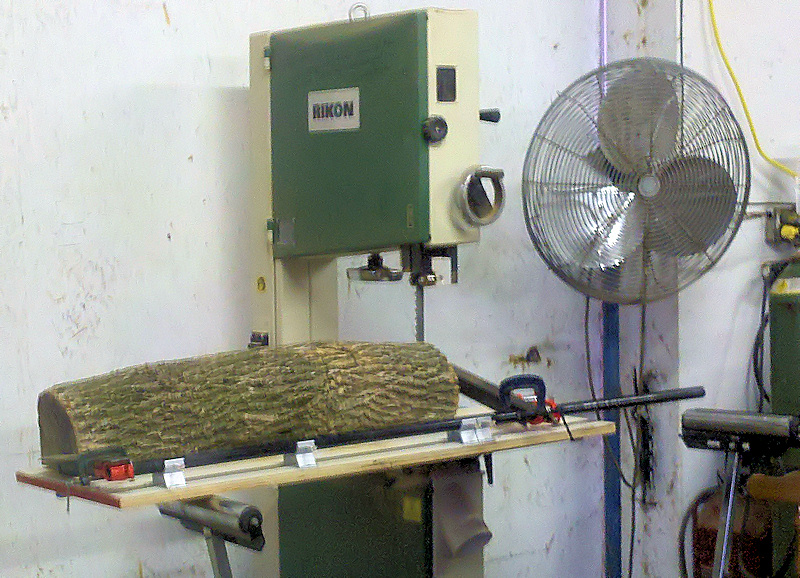
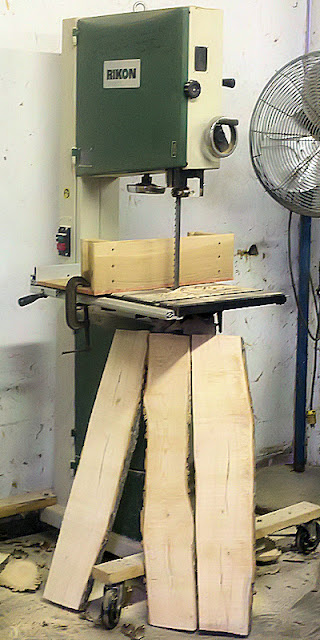
i also like the bandsaw sleds for slabbing smaller lengths . i can only do 15" resaw but that's plenty for small craft i do with little pieces.
Monte, what advantages do you find in using the track/carriage mounted rig?
i love my alaskan mill...
i find the best part of a chainsaw mill is the light weight,portability and quick setup.
i guess i feel like if i need to bring the log to the mill i'd be better off with a bandmill. or that "rip-saw chainsaw bandmill attachemnt looks pretty nifty,albeit a bit pricey.
i've seen other portable mini-bandmills too. like "lumber smith"
Monte Hines
Joined: Dec 14, 2011
Posts: 190
Location: Andalusia, IL. Zone 5a
3
posted
0
Monte, what advantages do you find in using the track/carriage mounted rig?
i love my alaskan mill...
i find the best part of a chainsaw mill is the light weight,portability and quick setup.
i guess i feel like if i need to bring the log to the mill i'd be better off with a bandmill. or that "rip-saw chainsaw bandmill attachemnt looks pretty nifty,albeit a bit pricey.
i've seen other portable mini-bandmills too. like "lumber smith"
Biggest advantages are that we don't have to place the 9ft EZ Rails in place, and affix to the log for the first cut. Also we don't have to hand adjust the depth of cut on the Alaskan mill.
On the carriage mill I just use the battery drill with socket to raise the chainsaw to the depth of cut desired.
I still like using the Alaskan mill in certain situations. On a very large log, I can square the log and use Mini Mill II to reduce size. It works for logs that aren't easily transported by our tractors with forks.
Owning a bandmill big enough to do a proper job is very pricey. It is my understanding that bandmills under about 15 HP are pretty under-powered.
If we have a large amount of logs, like now due to storm damage (over 100) we are having portable bandmill and operator come in for 2-3 days to slab the wood. I will stack, sticker, store, and slowly dry in open sided barns.
We have to have a couple of chainsaws to manage downed and damaged trees anyway. The Alaskan and small carriage mill allow us to keep up with normal amount of annual timber management and salvage for lumber. Remaining stuff is used for raised beds, biochar, and firewood.
I can resharpen chainsaw chain easily and cheaply myself. Buying and maintaining large bandsaw blades requires more skill, equipment and expense.
Everyone has to decide what is right for them, depending on their circumstances.