|
Pages: [1]
|
 |
|
kelda
Posts: 263
|
 |
August 12, 2008, 12:19:40 AM |
|
So what's the dif between using an outhouse and a composting toilet/bucket/pile as far as the composting process goes? Provided that both use sawdust as the carbon? I mean, one is in a deeper hole but there's still plenty of oxygen and worms down there.
(I admit I haven't read the Humanure book and the answer may be in there).
And while we're at it, if say you were just pooping in buried holes all over a pretty big property, then how would this compare biologically with just a big pile composting? Just more spread out nutrients, or more spread out pathogens?
|
|
|
|
|
Logged
|
|
|
|
|
|
paul wheaton
Administrator
Posts: 1338
|
 |
August 13, 2008, 09:57:29 AM |
|
I, also, have not read the book.
My thinking is that the so called "composting toilets" are probably mis-named. I think they are more like "poop cookers." They encourage you to not pee in them. And then they use some sort of energy (sometimes solar) to dry out the poop. If the temp is hot enough, the poop will be sterilized. Then somebody has to move the poop. But at this point, it is quite safe for use as almost anything. The only concern might be what kinds of meds a person might be taking that is still in the baked poop and might not be good to introduce to your soils.
If you have standard poop (not cooked), I think minimizing the surface area is wise. And to keep it from the air and bugs as much as possible is wise. Frankly, a septic system seems optimal to me. But it is expensive and it does use a fair bit of water.
One thing I keep thinking of is hearing how peace corps folks teach folks in africa to stop pooping in the woods. Apparently flies go out, land on the poop, then come back and land on their food. And lots of people die from this.
So I like the idea of a properly managed outhouse. A big roof. Rain water is directed away from the outhouse. And people are asked to not pee there - just poop. Lots and lots and lots of sawdust is provided. With a healthy system there should be no smell (or almost no smell) and nobody should ever have to empty it. With a nearly dry system, nothing should end up in the ground water.
I like the idea of building an outhouse on skids. And then if the hole ever does fill up, you can just move the outhouse to be over a new hole. Put a nut tree seed on the old hole. If you grow the tree from seed, it will develop a fantastic tap root (transplanted trees nearly always lose their taproot). By the time the tree bears nuts, the pathogens will be long gone.
|
|
|
|
|
Logged
|
|
|
|
|
|
paul wheaton
Administrator
Posts: 1338
|
 |
August 19, 2008, 01:23:30 PM |
|
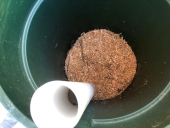
That looks like a real composting toilet. Most of them that I have seen don't have a big bin like that. They have something more like a little box under the toilet.
|
|
|
|
|
Logged
|
|
|
|
|
|
SueinWA
Posts: 303
|
 |
October 08, 2008, 08:18:38 PM |
|
READ THE BOOK!!!
It's right here at http://www.joseph-jenkins.com/books_balance_contents.html
It's interesting, it's funny, it has drawings and photos. He answers all your questions about pathogens and everything else, even stuff you hadn't thought of asking.
And he explains why you shouldn't bury it in a hole in the ground. Or multiple holes in the ground. Do that, and you're no better than these chemical farmers who are dumping chemical nitrogen and phosphorus into the world's water supply.
PLEASE... Read it!
Sue
|
|
|
|
|
Logged
|
|
|
|
paul wheaton
Administrator
Posts: 1338
|
 |
October 09, 2008, 02:39:08 PM |
|
So now I've read it. Or, at least, I've read most of it. I skipped over about 20% of it.
And now I would like the author to give me an opinion on the dry outhouse and on tree bogs and possible hybrids.
|
|
|
|
|
Logged
|
|
|
|
|
Pages: [1]
|
|
|
|
|