I got home from a long trip for work and hear that one of the new apple trees isn't doing so well. "It's covered in ants!" I know right away what's going on. The ants are herding aphids!
Yeah, yeah, you think I'm a few fries short of a happy meal and this just seals the deal. But I tell ya it's true. I'll confess that they don't ride little miniature horses and yell "HYA! GET ALONG LITTLE DOGGIES!", but they will pick up an aphid and move it to where they think they will get the best sugar. Then, when the aphid is nice and plump, they suck the sugar out of the aphid's butt! Mmmmmmmmm .... sugary aphid butt ......
Want proof? See the movie ANTZ. Take a look at the bar scene where Weaver says to Zee "Don't you want your aphid beer?" and Zee says "I can't help it. I have a thing about drinking from the anus of another creature. Call me crazy."
Okay, so a cartoon movie without any double blind studies isn't the most persuasive thing. Well, how about THIS!
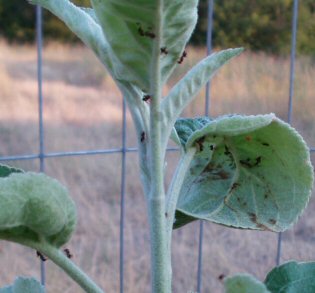
Ants on my apple tree. And if you look close, you can see them fiddling with the aphids.
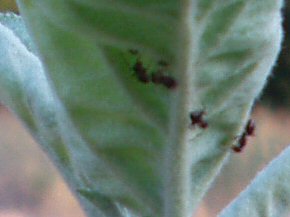
The next two pictures are close-ups from this pic.
The two ants right about in the middle are each tending to one aphid.
There are at least five aphids in this picture.
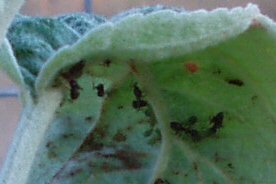
See the aphids? No? The next picture is a close-up.
There are at least eight aphids in this picture.
Here you can see aphids on top of the leaf. Notice how the leaf curls in wherever aphids are present. I can see about eight aphids in this pic.
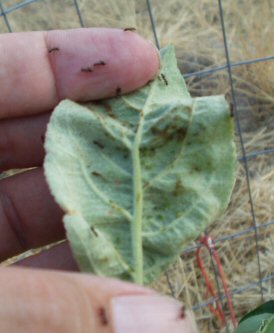
About twenty aphids?
AHA! Photographic evidence! Well, I couldn't zoom in enough to see the ants actually sucking sugar out of the aphids. I tried to find some pics through google and struck out. I did see something on the discovery channel once about it. And I remember reading it in a book once! (a bibliography like this is so much easier to write than naming actual sources)
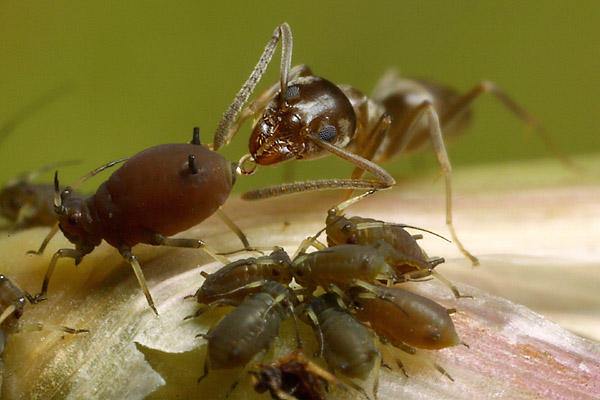
Reader "Aase in Norway" connected me with Charles Chien who actually did take a picture of an ant enjoying sugary aphid butt! Real proof!
(Thanks Charles for giving me permission to post your excellent pic here!)
Those of you from down south will be thinking that I'm a heavy duty tough guy letting those ants crawl on me like that. But these aren't the fire ants you're used to. These are black ants. They can bite, but rarely. For these pictures I had dozens of them crawling all over my arms and they never bit me. If they did, I would squeal like a little girl.
For those of you that don't know what aphids are, they are small, soft bodied insects with a needle like mouth kinda like a mosquito. But instead of sucking the blood from animals, they suck the blood from plants. As I'm sure you know, plants convert sunlight into sugar. They then pump the sugar throughout the plant, including down to the roots. Aphids stick their needle in and extract the sugar as it is on it's way down to the root.
Getting rid of aphids is easy. For best results I order up some "aphid lion" (lacewing larvae) eggs. I used to get ladybugs, but they tend to fly away before the job is done. Aphid lions don't have their wings yet. And they're just starving for aphids.
Since the ants will attack anything that comes near the aphids, I knew I had to get rid of the ants first.
Controlling ants organically. Plan A:
Diatomacious Earth (DE) is an off white talc-like powder that is the fossilized remains of marine phytoplankton. When sprinkled on a bug that has an exoskeleton (such as an ant) it gets caught between their little exoskeleton joints. As they move, the DE acts like razor blades and cuts them up. DE only works when it is dry. DE does not harm other animals, in fact, some folks feed it to their animals thinking that it will wipe out some parasites. DE can irritate lung tissue (just as any talc-like dust would), so try not to breathe in any dust.
Since DE works only when it is dry, use it only on a dry day with little or no wind. Put it on around 9 or 10 in the morning so that morning dew won't wet it.
A few times in the past I have sprinkled a little DE on problem ant spots and the ants would then be gone. So naturally, this is what I did here. Sprinkle sprinkle sprinkle. And then I said the magic words "DIE YOU LITTLE BUTT SUCKERS! BWA HA HA HA HA HA."
The one thing to remember about DE in this case is that when the ants are all gone, make sure to rinse away the DE so that the beneficial insects that will be eating the aphids won't be hurt by the DE.
While I was there, I smashed scads of aphids. They smash super easy. Just touch them and they pop. So I just gently ran my fingers over the leaves. Most of the aphids are on the bottom of the leaves, but a few were on the top. I probably smashed about a third of all the aphids on this little tree. For those of you that don't have a natural green thumb, by the time you've smashed a few aphids this way, your thumb is mighty green. You can now feign horticultural superiority until you wash your hands.
I also smashed all the ants that dared to walk on my hands and arms. I probably smashed about 40 ants this way. Maybe 5% of their population.
I came back the next day to view the results of my handiwork. It was as if I was never there. Scads of ants and aphids. I said to them "YOU MAY HAVE WON THE BATTLE, BUT THE WAR AIN'T OVER YET!" So I shook a bunch of ants off the tree, smashed a bunch of aphids and ants and stormed off to formulate my new scheme.
Controlling ants organically. Plan B:
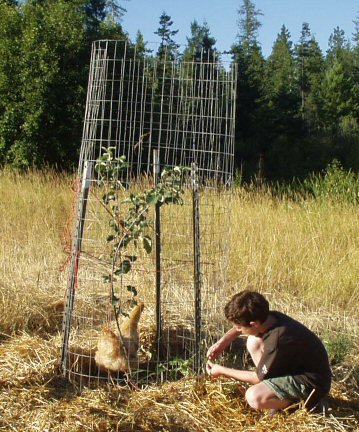
Chickens eat bugs. I have lots of chickens. The tree is already in a cage to protect it from the deer. As luck should have it, the wires on the cage would contain a chicken. This evil plot could work ...
"BIO-REMOTE DANE! FETCH ME A CHICKEN!" (Being the master of 80 acres means that there could be some hiking involved between two points. Therefore it behooves the lazy to to have henchmen)
"Yes Sir!"
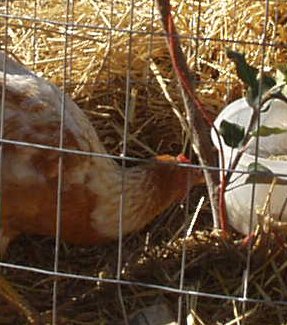
A great deal of squawking from the hen house and Bio-Remote Dane returns with a lovely Buff Orpington hen. Dane puts her in the cage along with some food and water.
We explain to the hen what we want her to do. I think she wasn't paying attention. Later she escaped and returned to the hen house. Coward.
The ants and aphids are probably throwing an underground party. So I smash a bunch of them by hand.
Controlling ants organically. Plan C:
It's possible that our first chicken agent didn't have the right stuff. I know I've seen plenty of chickens eating plenty of grasshoppers. And I've seen chickens eating big, carpenter ants. There were heaps of ants in the cage, but I never saw that chicken even look at them. Maybe the ants were small enough that the chicken couldn't see something that small.
A chick would be 20 times smaller. Does an ant appear 20 times larger to a chick than a full grown chicken? While one of these ants appears ant sized to me, it might appear dog sized to a cricket.
A chick could get through the wires of the fence. So we needed a chicken that was small, but not so small that it could get out of the fence.
This time, Bio-Remote Dane provided an adolescent red star chicken. We put her in the cage, and before we could explain her mission to her, she started gobbling up all the ants.
Now this chicken is a real "team player"! By "team player" I mean that she reads my mind and does all of my work for me.
Bio-Remote Dane checks the feed and water every couple of hours. After eight hours we return the chicken to the coop. I'm not sure if there's much difference. We try this for two more days and there are still plenty of ants and plenty of aphids. Maybe a little less. But that could also be because I like to smash them. One thing is for sure: The effort to results ratio is lousy. We need a new plan!
Controlling ants organically. Plan D:
I got distracted for a week or so. Yeah, that's it. I wasn't just avoiding the problem. Nor was I whining about losing to a bunch of ants. I wasn't sulking about how my army of chickens, trained in insect warfare had failed to conquer a few hundred tiny ants. Nope. Not me. I just had other things to do. Got a little busy, that's all. It could happen to anybody. Really.
So I wander out to the old battleground. It's worse than ever. After a few minutes my thumb is really green. But somehow, it seems like an empty green.
Why did the DE not work? It worked before. What was different? Did I use the wrong magic words? Have the ants developed some sort of DE resistance technology? Maybe they heard me talking about it before and were prepared ....
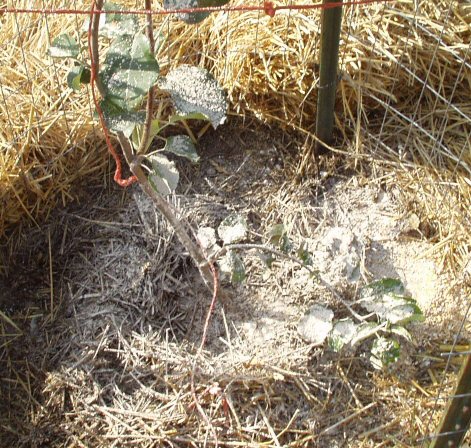
I snuck back to the garage and got a big scoop of DE. I tiptoe up to the cage and ... DE on the leaves! DE on the ground! DE everywhere! Too much DE!!!
With Plan A I used about a third of a cup of DE and put it only on the leaves. This time I used about a cup and a half and put about half of it on the ground.
The next day I found some ants near the base of the tree still alive. The tree had been watered a few days before and the DE wicked some moisture out of the ground. I added some fresh DE. The day after that I could find only three ants alive and I found only three aphids. I smashed them. Personally.
Our side suffered no losses. And as they say, history is written by the Victor. Victor is a rooster that doesn't know how to write, so I wrote this.
VIVA LA FARM!
update! I wrote this article before learning the word "permaculture". My opinion on solutions has, I think, evolved. In this case, the real problem is a lack of polyculture. There should be dozens of plants under the apple tree that would make the tree healthier and stronger and would also repel ants and aphids (like catnip). The apple tree should be near lots of trees (non-apple), shrubs and undergrowth. I've also learned a great deal more about growing apple trees from seeds, or from their own rootstock, and about pruning techniques (or, rather, non-pruning techniques would be more accurate). To get a lot more details about this sort of thing, read below in the discussion.
I had a miniature rose planted in a barrel and it kept getting aphids and nothing i used worked till I planted mint in the barrel next to the rose. I have not had an aphid in there since. Sometimes an herb with a fragrance will repel bugs.
I've heard that chives around the base of a tree will disuade ants from climbing the trunk.... I've heard this goes double for tansy, although i've never planted that. If the ants get into my strawberry patch this year, you can bet i'll try it out though.
York, PA, United States
USDA Plant Hardiness Zone 6 (6a-7a)
Annual Rainfall = 62"
January Temp Avg = 33
July Temp Avg = 76
I'm trying a wide swathe of water-proof automotive grease around the trunk of my fruit trees. Day one and so far so good. Most ants and aphids are turning right around and heading down the trunk - a few unfortunates got about half way through. I'm not sure how the trees will react though.
What about using boiling water? Certainly not on the roots of your apple tree, but what about for ants in walkways, or for very large colonies in the lawn?
I've also read about boiling water on ant hills, but I haven't tried it yet. We have several large ant hills in our backyard...also, a three year old. So chemicals really aren't an option.
paul--HAHAHAHAHA!!! you're a hoot! love your site, love your stories. you showed those ants and aphids who's boss...okay, even if it took more than a week! woo-hoo, go paul! and dane, you look like the best assistant a boss ever had. i found this site by searching for organic lawn care tips and got lost laughing at the stories. thanks for the giggles! -mrspokey in CT
I found your site while searching for a remedy to my MASSIVE aphid invasion problem on my prized french plum tree. I came back from vacation today and was checking over my plants and AGGHHH there was the evidence of rotten creatures at work on my tree . Upon closer inspection, there too were ants hardily at work. I rushed into the house to hop onto the computer to find the quickest solution and came across your similar plight!!! I thoroughly enjoyed the read and will be going out for some DE post-haste. Thanks for the tip!
While I think the stuff listed above is good for short term, I really think that the stuff that j. bruce listed is probably the smartest for long term.
Since I wrote that, I've come across several plants with similar problems and have seens loads of ladybugs. On the trees with ants, the ladybugs are not making much progress. So I think that if one were to focus on controlling the ants, the ladybugs in your area would take care of the aphids.
Hello, I just found your site, and I thought I'd tell you what the folks on the Organic Gardening List do for aphids. A strong spray of water can knock off most of the aphids. You need to do this every few days, as new generations of aphids appear that frequently; but the ones you knock off are (I've been told) not able to come back.
What a great site! I, too, was looking for lawn care tips when I came across the site. Love it!! Great tips given in an amusing format. What more could I ask for??
What about ants in mulch? I have millions of the little critters in my wood mulch & I really don't like them coming into my house when I did not invite them!
I'm thinking of using DE for an ant problem. About how much should I buy at one time? How much territory would a 5 lb bag cover, for example? Can I buy it locally, or is this something that would be better bought over the internet?
I saw a five pound bag at a farm supply store a few days ago.
The trick with buying it over the internet is the cost of the shipping.
What sort of ant problem are we talking about?
The thing to keep in mind is that DE will kill ALL creatures with an exoskeleton - including your beneficials. There's nothing wrong with having a few ants. But having ants killing your growies is might rude on the part of the ants!
Wow very interesting, came across that page while i was looking for a remedy too. i've got a plum tree (about 6-8 meters tall), i don't remember what kind tho :/ (grows little green plums) and the ant/aphid infestation is MASSIVE. there are atleast 40+ aphids and 1 ant on each infected leaf, they form a solid sheet on the bottom. im not exactly sure how many there are cause it's a fairly large tree, but on a warm day, there is a chain of ants constantly moving up and down the tree trunk. Where are you guys located? cause the aphid in that picture looks nothing like the ones we have here, im in the western coast of canada, and the ones we have here are like 1/4 that size, and as green as the back of the leaves (kind of a neon aqua green). There are enuff aphids on the tree that it's making the ends of the branches shrivel
so when you say garlic will repel ants, do you mean like rub a piece of garlic around the base? or do you mean like grow garlic, cause if chives work too, then growing garlic chives must work great lol...
edit: also, do you think taping a cup around the trunk and filling it with that DE stuff would work? cause the ants can't get up anywhere other than up the trunk, and the lady bugs that eat aphids, can just fly up there rite?
I think this was suggesting stuff to plant. But for immediate results, throw DE on the ground around the trunk of the tree on a dry day. Do that every day for a few days. The DE on the ground will probably destroy most of the ants almost none of the ladybugs.
yay, ok i finally found some time and transfered some of my garlic chive plants into the ant's home (ant hole + shovel = pwn) now im just wondering where i can get DE, i should be able to buy it at any hardware store that has a gardening section rite? and does it work if i mix DE into food, so that when the ants try to eat it, it'll cut up their insides?
Don't try to get the ants to eat it. Just try to get the ants dusted with it. If you put lots of it where they hang out, it kinda blows onto them and then gets between their joints and cuts them up.
I've read this thread with interest - I too have aphids and ants! Can I ask what is DE - it is mentioned here, but I've never come across it - can you get it in the UK?
Diatomacious Earth (DE) is an off white talc-like powder that is the fossilized remains of marine phytoplankton. When sprinkled on a bug that has an exoskeleton (such as an ant) it gets caught between their little exoskeleton joints. As they move, the DE acts like razor blades and cuts them up. DE only works when it is dry. DE does not harm other animals, in fact, some folks feed it to their animals thinking that it will wipe out some parasites. DE can irritate lung tissue (just as any talc-like dust would), so try not to breathe in any dust.
if you spray any bush which is covered with aphids...where are they going to go? on the other flowers and plants? Does that actually work or does it just spread them around.......Will diatomaceous earth also destroy earwigs and weevils.?...what about snails.? What purpose do aphids and ants serve? I really abhor them both but still find them fascinating and...can we live in harmony with them....They have also invaded my home in places where there was moisture...they're not carpenter or termites but they call them moisture ants...they appear to be the same ants that are milking the aphids....and are there other alternatives to fumigating your home....
ladybug wrote: iWill diatomaceous earth also destroy earwigs and weevils.?...what about snails.?
My understanding is that diatomaceous earth will destroy crawling (not flying) insects and arachnids (spiders). . A snail is not an insect or spider and has no joints that the DE can get into. I doubt it would have any effect on snails.
I just wanted to say i loved the artcile about the ants and aphids. We have a major infestation, and have tried squishing them, garlic,onion,soap,spray, just soap spray, ant bait disks...It is comforting to know I am not alone in the war:) Also I am getting some DE soon. The pictures were great too.
I've been reading all the talk of ant and aphid control using diatomaceous earth. Just want to let you all know that DE will control and kill them quite well and, the concern about breathing it in can be minimized first by, wearing a dust mask if you're going to use a lot of it at once and, use the "wet" application whenever necessary, and don't apply it on a windy day. Dust of any kind is bad for you in large quantities. A friend of mine's dog died of lung cancer from hanging around his wood shop where they made cedar furniture. Cedar isn't bad for you and it repels bugs but, there is such a thing as too much of a good thing sometimes. Also, use only pure fossil shell flour and fossil shell flour with pyrethrine for the tough situations. There are many kinds of Diatomaceous Earth. Some are for swimming pools that have been altered chemically and heated are toxic and salt water DE, which you don't want around either and quite a few others are available, Fossil shell Flour is used to treat stored grain in Silos. We eat it most of the time and don't even know it. It's a very safe product to use. Beat malathion hands down! Also, wanted to let you know that, DE doesn't harm earth worms but, it will eliminate slugs. It kills fleas, ticks, and internal parasites and adds minerals to soil and food. Fossil Shell Flour in it's pure form is good for you and all your livestock. If you want to know a whole lot more and get some free instructions on it's use, you can go to this page on my web site at http://www.dirtworks.net/Diatomaceous-Earth.html and read the page as well as download information about it's use, application and chemical analysis.
John Meshna (owner)
Blue River LLC
1195 Dog Team Road
New Haven, Vt 05472
I've been looking for something to get rid of ants/aphids for a while now, they're taking over my pasture. A friend suggested getting guineas. Researching the web indicates that guineas are excellent at de-bugging. They also have an appetite for small mice and baby rats. Anyone had any experience with success with guineas. Yes, I know they are noisy.
From what I've researched, guineas will just about solve all insect problems, slugs too, and leave your garden plants alone. Gardening With Guineas - by Jeannette S. Ferguson is the book I'm referring to. She also has a web site that gives out some good information. I read about the Red Star chicken you used with interest. I understand she didn't clear the ant problem as quickly as you'd have liked. Do you think a large, free roam flock of Red Star chickens would do the trick in my pasture?
Seems to me, this talk 'bout ants and aphids has got a little to-the-point.
[If you are a stuffy-like person, in a big rush to find out something useful, just skip to the next post. This post don't make much sense to me, and I'm the one a-writin' it.]
Anyways, I think I am going to report this post to the moderator, because it is mostly long and pointless; and furthermore, like everything on this page, it reminds us about ants getting meals from unwholesome places.
Anyways, I was in my back yard this evenin' and I saw some ants and aphids on my precious grape plant. At first i thought these ants a-eatin' these aphids because, these southern fire ants have eaten' me several-o-times whilst diggin' or walkin' or messin'.
These (above mentioned) ants have made quite a nest below (above mentioned) grape plant.
Anyways, I sees ants and aphids crawling 'round my grape plant. I look close and sees the ants were just a-runnin' around aphids, crazy like. Then I though they wasn't a-eatin' those aphids, caus' if they was a-eatin' those aphids; 1) those aphids would be already gone. And 2) those aphids would have more ants a-chompin' and less ants a-runnin.'
So I google "ants aphids" to see what exactly those ants were a-doin.' And boom! I find this whole butt lickin' phenomenon!!! Who-da-thought? But it makes sense -- with those ants just a-runnin' like they were a-lookin' for some delicious sweet somethin.'
Anyways, all this talk about DE and chickens. I am somew.... whait a phone call. Just a minute....
Ok... I'm back. Geeze, Some people. Don't know how to fix voicemail service for an ubuntu ltsp remote phone room call center server; wish they would stop a-callin' me.
Anyways, bout these butt-eatin'-aphid-ants. I don't have any DE or chickens and squishin' em' don't do the trick. I mean, the 'home owners association' would be cool with DE, but chickens... They would probably say they were farm animals, not pets.
Now, some-o-them smart folks say conventional solutions, cauz' I have a mint plant on the poach. Got some chives and basil in there too. But I would need to go down those stairs for clippin' basil. But I am going to put that mint, chive, basil plant next to the grape plant with those ants. But I don't remember, is this taking care of ants or aphids?
Anyways' I think we should all move to www.itacimirim.com Then we won't have to a-worry about ants or aphids, neither.
I'm pretty new at this whole organic pest control stuff and I haven't read all the replies th this ant/ aphid victory but what about used coffee grounds to get rid of the ants. I have tried it in my lawn and it works very well, but I haven't tried it around my plants b/c ants haven't become much of a problem yet.
I know that one of the people who was in the P-patch I was in swore by mulching with coffee grounds, but I wonder if it wouldn't change the pH of the soil...? seems like it would make things more acidic, and I also wonder about the wisdom of adding caffeine into the ecology... when I was in college taking genetics, my professor told us that caffeine was the single most mutagenic (causing mutations) legal substance that people could freely ingest...
I believe that your prof might have been a little off the mark. Apparently caffeine is mutagenic in bacteria but only mildly mutagenic in mammalian cells. The amount it would take would kill you before it would mutate your genes.
At any rate, I doubt it is as bad as the stuff in chemical pesticides.
I have a question about why the need to get rid of ants all together. Don't they pollinate some things? Like peonies?
As far as chickens and getting rid of ants, I have found that a flock of chickens can be very handy for getting rid of big ant hills (among other things). I have put cracked corn on and around some monster ant hills and once the hens find it the hill doesn't stand a chance. They scratch it down to nothing.
My opinion on using mint is 'buyer beware.' Personally I would not plant mint in any of my gardens, even with the hope of keeping it contained in a pot. Once it escapes it spreads at an insane rate.
Well Geee... where to begin, I guess the first thing i would say is, fresh water DE does not have an adverse effect on your lungs or beathing. Those effects are found only with salt water DE, swimming pool DE and all the myriad forms of DE that are produced for filtering and other industrial processes. It is a dust and can make you sneeze if you breath enough of it, just like saw dust or house dust or any other particulate matter. If you plan on being around a lot of it like when you're feeding livestock or dusting a whole house you can wear a standard dust mask like the kind you buy at hard ware stores to keep from sneezing a lot. It's not harmful though. Ants, ants, ants.. you only need to kill ants when they are in your kitchen or damaging something you want left alone. Big black ants on Poeneas in spring are necessary to the plant. they don't pollinate the flower, they eat the sticky sap that glues the bud shut, thus allowing it to open. Once the bud opens and blooms, they go away. I had a client in my landscaping business a long time ago who did everything they could to kill these ants and couldn't figure out why they wouldn't go away! "Of course they aren't going away," I said. "They need to eat and you're trying to lock the refrigerater door! "Stop it, they'll go away as soon as the food is gone," I said.
I could ramble for hours about the benefits of Diatomaceous Earth. Not only do chickens eat a lot of nasty bugs but, they can be bitten and tortured by bugs like mites and ticks and DE left out in a dusting box can be a real nice thing for a suffering bird. They love dusting themselves and thus killing all their parasites and when they eat it, it provides them with important minerals that help them produce healthy, more nutritious eggs and harder egg shells that don't get broken in the coop and during transport to market. When you put the shell into the compost, the minerals get released back into the soil for use by the plants. In short, the stuff is great. It has many uses and used as directed it's perfectly safe.
John Meshna (owner)
Blue River LLC
1195 Dog Team Road
New Haven, Vt 05472
All the remedies are such - remedies. They may push your intentions for a while but at the end, they will not be solutions.
Here's a remedy-solution without having to show who's the boss....
Any remedy will work provided you have a sacrificial plant for them to feast on. Choose a sturdy one that they cannot suck dead dry. Spray soap with oil (etc.) on all your faves and leave your "offering" out.
"Trap" plants can be a good idea when properly located. One of the best plants I ever used to trap pests was tobacco. I originally planted it just see what it looked like and to find out if it would grow in my Vermont garden. It grew really well and produced lots of beautiful flowers and as it turns out, the leaves are hairy and a little sticky and after a short time all the leaves of the tobacco were covered with aphids. The aphids had no detrimental effects on the tobacco and seemed to just sit still. I'm guessing they ate the sap and it was toxic to them and so sticky they couldn't get away. In amongst the aphids were a smattering of red spider mites, some mosquitos and various little flies. The tobacco attracted a lot of bees to the garden too.
That same garden was never attacked by Japanese Beetles either due to the wild grape vine that grew across the creek from it. That vine would get covered every summer with beetles and I rarely found any in the garden. It seemed to be just the right distance away so that the beetles would go there instead of the garden and not so close that the beetles strayed into the garden.
There a great little book on this type of thing called :Carrots Love tomatoes" by Louise Riote from Storey Publishing. It's an easy read and very informative.
John Meshna (owner)
Blue River LLC
1195 Dog Team Road
New Haven, Vt 05472
Are you okay? You look a little big. Maybe this tiny ad will help:
All of the video from the Eat Your Dirt Summit - more than 42 hours!



 5
5




 . Upon closer inspection, there too were ants hardily at work. I rushed into the house to hop onto the computer to find the quickest solution and came across your similar plight!!! I thoroughly enjoyed the read and will be going out for some DE post-haste. Thanks for the tip!





